Yes, an analog multimeter can certainly measure capacitance, but it is best suited for quick status checks such as verifying functionality or observing the capacitor's charging behavior. If you need to determine the exact capacitance (in µF), the tolerance, or the component's overall quality, a digital multimeter with a capacitance range or an LCR meter is a better choice.
Interestingly, many veteran technicians still keep an analog multimeter in their toolkits, even though digital models have become the standard. This isn't because analog meters are more accurate; rather, they provide immediate visual feedback watching the needle deflect allows one to instantly gauge the capacitor's state.
However, there are significant limitations to this testing method that one should be aware of.
Why do many electricians still keep analog multimeters?
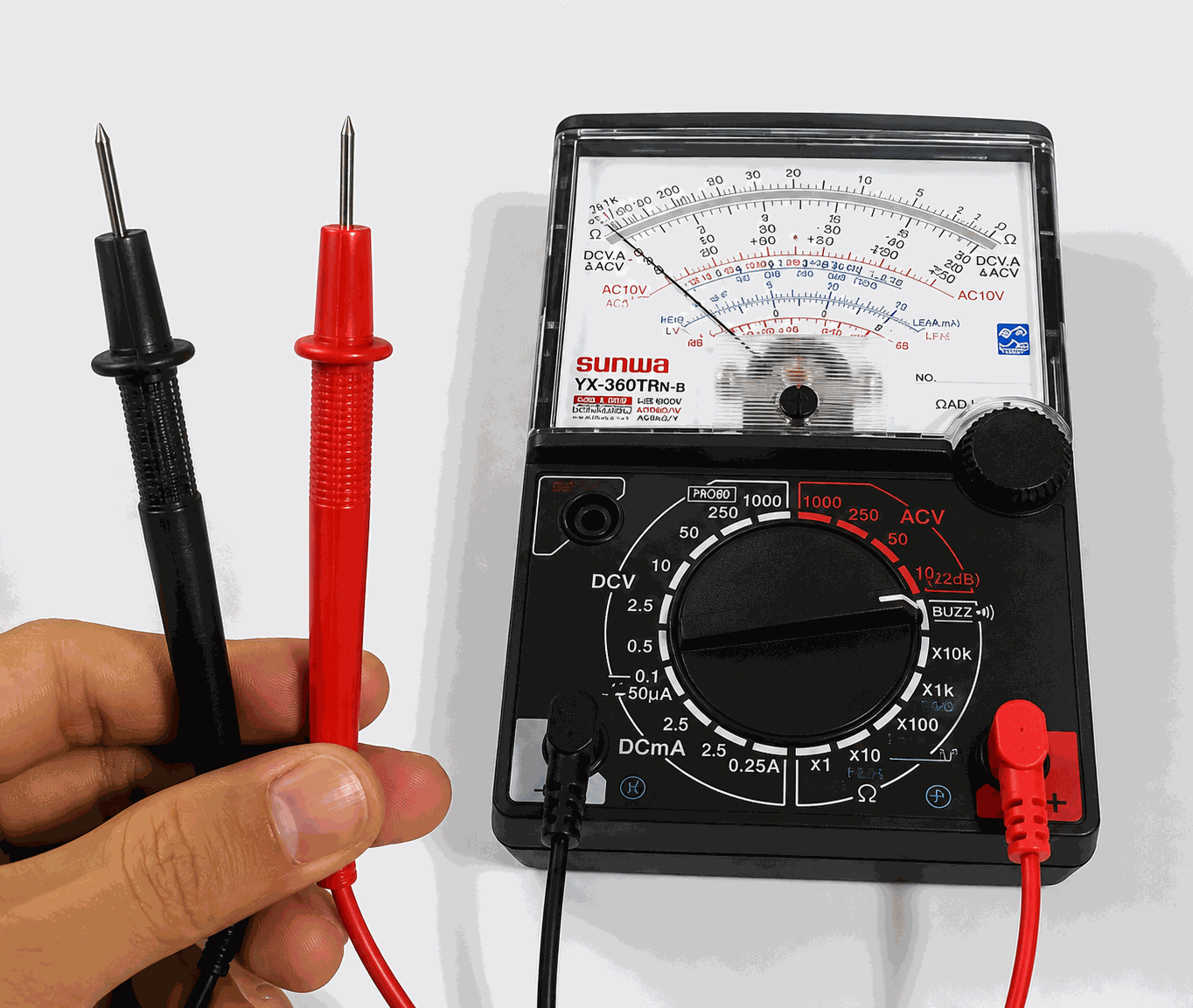
Analog multimeters do not measure capacitance directly; when switched to the resistance range, the internal battery supplies a small current to the capacitor. If the capacitor is functional, the needle will deflect rapidly and then slowly return to its initial position as the capacitor charges. By simply observing the needle's movement, an experienced technician can often distinguish between:
+ A capacitor capable of holding a charge.
+ A shorted capacitor.
+ An open-circuit capacitor.
+ A capacitor with significant leakage.
For this reason, analog multimeters remain quite useful for quick on-site testing.
Analog watches do not show the most important thing
What really matters isn't simply whether the capacitor is alive or dead. What people need to know is:
+ Is the capacitance still exactly 10 µF, or has it dropped to 6 µF?
+ Has the tolerance limit been exceeded?
+ Does it need immediate replacement?
These are questions an analog multimeter simply cannot answer. Even if the needle moves normally, the actual capacitance may have dropped significantly, affecting the motor's ability to start or the circuit's operation.
Types of capacitors that are virtually impossible to measure with an analog multimeter
Analog meters work quite well with high-capacitance electrolytic capacitors.
Conversely, with capacitors in the range of tens of nanofarads (nF) or hundreds of picofarads (pF), the needle barely moves enough for the user to notice.
That is why this method is suitable only for:
+ Pump start capacitors.
+ Fan capacitors.
+ Motor start capacitors.
+ Certain power supply electrolytic capacitors.
For ceramic capacitors, film capacitors, or electronic components with low capacitance, a digital multimeter or an LCR meter will yield much clearer results.
A digital meter allows you to determine exactly how much capacitance remains
Most modern digital multimeters come with a built-in capacitance measurement function. After fully discharging the capacitor, the user simply connects its terminals to the meter to read the capacitance value directly.
However, if more in-depth testing is required nsuch as measuring actual capacitance, ESR, capacitor loss, or component quality a dedicated LCR meter is a more suitable choice. These devices are widely used in electronics maintenance, laboratories, and production lines.
When are analog watches still a sensible choice?
If the goal is simply to quickly determine:
+ whether the capacitor is short-circuited,
+ whether the capacitor is open-circuited, or
+ whether the capacitor can still charge and discharge,
then an analog multimeter performs the task quite well. Conversely, when an accurate assessment of the capacitor's condition is required or when diagnosing the cause of unstable device operation a digital multimeter or LCR meter will save a significant amount of time.
Reference: Not everyone knows how to test a capacitor using a multimeter
Conclude
Analog multimeters are not necessarily "obsolete." For many technicians, they remain effective tools for quick checks during fieldwork.
However, if the goal is to verify whether a capacitor meets its specifications, accurately measure capacitance, or assess component quality, then multimeters with capacitance measurement functions or LCR meters will yield more comprehensive and reliable results. These are the solutions EMIN currently offers to meet the needs of testing, maintenance, and repair for electrical and electronic equipment..