Temperature Sensor Modules
Stable temperature data is essential in embedded electronics, industrial control, environmental monitoring, and equipment protection. On this page, you can explore Temperature Sensor Modules used to detect, convert, and transmit temperature signals in a form that is easier to integrate into control systems, monitoring platforms, and connected devices.
This category covers both compact sensing modules for PCB or device-level integration and signal-conditioning solutions designed for panel or DIN rail installation. That makes it relevant for applications ranging from embedded product design to plant instrumentation, HVAC monitoring, and remote telemetry.
Where temperature sensor modules are typically used
Temperature measurement appears in far more systems than many buyers first expect. It is commonly used to supervise enclosure heat, monitor process lines, protect power electronics, verify storage conditions, and support data logging in industrial or commercial environments.
In embedded projects, a module may provide a convenient way to add sensing without designing the full analog front end from scratch. In industrial settings, the need is often different: users may require a conditioned output, support for 2-wire, 3-wire, or 4-wire connections, or compatibility with standard control architectures such as analog current or voltage transmission.
Different module formats in this category
This selection includes more than one type of temperature-related device, so it helps to separate the use cases clearly. Some products are sensor modules intended to detect temperature directly at the board or field level, while others act as transmitters or transducers that convert sensor input into signals suitable for automation systems.
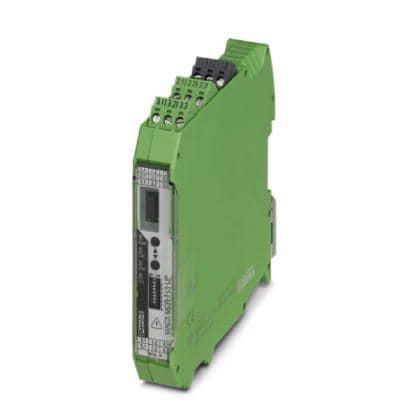
For example, TE CONNECTIVITY SENSORS offers PCB-mount options such as the PF0001822 and PF0002128, which are suited to compact integration in electronic assemblies. For industrial panels and process interfaces, products such as the PHOENIX CONTACT 2811394 and Endress+Hauser TMT series are designed to handle temperature input and provide standardized output for downstream control or monitoring equipment.
Examples of products and application fit
For board-level design, TE CONNECTIVITY SENSORS modules can be a practical choice when space, mounting simplicity, and direct integration are priorities. These types of modules are often considered in OEM equipment, custom devices, and embedded systems that need local temperature feedback near a PCB or internal assembly.
Where the application requires field signal conditioning, PHOENIX CONTACT and Endress+Hauser provide examples of interface-focused devices. The PHOENIX CONTACT 2924320 and 2811394 are relevant for control cabinet environments, while Endress+Hauser TMT80-AA, TMT127 variants, TMT128-ATAKA, and TMT188-JJAEA illustrate how temperature transmitter families can support analog output and DIN rail installation for industrial instrumentation.
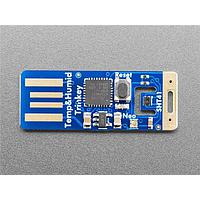
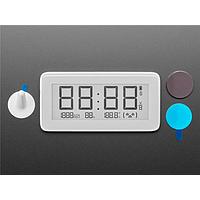
There are also connected monitoring use cases. The Adafruit 4881 Bluetooth temperature and humidity device is better aligned with local display or wireless environmental tracking, while the Advantech TREK-120-BNLUS0A0 points toward remote temperature and humidity monitoring over LoRa in distributed deployments.
How to choose the right temperature module
The first selection point is the measurement architecture. If you need direct sensing in a compact electronic product, a PCB-mount module may be the right fit. If you already have an RTD or thermocouple in the field and need to feed a PLC, controller, or monitoring system, a transmitter or transducer is often the better option.
Next, check the electrical and installation requirements. In this category, some models support wire-based interfaces and industrial supply ranges, while others are optimized for compact embedded assembly. Buyers should also verify whether the application needs current output, voltage output, Bluetooth connectivity, or long-range wireless transmission.
Temperature range matters as well. Certain Endress+Hauser and PHOENIX CONTACT products are intended for wide industrial measurement spans, whereas a compact wireless environmental sensor may be more appropriate for room conditions or equipment areas with moderate operating temperatures.
Key factors for industrial integration
For automation and process applications, integration is rarely just about sensing temperature. Signal stability, wiring method, cabinet space, mounting style, and compatibility with the receiving controller all influence the final choice. That is why transmitter-style modules are often selected when a raw sensor signal needs to be normalized into a more robust output for plant systems.
Products in this category show several common industrial patterns, including DIN rail mounting, analog output, and support for multiple wiring schemes. These features are especially useful when retrofitting existing systems or when standardization across multiple panels is important.
If your project also involves broader sensing functions, it may be useful to compare related technologies such as acceleration sensor modules or distance sensor ICs and embedded modules for machine monitoring and smart device design.
Embedded, wireless, and industrial use cases on one page
One of the strengths of this category is that it brings together components for several engineering workflows. Design engineers may look here for compact modules that simplify thermal measurement inside a device. Control engineers may focus on transducers and transmitters that bridge field sensors with analog control infrastructure. IoT developers may be more interested in Bluetooth or LoRa-based options for distributed condition monitoring.
This variety is helpful, but it also means product selection should be guided by system role rather than by name alone. A board-mount module, a DIN rail temperature transmitter, and a wireless environmental node may all relate to temperature measurement, yet they solve very different integration problems.
What to verify before ordering
Before selecting a part, confirm the sensor type or signal type required by your system, the intended installation method, and the communication or output format expected by the receiving equipment. It is also good practice to review the allowable operating temperature, supply range, and whether the module is intended for general embedded use, control cabinet use, or remote sensing in the field.
When comparing options, focus on the practical path from sensing point to usable data. In some cases, the simplest solution is a compact onboard module. In others, a dedicated temperature transmitter or transducer will reduce integration effort and improve signal handling across longer cable runs or industrial interfaces.
Conclusion
Choosing among temperature modules becomes much easier when you start with the application: onboard sensing, industrial signal conversion, or wireless environmental monitoring. This category brings together representative solutions from brands such as TE CONNECTIVITY SENSORS, PHOENIX CONTACT, Endress+Hauser, Adafruit, and Advantech, helping engineers and procurement teams evaluate options that match real installation and control requirements.
If you are building a compact embedded device or expanding an industrial monitoring system, reviewing module type, output format, mounting style, and operating range will usually lead to the right shortlist. A well-matched temperature module not only improves measurement reliability but also simplifies the overall design of the system around it.
Get exclusive volume discounts, bulk pricing updates, and new product alerts delivered directly to your inbox.
By subscribing, you agree to our Terms of Service and Privacy Policy.
Direct access to our certified experts