Erosion and corrosion can gradually reduce the material thickness of pipelines, storage tanks, boilers, pressure vessels, and many other industrial structures. An ultrasonic thickness gauge provides a basis for identifying areas of material degradation, planning inspections, and supporting maintenance decisions. In many cases, when only one side of a component is accessible, non-destructive ultrasonic measurement is a suitable method for evaluating wall thickness without the need to cut samples.
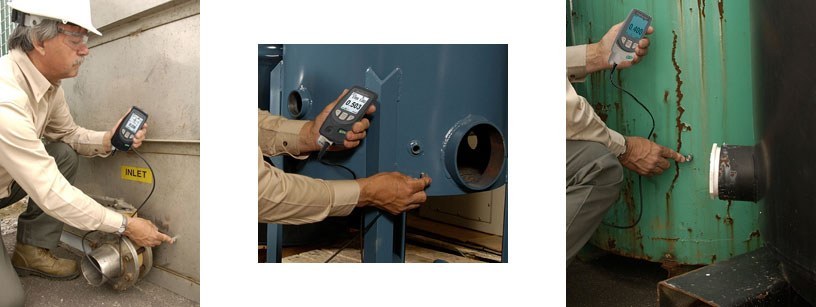
This approach can be applied to pipes, pressure vessels, storage tanks, boilers, propeller blades, and other components exposed to wear or chemical attack. It is also relevant to metallic and certain non-metallic materials that transmit ultrasonic waves and have relatively parallel top and bottom surfaces.
Understanding Erosion and Corrosion
Erosion is material loss caused by repeated mechanical interaction. Examples include abrasion from particles, impingement by liquids or solids, friction between contacting surfaces, turbulence in high-speed fluids, and cavitation. It may wear away a protective coating, the substrate beneath it, or both.
Corrosion is deterioration of a substrate through chemical action or change. For metals, oxidation is a common cause. Marine environments can be particularly demanding because seawater, humidity, wind, temperature, airborne contaminants, and biological organisms may all influence corrosion activity.
These mechanisms often interact. When erosion damages a protective coating, the underlying substrate may become more exposed to corrosion. Conversely, an already degraded surface can present additional challenges during inspection.
Why Remaining Wall Thickness Matters
The central objective of erosion and corrosion inspections is to determine the remaining wall thickness without cutting, removing, or otherwise damaging the component. Measurements taken at multiple locations can help identify areas with comparatively greater or lower material thickness.
For large assets, close measurement intervals can provide a more detailed view of thickness variation across the inspected area. This is useful on components such as tanks, pipes, and marine equipment, where deterioration may not be evenly distributed.
Thickness information also supports condition monitoring where inspection access is limited to one side of the substrate. In applications affected by erosion or corrosion, ultrasonic gages may additionally be used for wall thickness measurement and for inspection tasks involving cracks, flaws, pitting, composite delamination, and welded or brazed joints.
Using an Ultrasonic Thickness Gage
The DEFELSKO PosiTector UTG C1 is designed for non-destructive steel substrate thickness measurement from 1 to 125 mm (0.040 to 5.00 in). It includes preprogrammed sound velocities for materials including 1018 steel, stainless steel, cast iron, aluminum, and plastics. Users may select a listed substrate or adjust the instrument to a known thickness or sound velocity.
The stated sound velocity range for PosiTector UTG is 1250 to 10000 m/s. Correct velocity selection is an important consideration because ultrasonic thickness calculations rely on the speed of sound through the material being inspected.
Sampling Larger Areas
When many readings are needed, the Scan Mode on PosiTector UTG enables up to 20 readings per second while a coupled probe is moved across the measurement area. The mode displays the number of readings along with the highest and lowest values. This can help an inspector review thickness variation within the sampled path.
Readings can also be stored and downloaded to optional PosiSoft computer software. Recording measurement results can be valuable when comparing locations or monitoring changes over time.
Rough and Curved Surface Considerations
Rough surfaces, scale, rust, and curved geometry can make consistent coupling more difficult. Before measurement, foreign debris such as rust or scale should be removed. Using an appropriate amount of couplant may reduce surface effects and help protect the transducer as it is moved across the surface.
For curved surfaces, PosiTector UTG is stated to provide the best results where the radius is greater than 50 mm (2 in). On smaller radii, the probe can be oriented with the dividing line on the transducer perpendicular to the curve.
Measuring Protective Coating Thickness
Substrate thickness is only one part of an erosion and corrosion assessment. Protective coatings can be measured separately to evaluate the barrier intended to shield a metal surface from handling and environmental exposure.
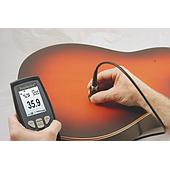
The PosiTector 6000 series is intended for non-destructive measurement of protective coating thickness on metal substrates. For non-ferrous materials such as aluminum, the N series uses eddy currents from an induced magnetic field. For ferrous substrates such as steel, the F series measures changes in magnetic flux density near the magnetic probe.
Separating substrate thickness measurement from coating thickness gauge helps inspectors select an appropriate method for the condition being evaluated. Together, these measurements can support a more complete understanding of material condition in mechanical engineering, marine, transportation, chemical production, oil and gas, storage, transmission, and power-generation environments.
Planning an Effective Inspection
In addition to monitoring thickness loss, an ultrasonic corrosion thickness gauge can also be used for wall thickness inspections, crack and defect detection, and void detection; composite material delamination inspection; and evaluation of welds or brazed joints. Typical users include inspectors, surveyors, maintenance teams, and material restoration specialists.
For erosion and corrosion measurement results to provide meaningful value, it is necessary to clearly identify critical areas, prepare the surface appropriately, select the suitable probe and measurement principle, and record results consistently. This provides a foundation for monitoring equipment condition over time and prioritizing areas for subsequent inspection.