Incorrect Suction Nozzle Diameter Causes Faster Wear on Internal Desoldering Pump Mechanisms
The suction nozzle directly contacts the solder joint and represents the smallest part of a desoldering pump. However, choosing the wrong nozzle diameter directly impacts the lifespan of the internal pump mechanism the most expensive component to repair or replace.
Incorrect Nozzle Size Causes Loss of Vacuum Seal at the Suction Point
A desoldering nozzle operates by pressing tightly against the molten solder joint, creating a sealed chamber where suction draws the liquid solder inside. Using a nozzle diameter larger than the solder joint prevents the tip from sealing flush against the PCB surface, allowing air to leak in alongside the solder, significantly weakening the suction power compared to the machine's rated capacity.

Conversely, a nozzle smaller than the solder joint cannot fully cover the molten solder volume. Solder spills over the nozzle rim before it can be drawn in, forcing the operator to trigger suction repeatedly for a single solder joint.
Why Loss of Vacuum Seal Causes Accelerated Internal Pump Wear
Manual-style desoldering pumps utilize compression springs and rubber pistons to generate instantaneous suction force upon activation. Whenever a proper seal is not achieved, the suction fails to remove all solder in one pass, compelling the user to trigger the pump multiple times per joint beyond its intended design limit.
As total trigger activations increase across repair shifts, the spring loses elasticity faster and the rubber piston experiences excessive friction against the cylinder wall, leading to premature wear and hardening. This habit rather than poor tool quality is the root cause of why many desoldering pumps lose power prematurely.
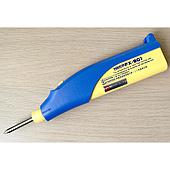
Reference: Pro'sKit SS-331B Desoldering Station

Signs Your Nozzle Size is Incorrect Before Equipment Failure
Having to trigger suction 2 to 3 times for a small solder joint indicates that the nozzle diameter is too large for the work area.
Solder splattering around the tip upon activation, or remaining around the joint edges after suction, indicates that the nozzle is too small to cover the molten solder area.
A weakening trigger sound or noticeably reduced recoil force compared to a new unit signals spring fatigue, suggesting a review of nozzle selection habits before replacing the machine.
Related article: Residual Solder in Multilayer PCB Plated Through-Holes Despite Appearing Clean to the Naked Eye
Selecting the Proper Nozzle Diameter for Different Solder Joints
Surface-mount component pins, small resistors, and capacitors require a small nozzle diameter (approx. 0.6 to 0.8 mm) to fit the minimal solder volume at these pads.
Standard through-hole component leads, IC DIP pins, and connectors suit medium nozzle diameters (approx. 1.0 to 1.5 mm).
Large solder joints on power terminals or thick wire leads require a nozzle diameter of 2.0 mm or larger to thoroughly pull the higher volume of solder in a single pass.
Keeping a selection of nozzle sizes on hand and swapping to the correct diameter for each soldering point is the simplest way to maintain proper pump mechanics and extend equipment service life.