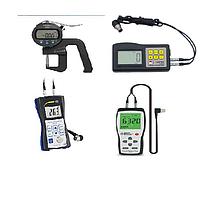
Thickness Gauge Repair Service
When a thickness gauge starts giving unstable readings, slow probe response, or obvious measurement drift, production checks and inspection routines can quickly become unreliable. A professional Thickness Gauge Repair Service helps restore measurement confidence, reduce unnecessary instrument replacement, and keep critical quality-control work on track.
This service category is intended for users who rely on thickness measurement in manufacturing, coating inspection, maintenance, and incoming quality verification. Whether the instrument is used for sheet material checks, coating thickness evaluation, or general dimensional inspection, proper repair work can help bring the device back into usable condition and support more consistent measurement results.
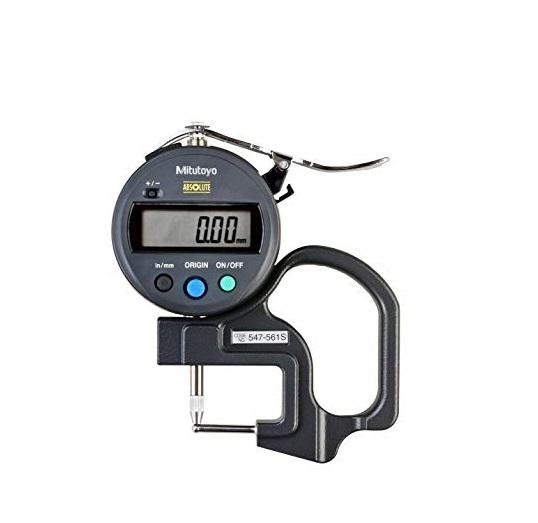
Why thickness gauge repair matters in daily inspection work
Thickness gauges are often used in repetitive measurement environments where accuracy, repeatability, and mechanical stability are essential. Even small issues such as worn contact points, display errors, sticking movement, probe damage, or inconsistent zeroing can affect results and lead to false acceptance or rejection of parts.
A dedicated repair process is especially valuable when the instrument still fits the application, but no longer performs as expected. In many cases, repair is a practical option for extending service life, especially for established brands such as Mahr, MITUTOYO, DEFELSKO, and ELCOMETER that remain widely used across industrial measurement tasks.
Common issues seen in thickness gauges
The exact fault depends on instrument type and usage conditions, but several patterns appear frequently in workshop and field environments. Mechanical wear from repeated contact, contamination from dust or coating residue, accidental impact, and long-term handling stress can all reduce measurement stability.
Typical service cases include inconsistent readings, pointer or display malfunction, poor return movement, damaged measuring faces, probe response problems, or difficulty setting the reference point. For digital models, users may also encounter intermittent power behavior or communication-related issues, while mechanical units may show backlash, friction, or gradual loss of smooth travel.
When these symptoms appear, continuing to use the gauge without service can introduce unnecessary risk into inspection records. If your facility also uses other handheld dimensional tools, related support may be relevant through micrometer repair services or caliper repair services.
What a repair service typically covers
A proper repair workflow usually starts with an inspection of the instrument’s condition and the reported fault. This may include checking the measuring mechanism, probe movement, display or indicator function, contact surfaces, housing condition, and general response during operation.
Depending on the problem, service work may involve cleaning, adjustment, part replacement where applicable, restoration of moving components, and functional verification after repair. The goal is not simply to make the gauge power on again, but to restore usable performance for real inspection tasks.
For many buyers, this is particularly important when the gauge is part of a broader measurement routine. A thickness gauge that returns stable, repeatable operation can help maintain continuity in procedures, operator familiarity, and quality documentation.
Supported brands and representative service options
This category includes service options for a range of recognized manufacturers used in industrial measurement. Representative examples include Mahr Thickness Gage Repair Service, Mitutoyo Thickness Gage Repair Service, DEFELSKO Thickness Gage Repair Servic, Elcometer Thickness Gage Repair Service, EXTECH Thickness Gage Repair Service, and TECLOCK Thickness Gage Repair Service.
Additional listed service options also cover brands such as PCE, PROCEQ, TQCSheen, and Cometech. Mentioning these names is useful not because every instrument shares the same design, but because repair requirements often vary by brand architecture, probe arrangement, indicator style, and intended application.
If your organization standardizes on specific manufacturers, it can also be helpful to review related brand pages such as MITUTOYO or DEFELSKO for broader product context.
How to decide whether repair is the right option
Repair is often worth considering when the instrument has known history, remains suitable for the measurement task, and shows a specific functional issue rather than total end-of-life failure. This is common in plants where operators are already trained on a particular gauge and want to keep methods consistent.
A practical evaluation usually looks at the severity of the fault, availability of service support, expected downtime, and the role of the instrument in production or inspection. For routine QC work, restoring an existing unit may be more efficient than changing to a new platform and retraining personnel.
It is also useful to consider whether the gauge is a standalone tool or part of a larger inspection set. Where multiple handheld instruments are in use, coordinated maintenance planning can reduce disruption across the metrology workflow.
Applications that depend on stable thickness measurement
Thickness measurement is important in many industrial settings, including metal fabrication, plastics processing, coating inspection, maintenance checks, and receiving inspection. In these environments, a gauge may be used to verify base material dimensions, monitor product consistency, or confirm whether a coating layer meets process expectations.
Because the instrument often supports acceptance decisions, repeatable performance matters as much as basic functionality. A repaired gauge that operates smoothly and responds correctly can help improve trust in inspection data, especially where results are logged as part of quality procedures.
Organizations that also maintain other material-testing devices may benefit from adjacent service categories such as hardness meter repair service, depending on the scope of their internal lab or shop-floor inspection process.
What information helps before sending a gauge for service
Before arranging service, it helps to record the brand, product name, visible symptoms, and operating conditions in which the issue appears. If the problem is intermittent, noting when it happens can make diagnosis easier. Information about impact events, heavy use, or unstable readings across known samples can also be useful.
Photos of damaged areas, probe tips, displays, or contact surfaces may support faster evaluation. If the unit belongs to a controlled inspection process, some buyers also prepare a short description of how the instrument is used so the service scope aligns with actual measurement needs.
This kind of preparation does not replace technical inspection, but it helps create a more efficient path from fault identification to repair assessment.
Choosing a service category that fits your instrument fleet
Not every measuring tool should be handled the same way, even when they seem similar in daily use. Thickness gauges have their own mechanical and functional characteristics, so selecting a specialized service category is the best starting point when the issue is tied directly to thickness measurement performance.
If your operation manages several types of handheld instruments, organizing service by instrument class can make maintenance easier, improve traceability, and support better planning for repair cycles. That is especially relevant in B2B environments where measurement tools are tied to production continuity and inspection accountability.
For teams using instruments from Mahr, MITUTOYO, DEFELSKO, ELCOMETER, EXTECH, PCE, PROCEQ, TECLOCK, TQCSheen, or Cometech, this category provides a focused route to evaluate repair needs without treating every measuring device as interchangeable.
Choosing the right service path for a faulty gauge starts with understanding how the instrument is used, what symptoms it shows, and how important measurement stability is to your process. A well-matched thickness gauge repair solution can help extend instrument life, support reliable inspection work, and keep existing measurement routines running with less disruption.
Get exclusive volume discounts, bulk pricing updates, and new product alerts delivered directly to your inbox.
By subscribing, you agree to our Terms of Service and Privacy Policy.
Direct access to our certified experts