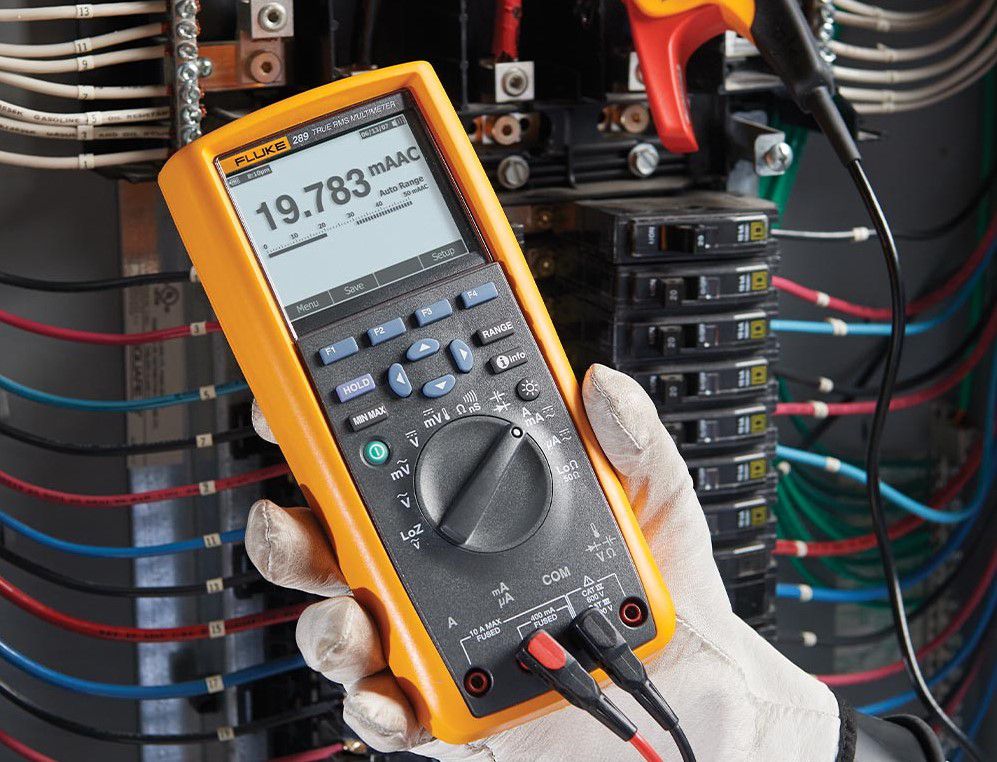
The Fluke 289 True RMS digital multimeter supports long-term data logging, displays trend graphs, stores multiple independent logging sessions, and enables on-screen data analysis through its high-resolution graphical display. These capabilities help maintenance engineers shorten troubleshooting time in electrical systems, PLCs, variable frequency drives (VFDs), and industrial automation equipment without carrying a dedicated data logger.
TrendCapture™ – Record and Display Trend Graphs
TrendCapture™ displays measured values as trend graphs over time, making it easier to identify the exact moment an event occurs, the magnitude of the change, and recurring operating patterns.
During data logging, the Fluke 289 simultaneously records measured values, timestamps, and Min/Max/Average readings while displaying the information as a trend graph on its QVGA graphical screen. Users can zoom in up to 14×, move the cursor to any data point, and read measurement values directly at the moment the signal changes. This enables on-site analysis without relying entirely on FlukeView Forms software.
Logging Session – Independent Data Sessions for Multiple Tests
Each logging session is stored independently with its own start time, logging duration, and number of recorded samples. Individual sessions can be reviewed directly on the instrument without exporting all recorded data to a computer.
For preventive and periodic maintenance, this provides a convenient way to compare equipment performance before and after repairs or evaluate long-term performance trends throughout maintenance cycles.
Low Pass Filter – Accurate Measurements on Variable Frequency Drives
The PWM output of variable frequency drives often introduces measurement errors in conventional True RMS multimeter.
The Fluke 289 incorporates a Low Pass Filter, which suppresses high-frequency switching components from PWM signals, allowing voltage and frequency measurements to represent the fundamental frequency more accurately.
This feature is particularly valuable when servicing HVAC systems, conveyor systems, servo drives, and VFD-controlled motors.
Peak Capture – Detect 250 μs Transient Events
The Peak Capture function detects transient voltage peaks with a response time of 250 μs, allowing users to identify short-duration overvoltage events that conventional RMS measurements may miss.
When combined with TrendCapture™, Peak Capture helps identify both the exact time of an event and the operating trend of the system throughout the monitoring period.
True RMS Performance Depends on Measurement Bandwidth
A True RMS digital multimeter calculates the actual RMS value of a signal rather than assuming an ideal sine wave. The Fluke 289 combines True RMS measurement with an appropriate Crest Factor specification, enabling accurate measurement of distorted waveforms commonly found in variable frequency drives, switching power supplies, and other non-linear loads. This helps maintain measurement accuracy in demanding industrial environments.
=> View the complete Fluke 289 technical specifications at here
Frequently Asked Questions (FAQ)
Does TrendCapture display waveforms like an oscilloscope ?
No. TrendCapture displays measurement trend graphs over time, not instantaneous voltage waveforms like an oscilloscope.
Can I view trend graphs directly on the Fluke 289 ?
Yes. The instrument allows users to view Trend Graphs directly on its display, zoom in up to 14×, move the cursor to individual data points, and read measurement values without connecting to a computer.
Can the Fluke 289 replace a dedicated data logger ?
For many electrical maintenance applications, yes. With TrendCapture™, Logging Sessions, Min/Max Recording, and multiple stored logging sessions, the Fluke 289 is well suited for long-term single-channel monitoring. For applications requiring simultaneous monitoring of multiple channels or sensors, a dedicated data logger remains the better choice.
Can the Fluke 289 log data without a computer ?
Yes. The instrument features internal memory for standalone data logging and on-screen review. When detailed analysis or reporting is required, logged data can be transferred to a computer using compatible software.
When should TrendCapture be used ?
TrendCapture is especially useful for diagnosing intermittent faults such as voltage dips, overload conditions, temperature fluctuations, unstable sensor signals, or periodic system abnormalities that are difficult to detect using normal multimeter.
Can the Fluke 289 measure signals from variable frequency drives ?
Yes. The Fluke 289 is equipped with a Low Pass Filter that removes high-frequency switching components from PWM signals, enabling more accurate voltage and frequency measurements at the output of variable frequency drives than standard AC measurement mode. For detailed PWM waveform analysis, however, an oscilloscope remains the appropriate instrument.
Who is the Fluke 289 designed for ?
The Fluke 289 is ideal for plant maintenance engineers, industrial electricians, automation engineers, HVAC technicians, VFD maintenance personnel, power distribution engineers, and professionals who require long-term data logging to diagnose intermittent or difficult-to-reproduce faults.
You can also refer to: Handheld multimeter, Pen-type multimeter, Benchtop multimeter