Concrete coating quality control is performed by verifying the condition of the substrate and checking four practical areas: surface profile, environmental conditions, coating thickness, and adhesion. These checks help confirm that the coating application is aligned with the preparation and protection requirements of the work.
Before coating, the concrete should be sound, free from contaminants such as dust, oil, and grease, and at a moisture level suitable for painting. A comprehensive procedure matters because coating failures can contribute to early degradation of the underlying concrete and require additional repair resources.
What should be checked before applying a coating to concrete?
Before application, the concrete surface condition, cleanliness, moisture suitability, and physical texture should be checked. The surface texture, also called the anchor profile or surface profile, needs to be compatible with the coating being applied.
A profile record can be useful because it documents the prepared surface for later reference. ASTM D7682 describes concrete surface profile assessment through visual comparison and quantifiable measurement.
A rapid-cure, two-part putty method can create a permanent relief mold of a surface sample. The mold may be visually compared with ICRI concrete surface profile coupons or measured at multiple locations with a purpose-built micrometer, in accordance with the test method.
Why are environmental conditions recorded during concrete coating work?
Environmental conditions are measured to help avoid rework and premature protective-coating failure. Climatic conditions during surface preparation and coating application are a major factor in the long-term performance of coatings on concrete.
Conditions should be observed during pre-treatment and application under appropriate environmental circumstances. Recording results before, during, and after the coating process can also provide evidence that these conditions were observed.
Handheld electronic instruments can be used by contractors, inspectors, and owners to measure and record relevant conditions. The PosiTector DPM is identified as an example of an instrument used for this purpose.
How is coating thickness on concrete evaluated?
Coating thickness is evaluated to control coating costs while maintaining adequate protective coverage. This is particularly relevant where contracts require independent inspection after work is completed.
Concrete coatings can serve cosmetic, durability, abrasion-resistance, and environmental-protection purposes. Examples of coating types used on concrete include latex paints, acrylics, lacquers, urethanes, epoxies, and polyester resins; their surfaces and thicknesses can vary substantially.
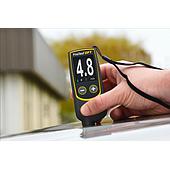
Concrete roughness can cause significant variation in individual thickness readings. ASTM D6132 describes a nondestructive ultrasonic method for measuring dry-film thickness of applied organic coatings, avoiding the need to repair the coating after inspection.
Ultrasonic equipment uses a probe, or transducer, to send vibration into the coating with a couplant applied to the surface. PosiTector 200 is cited as an example of this equipment. SSPC-PA 9 uses ultrasonic gages on cementitious substrates and determines thickness by averaging a prescribed minimum number of acceptable readings across separate spot-measurement areas.
What does pull-off adhesion testing show on coated concrete?
Pull-off adhesion testing quantitatively evaluates resistance to separation between a coating and its concrete substrate under a perpendicular tensile force. ASTM D7234 details this method for coatings on concrete using portable pull-off adhesion testers.
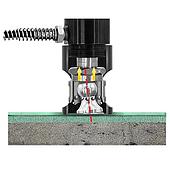
In the test, a flat pull stub, also called a dolly, is bonded to the coating and allowed to cure. An actuator is attached, and pressure is gradually increased; the force at pull-off provides a direct indication of tensile adhesion strength between the coating and substrate.
A portable tester includes a pressure source, pressure gage, and actuator. Careful preparation of the dollies and control of unintended bond failures are important because they affect how meaningful and predictable the adhesion results are.
On concrete, the applied pressure can exceed the concrete's internal tensile strength, causing cohesive failure within the concrete. With proper cutting around the dolly, the method can also be used to measure tensile strength of uncoated concrete and concrete repairs. PosiTest AT Automatic & Manual models are identified as examples of pull-off adhesion testers.
Which checks form a practical concrete coating quality-control sequence?
A practical sequence is to confirm that the concrete is sound, clean, and suitably dry; establish or record the required surface profile; monitor relevant climatic conditions; measure the applied coating thickness; and evaluate adhesion where required. Each check addresses a different factor that can influence coating performance.
Surface preparation and environmental observations take place before and during application, while thickness and adhesion measurements assess the completed coating system. Together, these controls support inspection decisions while addressing coverage, bond strength, and conditions that may contribute to premature failure.