Selecting a suitable laser distance meter should start with your actual requirements: whether you will be measuring indoors or outdoors, the required measurement range, and whether indirect measurement or data storage is necessary. The following guide explains how to choose a laser distance meter based on the specific requirements of different industries.
What Is a Laser Distance Meter?
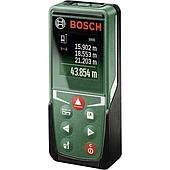
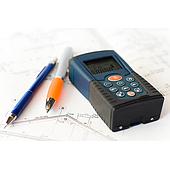
A laser distance meter, also known as a laser measuring tool, is an electronic device designed to measure length and height and calculate area and volume using laser technology. Compared with traditional tape measures, it reduces manual effort and is particularly useful when measuring elevated, distant, or hard-to-reach locations.
In industrial environments and on construction sites, laser distance meters also support tasks such as equipment positioning, checking installation spaces for electrical cabinets and piping systems, measuring structural frameworks, and verifying dimensions for maintenance purposes.
Key Criteria for Choosing a Laser Distance Meter
Before considering the requirements of specific industries, you should understand the four most important technical specifications:
Measurement range (maximum distance): Typically ranges from 30 m to over 250 m, depending on whether the application requires indoor or outdoor measurements.
Accuracy (measurement error): Typically ranges from ±1 mm to ±2 mm. Applications requiring high precision demand instruments with minimal measurement error.
Ingress protection (IP) rating: Dust and water resistance ratings, such as IP54 and IP65, are particularly important when working in harsh construction environments.
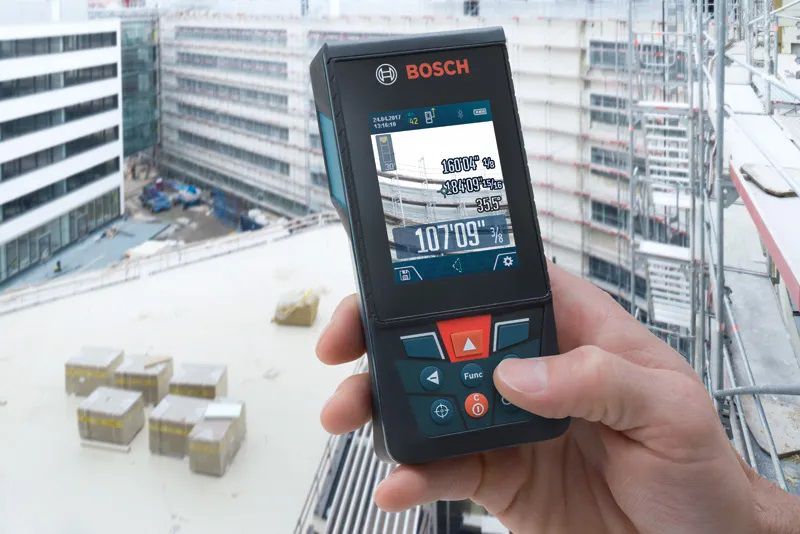
Smart features: These may include tilt measurement using an inclination sensor, Pythagorean measurement, Bluetooth connectivity to smartphones, and target-viewing cameras for long-range outdoor measurements.
How to Choose a Laser Distance Meter for Different Industries
Construction and Civil Engineering
Working conditions: Measurements are frequently taken outdoors on construction sites, where equipment is exposed to dust, dirt, and impacts. Long measurement distances may also be required.
Selection criteria:
Measurement range: 80–150 m to accommodate large spaces and outdoor environments.
Durability: Choose a model with a shock-resistant rubber housing and a minimum dust and water protection rating of IP54 or IP65.
Essential features: A 360-degree tilt sensor, Pythagorean measurement for calculating heights and distances indirectly, and an optical viewfinder or built-in camera for accurate targeting in bright sunlight.
Interior Design and Real Estate
Working conditions: Measurements are primarily taken indoors, including rooms and floor plans. Speed, portability, and convenient data storage are key requirements.
Selection criteria:
Measurement range: 30–50 m is generally sufficient for houses, offices, and apartments.
Design: Choose a compact, lightweight device that fits comfortably in the hand and can be operated quickly with one hand.
Essential features: Functions for adding and subtracting measurements, automatic area and volume calculations, and Bluetooth connectivity for transferring data directly to floor-planning and design applications on smartphones or tablets.
Mechanical, Electrical, and Plumbing (MEP) Installation
Working conditions: Measurements involve ceiling heights and the positioning of ventilation ducts, cable trays, water pipes, and electrical cabinets, often in elevated or obstructed locations.
Selection criteria:
Measurement range: 50–100 m.
Essential features: Intelligent indirect measurement for determining heights when the base is obstructed, continuous measurement (tracking) to identify target distances, and a tripod mounting thread to keep the device stable when taking measurements at elevated locations.
Land Surveying and Heavy Industry
Working conditions: Applications involve measuring large areas and very long distances, requiring high reliability and minimal measurement error.
Selection criteria:
Measurement range: 150–250 m or more.
Accuracy: Very low measurement error, ideally ±1 mm or better.
Essential features: A large color display that remains readable in bright sunlight, optical camera zoom for targeting distant measurement points, ample internal memory for storing measurement data, and professional data output interfaces.