Investing in a wire stripping machine is not simply about choosing the fastest model or the one with the most features. For manufacturers, this decision directly impacts product quality, operating costs, and the scalability of production lines for years to come. The right machine should not be selected based on the number of functions it offers, but on how effectively it meets current production requirements while supporting future business growth.
Which Type of Wire Stripping Machine Should Choose ?
If your production volume is relatively low and you mainly process only a few wire types, a semi-automatic wire stripping machine can provide excellent performance at a reasonable investment cost.
As production volume increases, higher precision becomes essential, or multiple wire types need to be processed each day, an automatic wire shipping machine offers significant advantages by reducing handling time, improving consistency, and maximizing production efficiency.
Rather than comparing only speed, output capacity, or purchase price, manufacturers should evaluate the entire picture—including wire characteristics, production frequency, operating costs, and after-sales technical support. This comprehensive approach helps maximize the return on investment while minimizing unexpected costs caused by selecting unsuitable equipment.
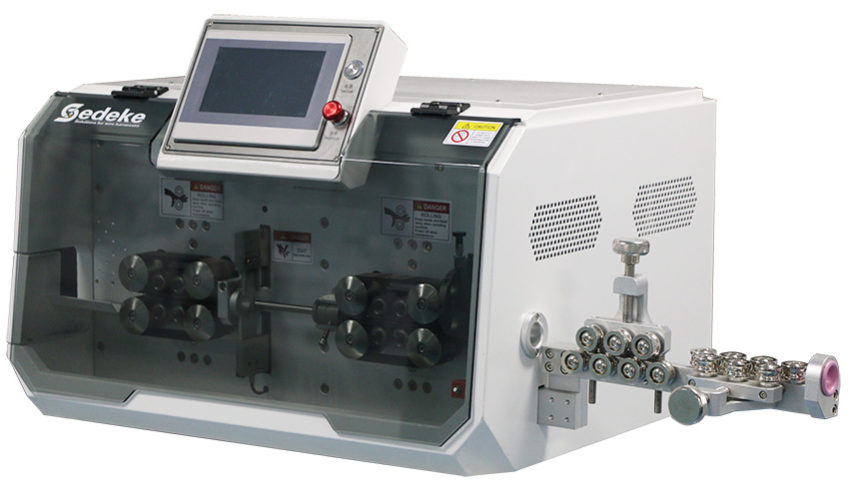
Key Factors to Consider When Choosing a Wire Stripping Machine
Don't Choose Based on Maximum Capacity—Choose Based on Daily Production Needs
Manufacturers often highlight machine speed as a key selling point. Some models are capable of processing tens of thousands of wire pieces per shift, but not every manufacturer requires that level of capacity.
If your daily workload ranges from a few hundred to several thousand wire pieces, a machine with moderate speed but excellent reliability will typically deliver a better return on investment. On the other hand, manufacturers operating multiple shifts or handling large-volume orders should invest in a high-capacity model from the beginning to avoid replacing equipment after only a few years.
Wire Cross-Section Determines Most of the Machine's Capability
Wire cross-sectional area: Every wire stripping machine is designed to handle a specific wire size range. If the wire is too small for the machine's operating range, the stripping blades may not control the cutting force accurately, potentially damaging the conductor. Conversely, wires exceeding the machine's capacity may overload the equipment or prevent complete insulation removal.
Wire construction: Solid wires, multi-strand flexible wires, flat cables, and multi-layer cables all require different stripping methods. A machine suitable for standard electrical wiring may not perform effectively on signal cables or industrial control cables.
Purchase Price Does Not Reflect the Total Cost of Ownership
A machine with a higher initial purchase price but stable performance over many years often delivers greater long-term value than a lower-cost model that requires frequent maintenance or replacement parts.
Maintenance expenses, replacement blades, wear components, machine downtime, and the availability of technical support all contribute directly to the equipment's total cost of ownership throughout its service life.
Flexibility to Process Multiple Wire Sizes
Modern manufacturing is no longer focused on producing only a few products in massive quantities. Many factories now process dozens of different wire types within a single day.
Cable Cutter Stripper often allow operators to store multiple processing programs. When switching to a different wire type, the operator simply selects the appropriate program instead of manually reconfiguring all machine parameters, significantly reducing setup time.
Consistency Is More Valuable Than Maximum Speed
In high-volume manufacturing, true productivity comes from producing thousands of wire ends with consistent quality.
Consistent stripping quality improves the efficiency of downstream processes such as crimping, terminal assembly, and final product assembly while reducing inspection time and product defects.
A machine capable of maintaining high stripping accuracy after hundreds of thousands of operating cycles will provide far greater long-term value than one offering higher speed but inconsistent results over time.
Consider Future Production Expansion
Many manufacturers purchase equipment that perfectly matches their current production needs but later encounter limitations when expanding capacity.
Some wire cutting and stripping machines can be integrated with automatic wire feeders, conveyor systems, or terminal crimping machines to form a complete production line. This scalability allows manufacturers to increase productivity without replacing their entire system.
After-Sales Service Directly Affects Production Continuity
Even the most advanced equipment requires periodic maintenance and occasional replacement of wear parts after extended use. If replacement blades or spare parts must be imported and take weeks to arrive, production may be interrupted.
Therefore, beyond evaluating technical specifications, manufacturers should also consider spare parts availability, technical support capability, and supplier response time. The true value of after-sales service often becomes most apparent when urgent support is required.
Choosing the right wire stripping machine is a long-term investment that significantly influences manufacturing efficiency. The ideal machine should not only match your current wire sizes and production volume but also deliver consistent stripping accuracy, allow quick changeovers between production orders, and provide the flexibility to support future business expansion.