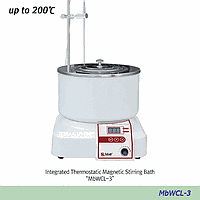
General-Purpose Oil Bath
Precise temperature control is essential in many laboratory and pilot-scale processes, especially when water is no longer suitable as the heating medium. A General-Purpose Oil Bath is commonly selected for applications that require stable heating above the boiling range of water, with more even heat transfer than direct hotplate contact and better process consistency during extended runs.
On this page, you can explore oil bath solutions used for sample heating, material conditioning, reaction support, and thermal testing in research and industrial environments. The range includes compact benchtop units as well as larger-capacity systems designed for broader working areas and higher throughput.

Why oil baths are used in laboratory heating
Oil baths are chosen when a process needs uniform heating and temperatures that typically extend well beyond what a standard water bath can provide. Because the thermal medium surrounds the vessel or sample area more evenly, the risk of localized overheating is reduced compared with direct surface heating.
This makes them useful in laboratories handling chemical preparations, sample preheating, viscosity-related work, material testing, and other thermal procedures where repeatability matters. For broader lab workflows, users may also evaluate related handling and support accessories such as laboratory carts and trolleys to move equipment and samples safely between work areas.
How a general-purpose oil bath works
The operating principle is straightforward: an internal heater warms the oil inside the bath chamber, and the heated oil then transfers energy to the container or sample placed in the working area. Since oil retains heat well and supports a relatively stable thermal environment, it helps minimize sharp temperature gradients inside the bath.
Many digital models also use electronic controllers and temperature probes such as PT100 sensors to improve setpoint control and monitoring. In practical terms, this supports better consistency for long holding times, staged heating, and routine thermal processes where a stable bath condition is more important than rapid temperature swings.
Typical temperature range, capacity, and control features
The products listed in this category cover several common laboratory size classes. Smaller units such as the WITEG WHB-6 are suitable for compact bench setups and lower sample volume, while mid-size models like the WITEG WHB-11 or DaiHan WHB-11 provide additional working space for daily lab use. Larger systems, including 22 L models and SH Scientific units up to 48 L, are better matched to applications that need more immersion area or larger vessels.
Across the featured range, typical operating capability extends from room temperature or ambient offset up to around 250°C or 300°C depending on the model. Buyers often look at temperature range, controller type, bath capacity, heating power, and safety functions together rather than focusing on a single number. For example, digital control, timer functions, alarm indication, and over-temperature protection can be just as important as nominal maximum temperature in day-to-day operation.
Representative product options in this category
For users who need a compact high-temperature bath, the WITEG WHB-6 High Temperature Oil Bath offers a smaller 6 L format with digital temperature control and a working range up to 250°C. It is a practical choice when bench space is limited and the process does not require a large bath footprint.
In the mid-range, models such as WITEG WHB-11 and DaiHan WHB-11 are often considered for general laboratory use because they balance usable bath volume with manageable external dimensions. For higher throughput or larger vessels, the SH Scientific SH-WB-20GDH and SH-WB-40GDH extend capacity further and support applications up to 300°C, which can be relevant for more demanding thermal workflows.
Brand preference may also depend on internal equipment standards or existing installed base. If you are comparing product families, it can be useful to review available options from DaiHan, WITEG, and SH Scientific within the same purchasing process.
How to choose the right oil bath
The first selection point is usually the actual process requirement: sample size, vessel dimensions, target temperature, and expected run duration. A bath that is too small may limit working flexibility, while an oversized unit can occupy unnecessary bench space and increase warm-up time or power demand.
Next, consider the required level of temperature stability and ease of operation. If the application involves repeat procedures, timed heating cycles, or quality-sensitive preparation, digital display resolution, probe-based feedback control, and alarm functions can make operation more reliable. A drain valve may also be valuable in larger units because oil handling and maintenance become easier.
Construction materials matter as well. Stainless-steel internal chambers are commonly preferred for durability and cleaning, while insulated structures help maintain thermal efficiency. In shared lab spaces, safety features such as sensor error detection, over-current or over-temperature protection, and power interruption recovery should be part of the evaluation.
Common applications across industries
General-purpose oil baths are used in research laboratories, quality control rooms, academic settings, and small production support environments. They are suitable for tasks such as controlled heating of glassware, thermal conditioning of samples, reaction support, viscosity-related preparation, and heat exposure tests where the operator needs a stable and predictable thermal medium.
They are also relevant in pharmaceutical, food, chemical, and materials-related workflows, provided the selected oil bath and thermal fluid match the process conditions. In some setups, users combine oil baths with other heating tools depending on the test method, while direct flame devices such as those found in burner and torch equipment are reserved for very different use cases.
Good practice for operation and maintenance
Reliable performance depends not only on the bath itself but also on correct use of the thermal medium and routine maintenance. The oil level should stay within the recommended operating range, and the selected oil should be appropriate for the intended temperature window. Using the wrong fluid can affect heating stability, cleanliness, and overall safety.
Operators should allow the bath to reach the set temperature before starting critical work, especially when process repeatability is important. Regular cleaning of the bath chamber, inspection of the probe and controller behavior, and removal of degraded oil help preserve long-term performance. For laboratories with stricter handling requirements, suitable lab apparel and PPE should also be considered during routine operation.
Finding a suitable model for your workflow
This category brings together general-purpose oil baths for users who need dependable high-temperature heating in a controlled laboratory format. The available range covers compact, medium, and larger capacities, with examples from DaiHan, WITEG, and SH Scientific for different bench layouts and process demands.
When comparing models, focus on the combination of capacity, temperature range, control method, safety functions, and maintenance convenience rather than choosing by size alone. A well-matched oil bath can improve process consistency, reduce thermal variability, and support safer daily operation across many laboratory heating tasks.
Get exclusive volume discounts, bulk pricing updates, and new product alerts delivered directly to your inbox.
By subscribing, you agree to our Terms of Service and Privacy Policy.
Direct access to our certified experts