Connection
Reliable fluid transfer in a laboratory often depends on small parts that are easy to overlook. Connectors, stopcocks, sealing rings, and related fittings play a critical role in keeping glassware and tubing systems tight, controllable, and safe during routine handling, chemical processing, and vacuum or closed-loop work. This Connection category brings together practical labware components used to join, seal, and regulate flow across a wide range of setups.
Whether you are maintaining an existing apparatus or building a new bench-scale process line, choosing the right connection parts helps reduce leaks, improve repeatability, and simplify replacement during service. The range here is relevant for laboratories that use tubing, flasks, manifolds, or transfer assemblies where material compatibility and proper fit matter.
What is included in the Connection category
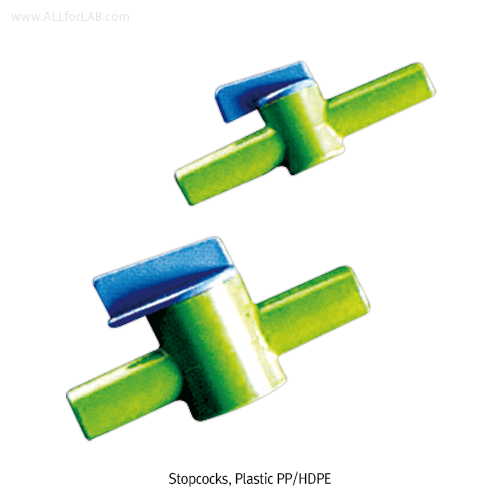
This category focuses on functional components that support joining, sealing, and flow control in labware systems. In practice, that can include stopcocks for manual control of liquid or gas pathways, O-rings for sealing flanges or joints, and similar accessories used to keep a laboratory assembly operating properly.
Unlike primary vessels or instruments, these items are often selected based on fit, material, and operating context. A stopcock with the correct outer diameter is important for tubing integration, while an O-ring must match the joint or flange size and the chemical or temperature conditions of the application.
Typical applications in laboratory setups
Connection components are used in many common lab tasks, from basic liquid handling to more controlled process work. They are often found in transfer lines, filtration arrangements, distillation assemblies, vacuum systems, and reactor or flask connections where a secure interface is essential.
For example, stopcocks such as the Kartell KA.374, KA.376, and KA.379 are relevant where an operator needs a straightforward manual shutoff or directional control point in a tubing-based setup. Sealing items such as the SciLab SL.ORi6012 flask flange O-ring or DaiHan O-rings are more focused on preventing leakage at mating surfaces, especially where repeat assembly and disassembly are part of normal lab work.
Material considerations when selecting connection parts
Material choice is one of the most important factors in this category. Polypropylene and polyethylene-based stopcocks are typically chosen for their practicality in general laboratory environments, especially where lightweight, corrosion-resistant components are preferred. In many setups, these materials provide a sensible balance between chemical resistance and ease of handling.
For sealing components, silicone and Viton each serve different needs. Silicone O-rings are often selected when flexibility and general sealing performance are priorities, while Viton O-rings are commonly considered where stronger resistance to certain chemicals or operating conditions is needed. Final selection should always be based on the actual media, temperature range, and mechanical demands of the application.
Examples from leading laboratory brands
This category includes connection components from recognized labware manufacturers such as Kartell, DaiHan, and SciLab. These brands are relevant for laboratories that need replacement parts or matching accessories for existing systems without treating every fitting as a generic item.
Representative products in this range include Kartell stopcocks with different arm outer diameters, making them useful for different tubing sizes, as well as DaiHan silicone and Viton O-rings in multiple dimensions for sealing duties. The SciLab SL.ORi6012 is a good example of a flange O-ring intended for a defined flask connection point rather than general-purpose use.
How to choose the right connection component
A practical selection process usually starts with the connection geometry. Check the required outer diameter, nominal size, or ring dimensions first, then confirm the material is appropriate for the chemicals and operating conditions involved. Even a small mismatch can lead to leaks, poor flow control, or unnecessary wear.
It also helps to think about the role of the part within the full assembly. A stopcock affects how precisely flow can be opened or shut, while an O-ring affects sealing integrity and maintenance intervals. If your setup also involves transfer accessories or dispensing hardware, related categories such as bottle top solvent pumps may be useful when planning the broader workflow.
Why these small parts matter in day-to-day lab operation
Connection parts may look minor compared with larger glassware or instruments, but they directly affect system reliability. A worn seal, an incorrectly sized ring, or an incompatible valve body can interrupt work, compromise sample integrity, or create handling issues during routine procedures.
Keeping suitable replacements available is often a smart maintenance practice, especially in laboratories with repeated cleaning cycles or frequent assembly changes. In some cases, related support materials such as adhesives or storage and handling items like bags may also support organization and upkeep around labware systems, but the core priority remains a correct mechanical and chemical fit at the point of connection.
Matching connection parts to your lab environment
Different laboratories prioritize different things. Teaching labs may need easy-to-handle replacement parts for general fluid routing, while research and process labs may focus more on sealing performance, repeatability, and compatibility with specialized apparatus. That is why connection components should be evaluated as part of the actual workflow rather than as interchangeable consumables.
When reviewing products in this category, pay attention to the intended form factor, material family, and dimensional cues in the item name. That approach makes it easier to narrow down suitable options quickly, especially when replacing a specific stopcock or sealing ring already used in your setup.
Final considerations
The right laboratory connection component helps maintain a stable, usable, and serviceable system. From Kartell stopcocks for flow control to DaiHan and SciLab O-rings for sealing applications, this category supports the small but essential parts that keep labware assemblies functioning as intended.
If you are selecting for replacement or new assembly work, start with size and material compatibility, then consider how the part will be used in the complete setup. A careful choice here can improve reliability, reduce downtime, and make routine laboratory operation easier to manage.
Get exclusive volume discounts, bulk pricing updates, and new product alerts delivered directly to your inbox.
By subscribing, you agree to our Terms of Service and Privacy Policy.
Direct access to our certified experts