Glass Beads
Precise particle size and consistent material behavior matter in many laboratory and industrial workflows, especially when media is used for mixing, packing, calibration, handling, or controlled contact with liquids and surfaces. In these applications, choosing the right bead diameter and format can make daily work more repeatable and easier to scale.
Glass Beads in this category are intended for labware and process-related use where clean, uniform spherical media is needed. The range includes multiple bead size options, helping users match the material to different vessel sizes, handling methods, and process requirements in research, quality control, and routine laboratory work.
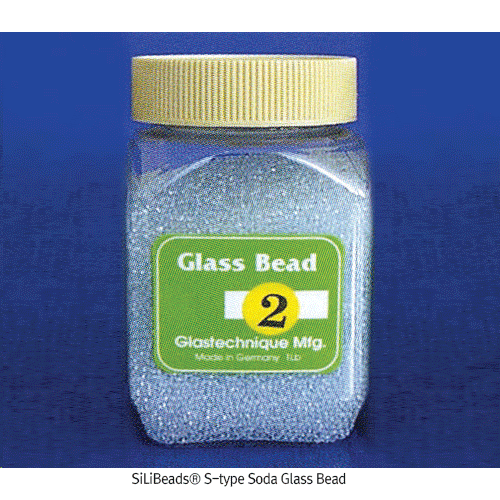
Glass beads for controlled laboratory use
Compared with irregular granules or improvised fill media, glass beads offer a more predictable shape and packing behavior. Their spherical form can support more uniform contact, smoother flow characteristics, and easier handling when a process depends on bead size consistency.
Within this selection, users can find products from SiLiBeads, a manufacturer often associated with laboratory bead media. The available assortment spans from smaller diameters up to larger bead sizes, which is useful when the same facility needs different grades for different test setups or preparation steps.
Available size ranges in this category
The product range covers several diameter bands, allowing buyers to choose a bead size that fits the intended vessel geometry, media bed behavior, or contact surface area. Smaller options such as SiLiBeads SI.5219 Gl bead 0.4-0.8mm s type xx and SI.4502 Gl bead 0.50-0.75mm s type are suitable where finer media is preferred, while SI.4503 and SI.4504 extend the range into the 0.75-1.25 mm class.
Mid-size and larger grades are also available, including SI.4505, SI.4506, SI.4507, SI.4508, and SI.4510 through SI.4513. This progression up to 3.80-4.30 mm gives purchasers a practical spread of options for workflows that require different packing density, bead mass, or interaction with samples and equipment.
How to choose the right glass bead size
The most important selection factor is usually bead diameter. Smaller beads generally provide a higher number of contact points in a given volume, while larger beads are often easier to separate, handle, or use in applications where more open spacing is preferred.
It is also useful to consider pack size and workflow scale. Several listed items are supplied as 20 kg/cs with 500 g/pk options, which can help teams balance bulk purchasing with smaller working quantities for daily lab use. If the beads will be used alongside other consumables or preparation materials, related labware such as bags or laboratory bowls may also be relevant to the overall setup.
Typical application context
Glass bead media can be relevant in laboratories, pilot environments, and technical workspaces where uniform spherical particles are needed as a process aid or support material. Depending on the method, users may be looking for consistent fill media, sample-handling support, spacing material, or a stable inert bead format for procedural use.
Because the category sits within labware, it is best approached as part of a broader working system rather than as a standalone item. In some environments, beads are selected together with containers, transfer accessories, or sealing materials. For example, supporting items such as adhesives or a bottle top solvent pump may be part of adjacent laboratory workflows, even if they serve a different direct function.
Representative products in the range
For buyers comparing options, the listed SiLiBeads models provide a clear step-by-step size ladder. SI.4502 and SI.4503 cover smaller diameters, SI.4504 through SI.4508 address the lower to mid-range, and SI.4510, SI.4511, SI.4512, and SI.4513 support larger size requirements.
This structure is helpful when a process specification calls for a narrow size band rather than a broad mixed grade. Instead of searching across unrelated items, procurement teams can review multiple nearby bead diameters within one category and choose the most appropriate format for testing, qualification, or standard operation.
Why consistency matters in bead selection
In technical purchasing, the value of glass beads is not only the material itself but also the repeatability they can bring to a process. Consistent size ranges can help reduce variation between batches, support clearer documentation, and make it easier to reproduce a setup across teams or sites.
This is especially important when a laboratory works under internal procedures or quality-controlled methods. A clearly defined bead grade can simplify ordering, stock management, and replacement planning, particularly when the same diameter is used regularly in one established workflow.
Finding a suitable option for your process
When reviewing this category, start with the required size range, then check the packaging format that best fits your usage volume. If your process is still being optimized, it may be practical to compare neighboring bead diameters before standardizing on one grade for routine purchasing.
Overall, this glass bead assortment is designed to support laboratories and technical users who need dependable spherical media across a range of sizes. With multiple SiLiBeads options available and a labware-focused context, the category provides a straightforward starting point for selecting uniform bead media that fits real operational needs.
Get exclusive volume discounts, bulk pricing updates, and new product alerts delivered directly to your inbox.
By subscribing, you agree to our Terms of Service and Privacy Policy.
Direct access to our certified experts