Measuring environmental conditions is an important step when preparing surfaces and applying protective coatings or primers, particularly on outdoor steel structures. Temperature, humidity, and the risk of condensation can vary depending on the time, location, and shading conditions. Using a paint hygrometer to monitor these parameters provides contractors, inspectors, and project owners with additional information to assess environmental conditions at the time the work is carried out.
Why outdoor conditions matter for coatings
Long-term coating performance on steel structures can be affected by climatic conditions during pre-treatment and application. Air temperature and surface temperature are not always the same. Direct sun, shade, object shape, and the mass of the structure may all influence surface behavior.
During the day, metal can absorb heat and become warmer than the surrounding air. At night, a metal structure can radiate heat and cool below air temperature. These differences matter because air and surface temperatures influence coating cure and the likelihood of moisture forming on the surface.
Applying a coating outside its suitable temperature range may contribute to defects such as blistering, pinholing, cratering, dry spray, or mud cracking. The applicable coating system requirements should therefore be considered alongside site measurements.
Key measurements for outdoor climate monitoring
Air temperature and surface temperature
Measuring both ambient air temperature and surface temperature provides a clearer picture than relying on either value alone. Surface temperature is particularly relevant when evaluating a steel substrate exposed to sun, shade, or changing weather. It can also help the team recognize conditions that may be unsuitable for satisfactory film formation.
Relative humidity
Relative humidity expresses the amount of moisture in the air as a percentage. High relative humidity can slow solvent evaporation. The source material notes that the maximum relative humidity for coating or lining application and cure is generally set at 85%, although the specific requirements for the coating system being used should guide job decisions.
Dew point and surface-to-dew-point difference
Dew point is the temperature at which moisture begins to form on a surface. It is determined by air temperature and relative humidity. Moisture on freshly blasted steel can lead to rust, while an invisible moisture film between the substrate and coating may contribute to premature system failure.
For this reason, the difference between surface temperature and dew point is a critical observation. The source references ISO 8502-4 and SSPC guidance stating that surface temperature should be at least 3°C or 5°F above the dew point during preparation, application, and cure. Project specifications and the coating manufacturer’s instructions remain essential when defining acceptance criteria.
Using the PosiTector DPM for climatic observation
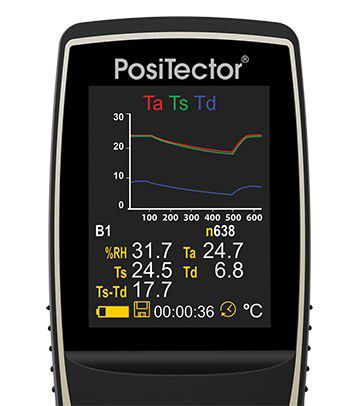
The PosiTector DPM Dew Point Meter is a handheld, non-destructive instrument designed to measure climatic conditions around coating and lining applications. It measures air temperature, surface temperature, and relative humidity, while calculating dew point temperature and the difference between surface and dew point temperatures.
This allows five conditions to be viewed together: ambient air temperature, surface temperature, relative humidity, dew point temperature, and the surface-to-dew-point difference. Bringing these readings together in one instrument can simplify periodic checks where conditions are changing.
When the PosiTector DPM detects a smaller difference value, its display contrast reverses, the red LED illuminates, and an audible alarm sounds. These indicators can draw attention to conditions associated with a greater probability of condensation.
Recording conditions across the job
Site observations are often more useful when they are documented over time. The PosiTector DPM can store the five observed and calculated climatic conditions together with date and time. Its Auto Logging feature records datasets at a user-selected interval.
A record of trends leading up to, during, and after application can support job documentation. It may also help identify differences between shaded locations, exposed areas, and crevices, where localized conditions can vary despite close proximity.
Comparing monitoring approaches
Traditional relative humidity assessment can use wet- and dry-bulb temperature readings from whirling or electronic hygrometers. With a whirling instrument, the device must be rotated steadily and readings must be taken promptly because temperatures begin changing after rotation stops. Relative humidity and dew point are then estimated using psychrometric tables, graphs, or slide rules, and compared with a separate surface temperature measurement.
By contrast, the PosiTector DPM electronically calculates the relevant values from its sensors and software. A single, hand-operated instrument can provide immediate readings and reduce the need to combine separate devices and manual lookup steps. This can be especially helpful when measurements and records are needed while working around large structures or from elevated access equipment.
Practical monitoring workflow
- Measure air temperature, surface temperature, and relative humidity near the area to be coated.
- Review the calculated dew point and the surface-to-dew-point difference.
- Compare readings with the applicable coating requirements and project criteria.
- Repeat checks as weather, sunlight, or work location changes.
- Store readings to maintain a time-based record of observed conditions.
Consistent outdoor climate monitoring helps teams make observations based on current site conditions rather than assumptions. For coating projects, this supports informed decisions throughout preparation, application, and cure.
The results from the dew point meter should be recorded along with the measurement time to make it easier to review changes in environmental conditions. The final assessment should be based on the coating manufacturer's guidelines, application procedures, and the project's technical requirements. Systematically monitoring air temperature, surface temperature, relative humidity, and dew point provides a foundation for controlling the conditions during protective coating application.