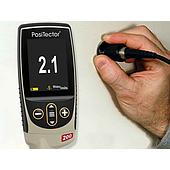
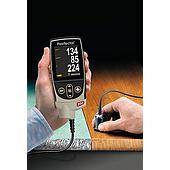
A non-metallic coating thickness gauge helps assess surface coating quality, particularly when coatings are applied to wood, concrete, plastic, or composite materials. For non-metallic substrates, ultrasonic measurement is a suitable option for evaluating coating thickness without damaging the sample. The PosiTector 200 is an ultrasonic coating thickness gage designed for non-destructive measurement of coatings over materials such as wood, concrete, plastic, and composites. Its Max Thick Mode provides an alternative approach for applications where surface echoes can interfere with identifying the coating-to-substrate interface.
How PosiTector 200 Measures Coating Thickness
The PosiTector 200 probe sends an ultrasonic sound pulse into the coating. The pulse reflects when it reaches an interface with a different density, which can include the boundary between the coating and its substrate. The instrument evaluates the pulse travel time from the probe to that interface and back.
Using the travel time and the speed of sound through the coating, the gage calculates coating thickness. This ultrasonic method supports non-destructive inspection, allowing the coating to be measured without cutting into the part or removing the applied material.
A density change is generally present at the coating-to-substrate interface. In some coating systems, the instrument can also identify interfaces between coating layers. On PosiTector 200 Advanced models, layer interfaces may be detected for different or identical coating materials when the initial layer has fully cured before the next layer is applied.
Default Measurement Mode
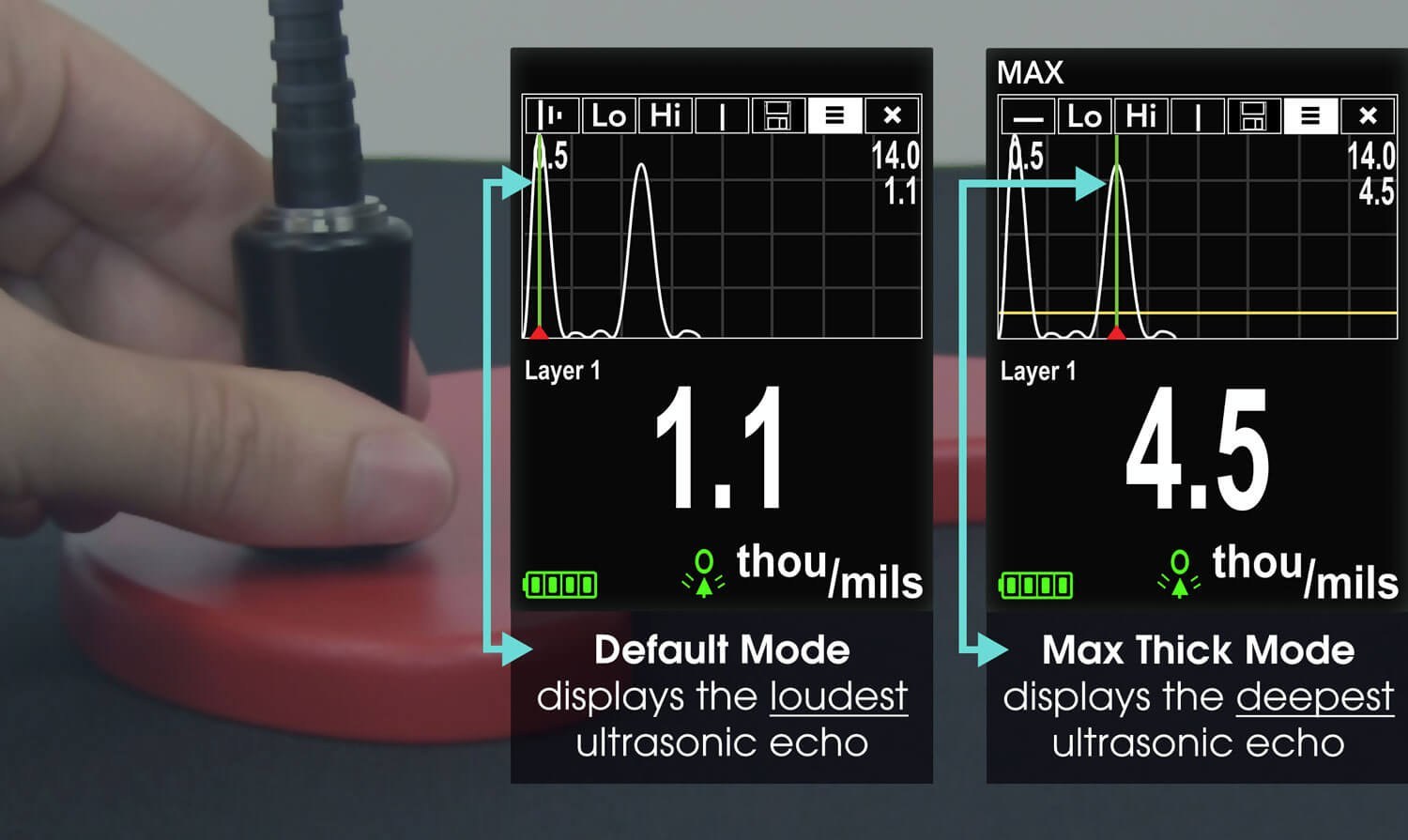
In its default mode, the PosiTector 200 searches within its measurement range for the loudest ultrasonic echo and reports the associated thickness. For many coating and substrate combinations, especially smooth polymer coatings, this approach can provide total coating thickness without requiring range adjustments.
When multi-layer measurement is selected, the instrument can report thicknesses associated with the strongest echoes according to the selected number of layers. This can help an inspector review individual coating layers as well as the overall coating system, where applicable.
However, rough surfaces and coating systems with numerous reflections near the surface may create strong, unwanted echoes. In these circumstances, a near-surface echo can be louder than the desired signal from the coating-to-substrate interface. Adjusting the Lo Range can be used to disregard unwanted echoes, but selecting a suitable range may take time and can be difficult where thinner coating areas must still be measured.
What Is PosiTector 200 Max Thick Mode?
PosiTector 200 Max Thick Mode changes the echo-selection approach. Rather than searching for the loudest echo, the instrument searches for the deepest significant echo. This can help it look beyond loud reflections near the coating surface and focus on the deeper interface associated with total coating thickness.
This mode is intended for cases where surface roughness or a noisy coating system produces distracting reflections. It can reduce the need to change the preset Lo Range solely to ignore those near-surface signals. The instrument still applies a preset loudness threshold, since small echoes can also occur within the substrate.
On PosiTector 200 Advanced models, the echo threshold can be adjusted in Graphic Display mode. When Max Thick Mode is active and multiple layers are selected, Advanced models report the thicknesses associated with the deepest ultrasonic echoes.
When to Consider Max Thick Mode
Max Thick Mode may be useful when coating thickness is being evaluated on wood, concrete, plastic, or other non-metal substrates and the surface condition generates prominent reflections near the top of the coating. It is particularly relevant when increasing the Lo Range would require an adjustment too close to the expected thickness, or when the operator prefers not to alter the range.
Before relying on any measurement mode, users should consider the coating system, substrate condition, and whether the returned echoes clearly represent the intended interfaces. For multi-layer inspection, curing between applications affects whether layer boundaries can be detected.
Application Limitation and Model Availability
Before testing with the Non-Magnetic Coating Thickness Gauge, it is necessary to determine the correct substrate type, surface characteristics and coating system structure to select the appropriate measurement mode.
Max Thick Mode is not recommended for thin metal substrates or composite materials such as carbon fiber and fiberglass.
For coatings on wood, concrete, plastic and other non-metallic substrates, the PosiTector 200 provides non-destructive ultrasonic measurement in standard mode.