Pull-off adhesion testing helps inspectors, contractors, finishers, and coating teams evaluate how strongly a coating resists separation from a rigid substrate. The method applies a tensile force perpendicular to the coated surface, making it useful for assessing the bond between a coating system and materials such as metal, plastic, wood, concrete, and glass.
For building and facility management work, adhesion strength measurement can support coating quality control, specification requirements, and maintenance planning. It can also help teams identify potential bond issues before premature coating failure leads to rework, corrosion exposure, or disruption to an asset.
What Is Pull-Off Adhesion Testing?
In a pull-off test, a dolly is attached to the coated surface. A portable adhesion tester then applies a direct tensile load to the dolly until separation occurs. The result indicates the coating system’s resistance to separation under that perpendicular force.
The method is relevant to many coating and lining types, including paint films, powder coatings, epoxies, varnishes, laminates, thermoplastic resins, elastomeric coatings, and inorganic coatings. Results must be considered in the context of the substrate, coating system, preparation process, and applicable project requirements.
Not every application has a universal pass/fail value. Expected results may instead be defined by the relevant parties, customer specifications, or an applicable testing standard. For this reason, documenting the test method, dolly size, surface condition, and observed failure mode is important when comparing results.
Why Adhesion Strength Matters in Facility Work
Coatings are often used to protect structural steel, concrete, equipment, and other surfaces from wear and corrosion. A coating may appear intact initially but still have insufficient bond strength for long-term service conditions. Pull-off adhesion testing provides a direct way to assess the bond performance of an applied coating.
The test may be used during coating development, surface-preparation verification, application quality control, inspection, repair work, or contract acceptance. It is also valuable when investigating a coating problem, although adhesion is only one factor that can affect coating performance.
Bond strength can be influenced by several process variables. These include coating thickness, climate during application, curing time and temperature, moisture, surface contamination, surface preparation, substrate density, and coating formulation or mixing parameters. A structured test program can help teams evaluate these variables more consistently.
Choosing a Dolly Size for the Test Range
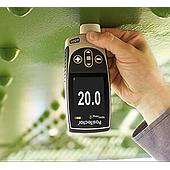
Dolly size affects the practical pull-off strength range. The PosiTest AT is designed to measure up to 3,000 psi (20 MPa) when using the included 20 mm dollies, which are commonly used on metal, wood, and plastic coatings.
Where a higher pull-off range is required, custom dollies can be selected. According to the supplied product information, a 14 mm dolly provides twice the pull-off strength of a 20 mm dolly and enables measurements up to 6,000 psi (40 MPa). A 10 mm dolly provides approximately four times the pull-off strength of a 20 mm dolly, supporting measurements up to 10,000 psi (70 MPa).
For lower-strength applications, including coatings on concrete, an optional 50 mm accessory kit is intended for pull-off strengths below 500 psi (3.5 MPa). When testing concrete, failure may occur cohesively within the concrete rather than at the coating-to-concrete interface. With appropriate cutting around the dolly, testing can also be used to assess uncoated concrete tensile strength and concrete repair areas.
PosiTest AT for Coating Adhesion Testing
The DeFelsko PosiTest AT is a portable pull-off adhesion tester available in Manual and Automatic versions. It is designed for coatings applied to rigid substrates. The tester allows the operator to select the dolly size so that the instrument can calculate and display the corresponding true pull-off strength.
Reliable pull-off adhesion testing depends on limiting shear forces, which act parallel to the coating surface rather than directly away from it. The PosiTest AT series is described as using a self-aligning feature with a spherical articulating dolly head and a ring of small bearings in the actuator to support vertical pulling.
Standards and Test Planning Considerations
Before testing, review the project specification and identify the relevant procedure. Standards referenced for pull-off testing include ASTM D4541 for portable adhesion testers, ASTM D5179 for organic coatings on plastic substrates, ASTM C633 for thermal spray coatings, ASTM C1583 for concrete surfaces and repair materials, ASTM D7234 for coatings on concrete, and ISO 4624 for paints and varnishes.
A consistent test plan should define the substrate and coating system, dolly size, surface preparation and cutting procedure, test locations, acceptance criteria where applicable, and reporting requirements. This approach helps make adhesion test results more useful for inspection records, corrective actions, and future maintenance decisions.