When reading technical documents or checking results, many people often encounter symbols such as 60 HRC, 85 HRB, or 72 HRA. While these are all part of the Rockwell system hardware, they are not interchangeable. Each scale is designed for a specific data set, using a specific probe and load.
HRC, HRB, and HRA all belong to the Rockwell hardness system
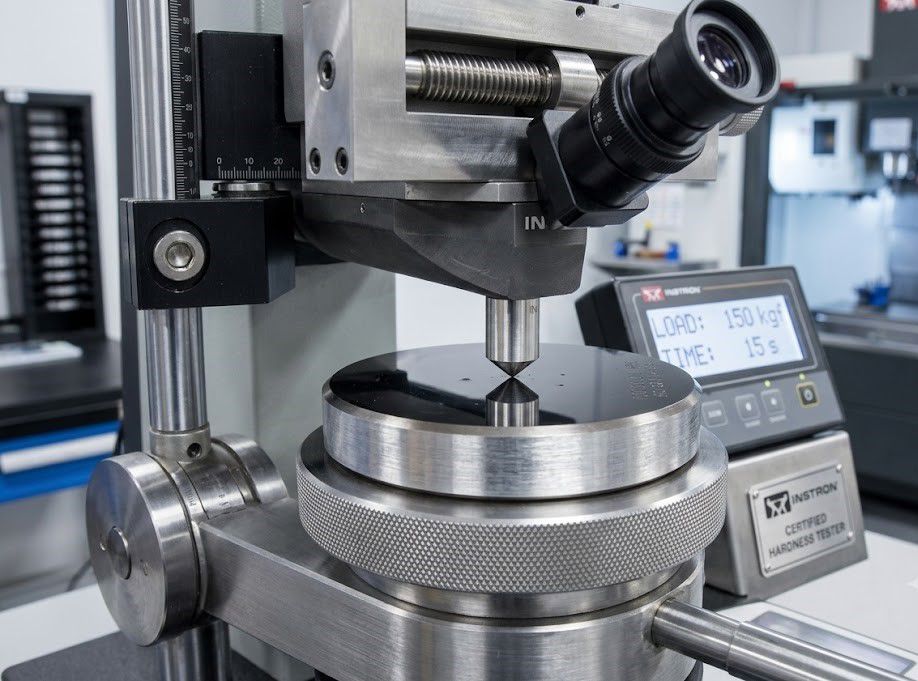
The Rockwell method determines hardness by measuring the depth of the indentation created on the material surface after applying a defined load.
Unlike Brinell, which requires measuring the indentation diameter, or Vickers, which requires microscopic observation, Rockwell provides quick results that can be read directly on the instrument. This is why this method is widely used in mass production, QC departments, and mechanical workshops.
The Rockwell system has several different scales, but HRC, HRB, and HRA are the three most common.
The differences lie in:
+ The type of probe used
+ The applied load level
+ The material group being tested
HRC is used for hardened steel and high-hardness materials
If you encounter a technical specification like 58-62 HRC on a drawing, it's almost certain that the part has undergone heat treatment. This is the most widely used scale in mechanical engineering, mold making, and metalworking.
HRC uses a 120° conical diamond indenter combined with a 150 kgf load. This configuration is suitable for high-hardness materials where a steel ball indenter would struggle to produce accurate results.
Materials commonly evaluated using HRC include:
+ Heat-treated steel
+ SKD11 mold steel
+ SKD61 mold steel
+ High-speed steel
+ Industrial cutting tools
+ Stamping dies
+ Wear-resistant shafts
In current QC laboratories, Rockwell hardness testers such as the HRMS-45, RHT-9000M are commonly used to test this group of materials.
HRB is suitable for copper, aluminum, and mild steel
Not all materials are hard enough to be measured using HRC; with softer metals, high loads and diamond indenters can create indentations that are too deep, leading to inaccurate results or exceeding the standard range. HRB is designed to address this group of materials.
The B scale uses a 1/16-inch diameter steel ball with a 100 kgf load. Thanks to lower impact force and a more suitable indenter, HRB provides consistent results for metals with medium or low hardness.
Materials commonly measured using HRB include:
+ Copper
+ Brass
+ Copper
+ Aluminum
+ Aluminum alloys
+ Low carbon steel
+ Unheat-treated steel
+ Mild cast iron
Read more
HRA is used for ultrahard materials
HRA is less common than HRC but plays a crucial role in high-tech materials fields. The A scale uses a diamond indenter similar to HRC but with a load of only 60 kgf. This setup limits the indentation depth, making it suitable for very hard materials or materials with limited thickness.
Common applications of HRA include:
+ Carbide
+ Tungsten carbide
+ Alloy turning inserts
+ Hard-coated cutting tools
+ Special wear-resistant materials
+ Engineering ceramics
Some materials can achieve over 85 HRA, a level beyond which many other scales are no longer suitable. In precision machining, HRA is frequently found in the technical documentation of cutting tools, turning inserts, and special alloy materials.
Why can't HRC, HRB, and HRA be compared directly?
A common mistake is looking at the numbers and making direct comparisons.
For example:
- 60 HRC
- 85 HRB
Many people assume that 85 is greater than 60, meaning the second material is harder. The reality is quite the opposite; each scale uses different probes and loads, so the numerical value only has meaning within that scale. The HRC number should only be compared to HRC. Similarly, HRB should only be compared to HRB.
This is also why technical documents always include the full HRC, HRB, or HRA symbols instead of just a simple hardness value.
Is it possible to convert between HRC, HRB, and HRA?
Current hardness conversion tables allow for approximate conversions between:
- HRC
- HRB
- HRA
- HB
- HV
However, the conversion results are still relative because each material has a different metallurgical structure. Two steels with the same hardness may not necessarily have the same tensile strength or wear resistance.
In official quality control requirements, direct measurement using the specified scale is always the most reliable option.
When should you use a Rockwell hardness tester?
Rockwell is particularly well-suited to manufacturing environments due to its fast testing speed, simple operation, and direct result reading capability.
Common applications include:
- Testing heat-treated steel
- Testing cutting tools
- Testing molds
- Testing input materials
- Testing machined parts
- Mass quality control
HRC, HRB, and HRA all belong to the Rockwell hardness system but are designed for completely different material groups. HRB is suitable for copper, aluminum, and mild steel. HRC is the most popular choice for heat-treated steel, mold steel, and high-hardness mechanical parts. HRA is used for carbide and superhard materials.
Understanding the differences between these three scales helps in accurately reading specifications, selecting the correct testing method, and effectively utilizing Rockwell hardness testers in QC departments and industrial production.