VD 550 Compressed Air Flow Meter Expands Measurement Capability Directly After the Air Compressor
In industrial compressed air systems, the measurement point immediately downstream of the compressor is often the most challenging area to control due to high flow rates, elevated temperatures, and continuous condensate formation. As a result, many facilities either install additional treatment equipment before the measuring point or accept unstable measurement data.
The VD 550 compressed air flow meter with a ¾” threaded connection was developed to directly address this challenge. The device enables reliable measurement of humid compressed air and technical gases directly after the compressor, even when no water separator is installed upstream of the measuring point.
In addition to the new design, the accessory package includes a ¾” threaded fitting and a drilling tool for creating a 20 mm measuring port, enabling fast installation for both new systems and retrofit projects.
High-Sensitivity Compressed Air Flow Sensor for Low Flow Ranges
One of the key advantages of the VD 550 is its ability to measure flow velocities starting from 2 m/s, allowing accurate monitoring even when the system operates under low-load conditions or experiences frequent demand fluctuations.
This feature makes the instrument particularly suitable for variable-speed air compressors, where airflow does not remain constant throughout the operating cycle.
According to the manufacturer’s technical specifications, the sensor utilizes differential pressure measurement combined with temperature and pressure compensation to maintain measurement accuracy across various operating conditions.
From a single measuring point, users can simultaneously monitor: Flow rate, Total consumption, Temperature, Pressure
As a result, the VD 550 is not only as a flow measurement device but also as a valuable tool for compressed air consumption monitoring and energy management.
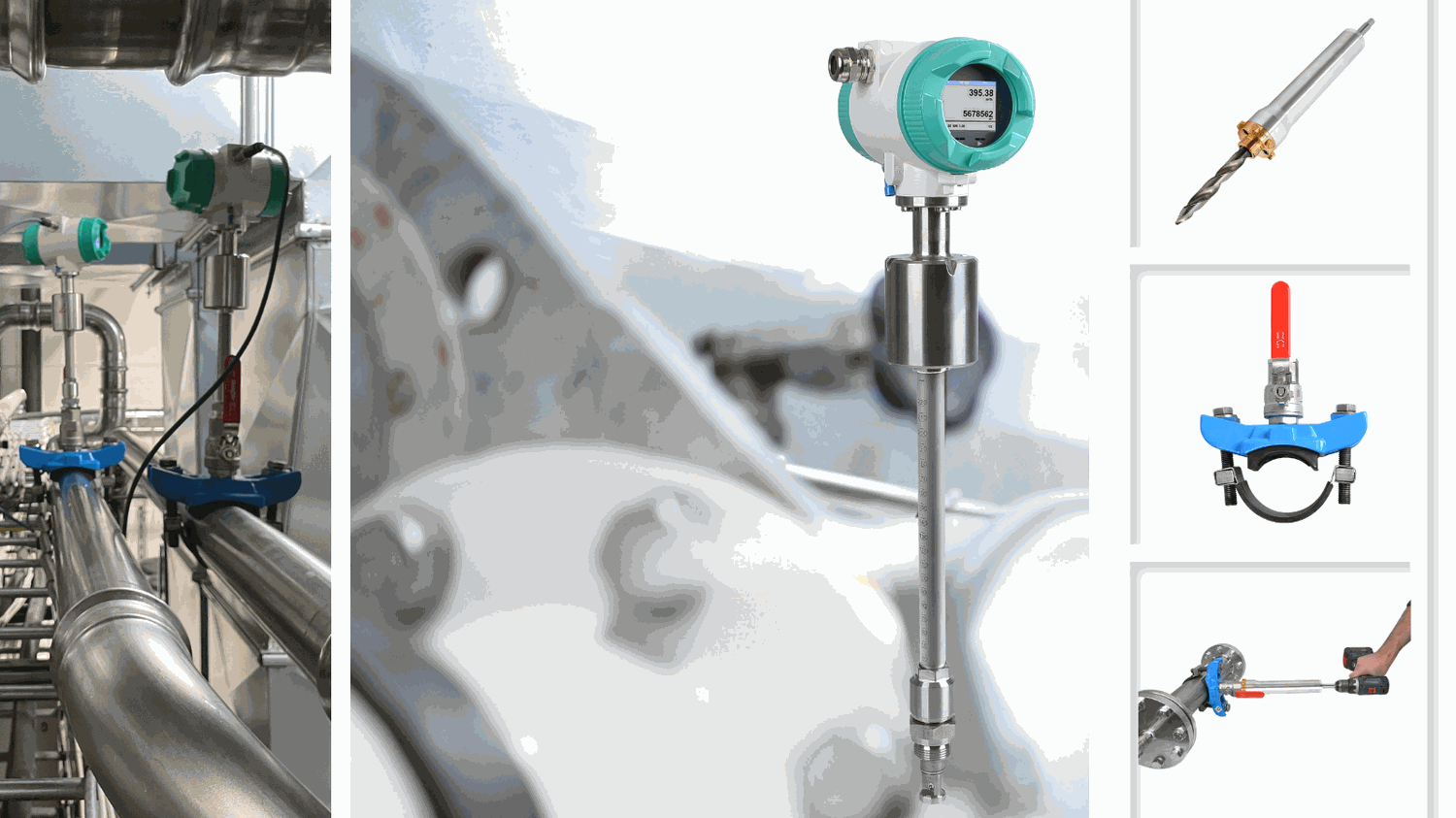
VD 550 Designed for High Flow Rates, Harsh Environments, and Large Pipe Sizes
As industrial compressed air systems continue to expand in capacity, sensors are increasingly required to support larger pipe diameters and withstand demanding operating conditions.
The VD 550 gas flow meter offers several key advantages:
Measurement in Temperatures up to 180°C
Suitable for installation near compressors and in high-temperature industrial gas applications.
Compatible with Pipe Sizes DN20–DN600
Supports flexible deployment from small production lines to centralized compressed air distribution systems.
IP67 Die-Cast Aluminum Housing for Industrial Environments
Impact-resistant construction suitable for field installation and environments with dust or high humidity.
Supports Multiple Industrial Communication Standards
The VD 550 can be seamlessly integrated into centralized control systems, SCADA, PLC, and energy management platforms through multiple communication interfaces:
4–20 mA
Pulse Output
RS485 (Modbus RTU)
Ethernet (Modbus TCP / PoE)
HART
IO-Link
M-Bus
Profibus DP / Profinet via Gateway
Its capability to operate directly with humid compressed air, combined with a design optimized for large pipelines and flexible connectivity, makes the CS Instruments VD 550 compressed air flow meter well suited for the digitalization of operational data in modern manufacturing facilities.