For full functionality of this site it is necessary to enable JavaScript.
EMIN.ASIA
0

What is a hydraulic press used for? Applications in modern manufacturing

08/19/2025 15:01:39

When it comes to hydraulic presses, many people immediately imagine giant blocks of steel being compressed neatly in just a few seconds. In fact, behind it is a familiar physical principle: Pascal's law. A small force when acting on a closed liquid can multiply many times at the output. It is this simple sounding principle that has turned the hydraulic press into one of the most important devices in modern industry today.

Do you know what a hydraulic press is used for?

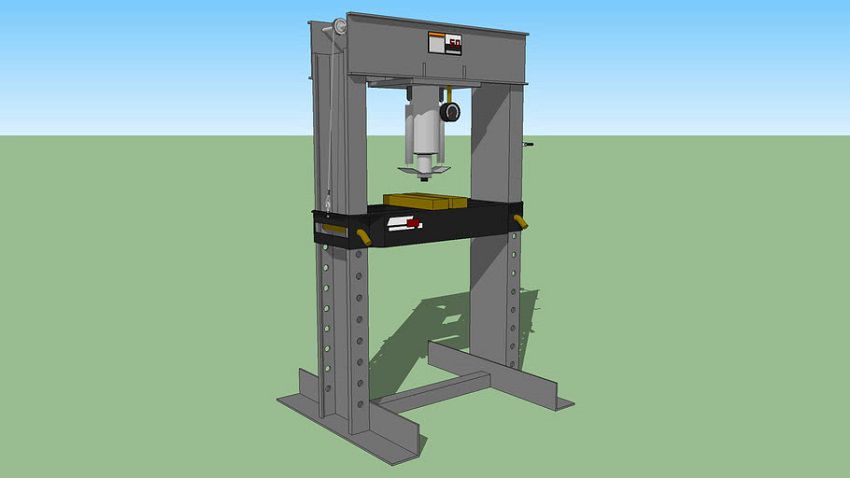
In metalworking, few machines are as powerful as a hydraulic press. Imagine the process of manufacturing a car: the body, hood, or brake parts all require enormous pressure to shape. Even in small mechanical workshops, hydraulic presses are a great help for removing bearings, straightening bent iron bars, or pressing rusty parts. A medium-sized machine like the KOCU TY12001 with a pressing force of 12 tons can handle seemingly impossible workloads.

When hydraulic presses are applied in the recycling field

When it comes to the environment, hydraulic presses have another role: turning bulky materials into neat blocks. End-of-life cars, aluminum cans, scrap iron and steel… can all be compressed to save space and reduce transportation costs. 
Thanks to this, the recycling process becomes more efficient. Not stopping at scrap, in many manufacturing plants, powdered materials such as pharmaceuticals or cosmetics are also compressed into tablets with high compactness and uniformity, thanks to hydraulic technology.

Applications in laboratory, production line?

In research labs, you’re probably familiar with its role: testing the strength of materials, compressing pellets for chemical analysis, or creating prototypes for the construction industry. Thanks to its stability and repeatability, hydraulic presses help researchers obtain reliable data, leading to the development of new, stronger, lighter materials.

Is it really safe to use a hydraulic press?

One of the common concerns is whether using a hydraulic press is dangerous. The truth is, with tens of tons of pressing force, this equipment is potentially risky if operated incorrectly. However, modern machines have been integrated with many protective features such as safety valves, emergency stop buttons and protective frames. When following the correct procedures, operators can use it with complete peace of mind. In places such as laboratories or small mechanical workshops, choosing the right machine capacity and regular maintenance are also important factors to ensure absolute safety.


Related News

Checking Lithium Battery Temperature with an Infrared Thermometer
11/10/2026 16:45:58

An infrared thermometer is a useful tool for quickly checking the surface temperature of lithium batteries without direct contact. This method allows technicians to identify abnormal temperature areas, assess operating conditions, and inspect battery systems during maintenance.

How common is the selection of RBW on a spectrum analyzer?
11/10/2026 15:13:05

You are measuring an amplifier, and only one peak appears on the screen—even though there are clearly two carriers. Or, you know for a fact that harmonics are present, but the noise floor sits above them. Or, after making adjustments, the scanner slows down to the point where you find yourself waiting for each individual sweep. These three scenarios often share a common cause: the RBW (Resolution Bandwidth)

How Do Thermal Cameras Inspect PV System Faults?
11/10/2026 14:06:04

Thermal imaging helps inspection teams identify temperature anomalies associated with PV panel, connection, junction-box, inverter, and battery issues while the system is operating.

Vietnam’s Semiconductor Industry Outlook to 2030: Opportunities and Challenges
11/10/2026 11:22:48

Những khoản đầu tư mới, cùng định hướng phát triển công nghiệp bán dẫn đến năm 2030, đang tạo nền tảng cho thị trường trong nước. Tuy nhiên, để nâng cao vị thế trong chuỗi giá trị toàn cầu, Việt Nam cần giải quyết bài toán về công nghệ lõi, nhân lực kỹ thuật và năng lực đo kiểm.

Stay Updated with Offers

Get exclusive volume discounts, bulk pricing updates, and new product alerts delivered directly to your inbox.

By subscribing, you agree to our Terms of Service and Privacy Policy.

Quick Support

Direct access to our certified experts