What is an UPS?
UPS (Uninterruptible Power Supply) is a backup device, providing a stable power source when the grid system has problems. UPS ensures that electrical equipment continues to operate continuously, helping businesses avoid significant losses such as data loss, production interruption, equipment failure, and costly restarts of the entire system. . With this essential role, UPS is an indispensable solution for factories and businesses.
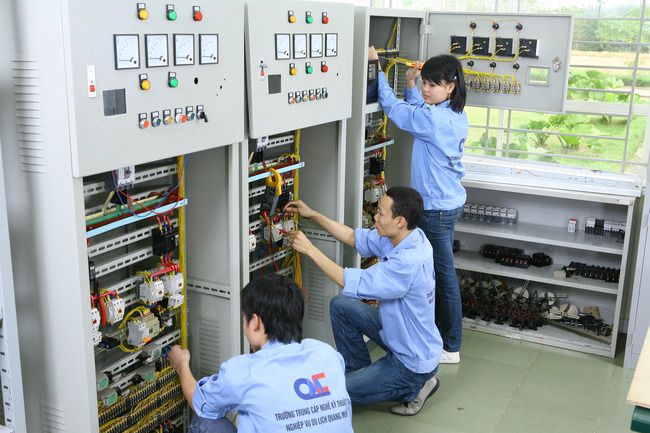
A UPS is an electrical device with a rather complex structure and operating principle, but can be simply understood as a system consisting of electrical loading and storage components, operating with an automatic switching mechanism to suitable for equipment requiring power supply. Below is detailed information about the structure and principle of UPS.
Structure and operating principle
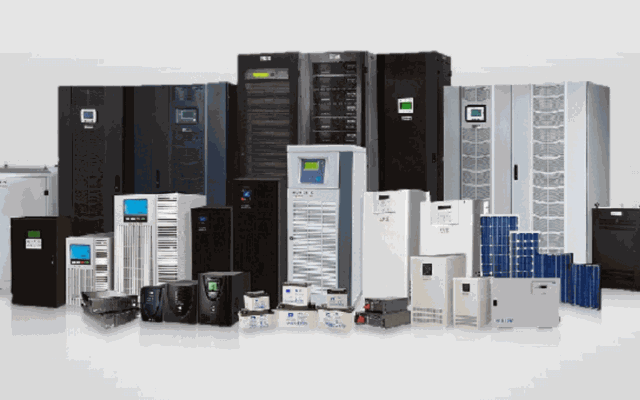
General structure of UPS
Inside a complete UPS system usually includes the following main parts:
- Battery: Responsible for storing backup power, can be integrated inside or externally depending on the model.
- Charger: Used to directly charge the battery.
- Rectifier: Converts alternating current (AC) into direct current (DC) for storage.
- Inverter: Converts back from direct current (DC) to alternating current (AC) to supply the device.
Regarding external design, UPS usually has a simple design, the main color is black or white. The control system uses buttons, some high-end models have touch screens or LCDs to display parameters such as battery capacity, frequency, and power consumption.
Operating principle:
The UPS operates on the principle of storing electricity in one or more batteries, then uses a circuit board to convert direct current from the battery into alternating current, providing power to the required equipment. Store the load with the appropriate frequency and voltage, such as 380Vac 60Hz, 220Vac 50Hz or 110Vac 60Hz.
The activation mechanism of the UPS is implemented as follows:
- When there is mains power, the UPS will charge the battery.
- When the mains power is interrupted, the UPS will convert direct current from the battery into alternating current to supply power to devices.
- When the grid power is stable again, the alternating current passing through the UPS will be rectified into direct current to recharge the battery, ensuring readiness for the next use.
This principle helps UPS maintain a stable power source and protect equipment in the event of a sudden power outage.
Reasons why you need to use an UPS
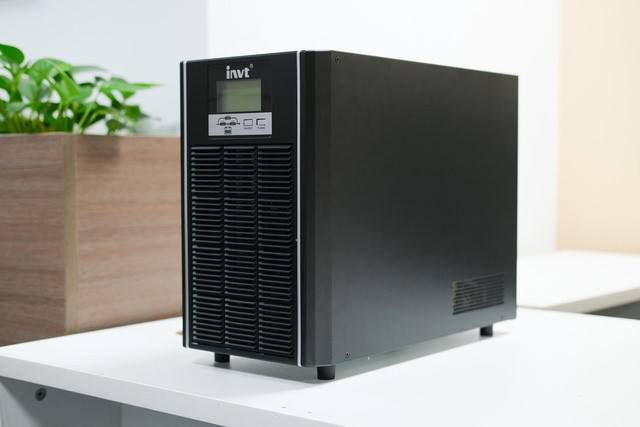
Many people often wonder: "What is an UPS used for?" The answer lies in the obvious benefits it brings. When a sudden power outage occurs, the UPS allows the production line to continue operating to wait for backup power, helping to save costs on restarting equipment. The computer system can be maintained to promptly save data, the server can be safely turned off, and the surveillance, internet, and camera systems still operate stably. These are the outstanding values of the UPS, helping users realize the importance of this device and consider investing to ensure continuous operation.
Applications of UPS:
UPS power supplies have many essential applications in different fields:
- Computer room - Server: Computers and servers are where important business data is stored, so an uninterruptible power supply is needed to avoid sudden power outages, causing damage to machinery or loss of important data. .
- Industrial production: In industrial factories, where machines operate continuously and consume large amounts of electricity, industrial uninterruptible power supplies play an important role in ensuring a stable power source, helping the equipment operate. smoothly and avoid interruptions and damage.
- Family activities: In daily life, uninterruptible power supplies help ensure continuous power supply for devices such as lights, refrigerators, elevators, helping to ensure uninterrupted activities. UPS for home use is usually compact and has moderate capacity, suitable for daily use.
- Medicine - Hospital: In the medical industry, uninterruptible power supplies are necessary equipment to ensure continuous operation of ultrasound, testing, X-ray analyzers and even emergency equipment such as ventilators. , pacemaker, ensuring safety and effectiveness during patient care.
- Traffic: Systems such as traffic lights, surveillance cameras, and signal lights need continuous electricity to ensure safe and orderly traffic operations.
- Bank: Computer systems and ATMs at banks use UPS to protect data and ensure transactions go smoothly, avoiding problems that can affect customer experience.
Refer to the product at:
UPS APC 1200VA/650W
Santak RACK 1KS UPS (36 V)
Santak TG 1250 PRO UPS (50 Hz)