
In the fields of cosmetics, food, and pharmaceuticals, the two concepts of "homogenization" and "emulsification" often appear together to the point that many people take them for granted. In reality, they are closely related but not entirely the same. One process creates an emulsion, while the other further refines the mixture, making it smoother, more stable, and less prone to separation.
What is emulsification?
Emulsification is the process of dispersing two immiscible liquids, typically oil and water, to form a homogeneous mixture called an emulsion.
The most familiar examples are lotions, body washes, and mayonnaise. If you simply pour oil and water into the same cup, the two phases will quickly separate. When stirred and with the addition of a suitable emulsifier, the oil droplets will disperse into the water phase or vice versa, forming a stable emulsion.
The essence of emulsification lies in its ability to bring two incompatible phases together in a single system.
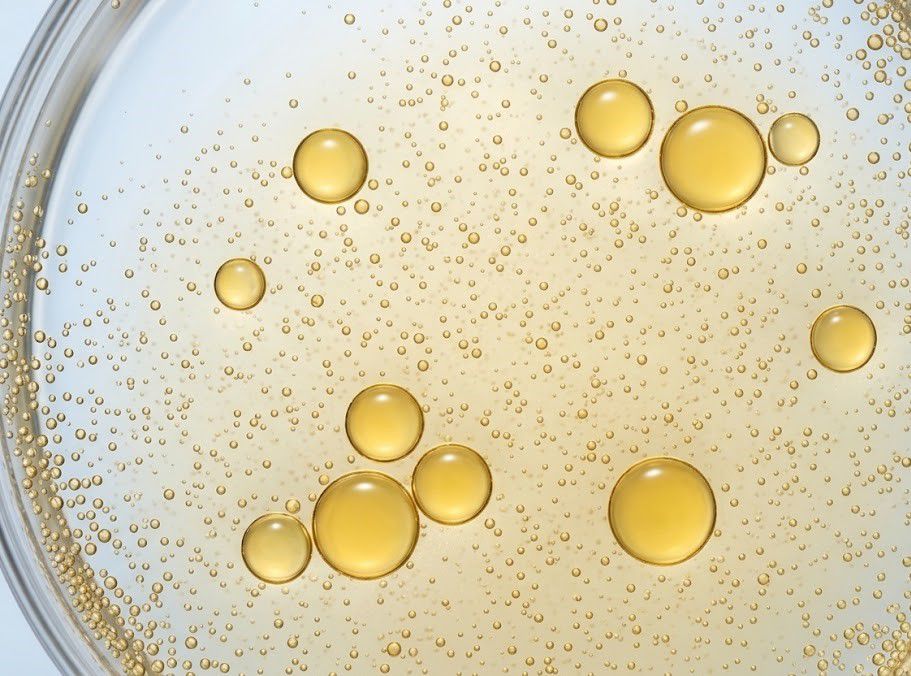
What is sample homogenization?
After emulsification, the size of the dispersed droplets remains relatively large. If left for too long, stratification or separation may still occur.
At this point, the homogenization process will further break down the particles using high shear force, high pressure, or ultrasonic waves, reducing the particle size to micrometers or even smaller.
The result is a smoother, more uniform mixture with greater stability.
A bottle of homogenized fresh milk will not have a film floating on top. Similarly, high-end creams or serums usually have a smooth and stable structure thanks to the final homogenization step.
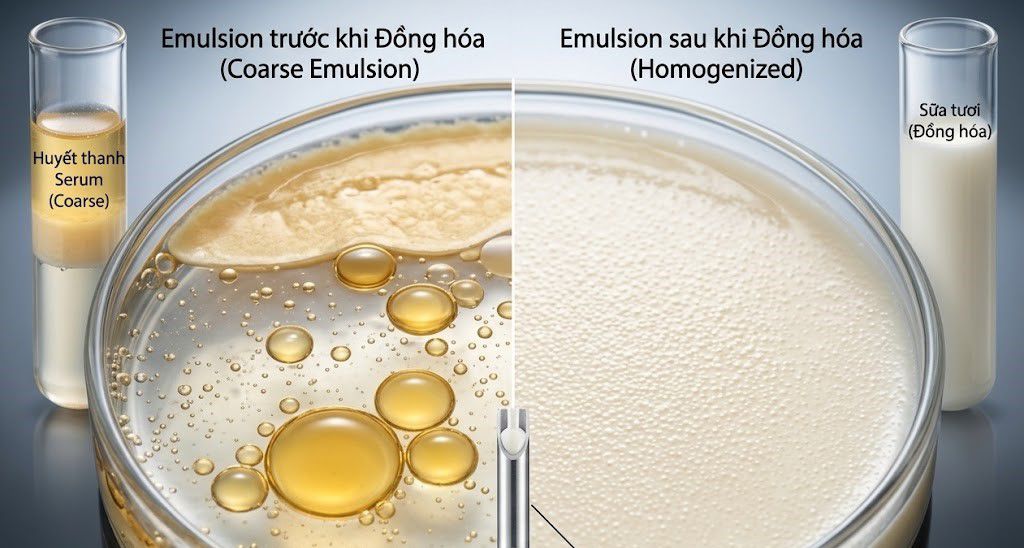
The biggest difference lies in the purpose of processing
If we imagine the manufacturing process as building a house, emulsification is the step of bringing the ingredients together, while homogenization plays the role of perfecting the structure so that all components are evenly distributed. Emulsification focuses on creating an emulsion, while homogenization focuses on reducing particle size and increasing the stability of the system.
Therefore, a product can completely go through both stages. Emulsification before homogenization is a fairly common process in the production of cosmetics, food, and pharmaceuticals.
Does emulsification always require homogenization?
This depends on the desired quality of the finished product. For simple mixtures or those requiring relatively low stability, conventional emulsification is sufficient.
Conversely, products such as:
- Skin creams
- Lotions
- Serums
- Drinking yogurts
- Nut milks
- Mayonnaise
- Pharmaceutical suspensions
often require an additional homogenization step to reduce particle size and extend product stability. If this step is omitted, separation or agglomeration is very likely to occur after a period of storage.
Why do emulsions still separate into layers even after emulsification?
This is a question that arises quite frequently during the development of cosmetic and food formulations.
The cause is not due to incorrect emulsification, but rather often stems from the large particle size. Oil droplets or dispersed phases tend to clump together and then gradually separate into two distinct layers.
Adding a homogenization step using a high-speed homogenizer significantly reduces particle size, thereby increasing the stability of the emulsion system.
This is also why many products with similar appearances have vastly different textures, user experiences, and shelf lives.
How does a sample homogenizer work?
Most modern laboratory homogenizers use a rotor-stator mechanism.
The rotor rotates at very high speeds, generating a strong shearing force that pulls the material through the narrow gap between the rotor and stator. Under the continuous action of this shearing force, large particles are broken down and more evenly distributed throughout the mixture.
The IKA T18 digital ULTRA-TURRAX, IKA T25 digital ULTRA-TURRAX, and IKA T50 digital ULTRA-TURRAX models distributed by EMIN are widely used in cosmetic, food, pharmaceutical, and biotechnology research.
Depending on the sample volume and product viscosity, users can choose the appropriate power and homogenizer head.
When is emulsification sufficient, and when should a homogenizer be used?
If the goal is simply to mix two phases of oil and water on a small scale, a conventional stirring system is perfectly adequate.
However, when it's necessary to create a product with high smoothness, minimize segregation, or process highly viscous mixtures, a high-speed homogenizer will be significantly more effective.
This is particularly noticeable in:
- High-end cosmetics.
- Plant-based milks.
- Sauces and condiments.
- Pharmaceutical suspensions.
- Laboratory biological samples.
Conclude
Oil and water can be emulsified to form an initial homogeneous system, but the final quality of the product depends heavily on the subsequent homogenization process.
In other words, emulsification creates the mixture, while homogenization makes that mixture smoother, more stable, and more consistent over time.
This difference is what makes sample homogenizers a familiar piece of equipment in many modern cosmetics, food, and pharmaceutical research laboratories, where the requirements for uniformity and product quality are increasingly high.