Imagine a technical department buying a bulk lot of soldering stations from a catalog and distributing them to everyone. The person in charge of electrical cabinet maintenance starts experiencing slow thermal recovery, having to wait extra time for enough heat when soldering terminal lugs. Meanwhile, the board repair technician faces the exact opposite issue: the tip is too large, heat is difficult to control, and working near IC pins easily bridges to adjacent components.
Switching to a different machine won't necessarily solve the problem. You need to look at the actual work first, then work backward to power rating, tip selection, thermal recovery performance, and workstation layout.
Why does the same soldering station feel "weak" to an electrical cabinet technician, yet "overpowered" to a board repairer?
A large terminal lug, heavy-gauge wire, power relay pin, or thick metal part will pull heat away from the tip very rapidly. The moment the iron makes contact, heat transfers into the metal mass. The soldering station needs fast thermal compensation so the tip temperature doesn't drop drastically while heating the joint.
On the other hand, smartphone circuit boards feature high component density, tiny pads, and extremely narrow spacing between IC pins. Here, delivering heat precisely to the target point is far more critical than raw power. A tip that is too large or heat radiating too intensely can make the operation difficult to control.
Therefore, asking "how many Watts should a good soldering station be?" isn't enough to make a decision. At the same power rating, real-world efficiency depends on the type of joint, tip selection, thermal recovery speed, and the technician's technique.
Soldering terminal lugs, relays, and heavy wires: thermal recovery is key
Electrical maintenance teams often handle solder joints with a much larger metal mass than on-board components. The tip must transfer sufficient heat to the joint without suffering a sharp temperature drop.
This is why soldering stations with excellent thermal recovery make a noticeable difference during continuous work. Technicians don't have to hold the iron in place for a long time waiting for the solder to melt, nor do they face the hassle of waiting for the station to regain temperature right after completing a joint.
For these types of tasks, wattage should only serve as a baseline reference. The ability to maintain temperature when the tip touches heavy thermal loads is what truly matters.
For instance, the JBC CD-2BQF available at EMIN features a nominal power of 175 W, a peak tool power of 130 W, a temperature range of 90–450°C, and idle temperature stability of ±1.5°C. This configuration is better suited for applications requiring strong heat delivery and recovery.
Repairing phone and laptop boards: soldering tips and precise heat control matter more than Wattage figures
Phone, laptop, and other high-density electronic circuit boards impose completely different requirements.
The spacing between component pins can be extremely small. An oversized tip makes precise positioning difficult and radiates excess heat into surrounding areas. In this scenario, the technician requires a tip sized accurately to the pad, delicate handling, and stable temperature control.
The HAKKO FX-951 serves as a clear example. It consumes 75 W, operates within a 200–450°C temperature range, and offers ±5°C idle temperature stability. HAKKO designed the FX-951 to be compact, supporting multiple handpiece configurations and tip choices for various electronic tasks.
Note an important detail: the FX-951 is now classified as discontinued by HAKKO, with the FX-971 introduced as its successor. Therefore, businesses looking to make new purchases should consult EMIN regarding stock availability, spare parts, and replacement options prior to finalizing a model.
The soldering tip is what the technician notices most after purchase
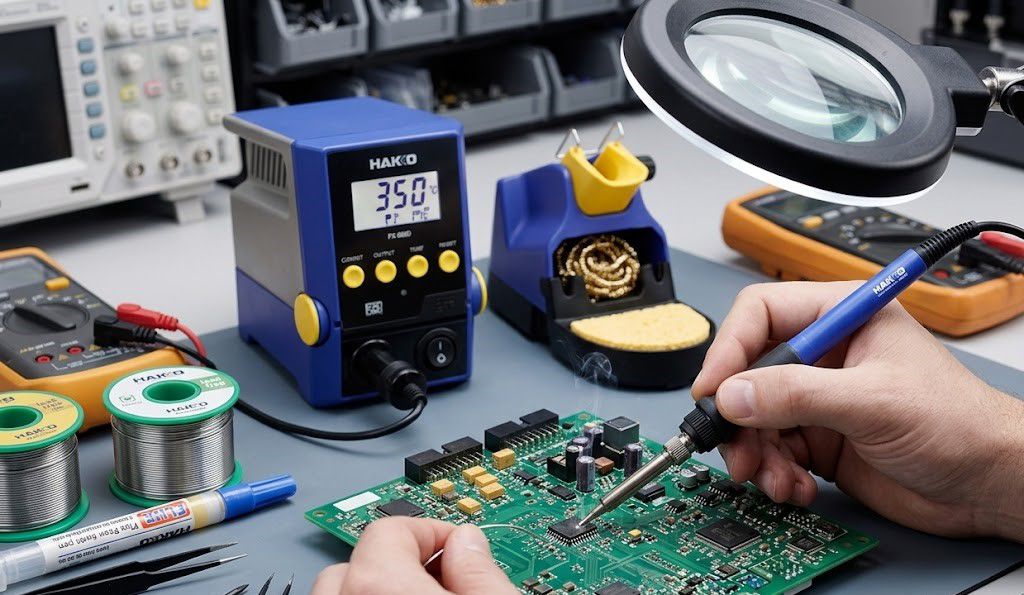
Main unit specifications are usually checked first, but the tip is what directly contacts the solder joint during every single operation. Electrical cabinets generally require tips with larger contact areas to transfer heat to wires, lugs, or heavy metal masses faster. Electronic boards, conversely, require small, fine tips or specialized geometry to avoid bridging neighboring pads.
Furthermore, a single job may require several tip profiles. A board repair technician might use a micro-tip for IC pins, switch to a wider chisel tip for drag soldering, and change to another shape for larger connection points.
Thus, when choosing a soldering station, inspect the compatible tip ecosystem rather than just looking at the base unit. The HAKKO FX-951, for example, utilizes the T15/T12 tip system (depending on the market) and supports various handpieces, whereas the JBC CD-2BQF uses the T245 handpiece alongside C245 cartridges.
Maintenance departments need portability; electronic repair benches prioritize compact organization
Maintenance technicians are not always seated at a dedicated workbench.
Some days require bringing the soldering station over to a control cabinet; other days involve on-site fixes along a production line. An overly heavy main unit, a short cord, or a bulky setup quickly becomes frustrating after a few days of use—even if the technical specs on paper look impressive.
By contrast, a mobile phone repair bench is often filled with microscopes, DC power supplies, hot air rework stations, solder feeders, and various small tools side by side. Desk space becomes a very practical factor. A compact station, lightweight handpiece, and well-routed cabling help technicians work comfortably through long shifts.
The FX-951 unit weighs around 1.2 kg with dimensions of 80 × 130 × 131 mm; the JBC CD-2BQF controller weighs approximately 2.74 kg and measures 170 × 176 × 145 mm. These figures clearly reflect two designs tailored for distinct operational styles.
Further reading:
Smoke and Burning Smell When Turning On a New Soldering Station: Normal or Cause for Concern?
Quick Fix for Solder Not Melting? How to Handle It
Occasional daily soldering vs. full-shift continuous work call for different machines
A technician who only handles occasional joints for cabinet repair has very different needs from a repair desk processing dozens of circuit boards every day.
The higher the operational intensity, the more factors like thermal recovery speed, tip lifespan, consumable replacement availability, and multi-hour stability should be factored into the overall cost. A cheaper upfront purchase isn't necessarily economical if tips degrade rapidly or if technicians waste time waiting for heat recovery.
Conversely, a repair station that only solders a few points occasionally doesn't necessarily need a high-power station packed with advanced features.
Selecting the right soldering station does not start with "How many Watts is it?". It begins by asking what the user will solder, where, and at what frequency.
Can a single soldering station be used for both electrical cabinets and board repairs?
Yes, particularly in technical departments with moderate usage frequency and tasks that don't lean heavily toward either extreme. However, if one user frequently solders heavy wires, lugs, or large metal parts while the other handles high-density boards, differences in thermal recovery speed, tip size, and maneuverability will become noticeable very quickly.
Are high-power soldering stations always better?
No. High power gives the station additional thermal compensation under heavy thermal loads, but it does not automatically make it suitable for every task. Small electronic circuit boards still require an appropriately sized tip and controlled heat levels to prevent heat transfer to surrounding areas.
Is the HAKKO FX-951 suitable for electronic repair benches?
The FX-951 features 75 W of power, a 200-450°C range, a compact footprint, and thermal recovery capability positioned by HAKKO for lead-free soldering. However, this model is discontinued, and HAKKO explicitly designates the FX-971 as its replacement; businesses should verify supply and spare parts availability prior to new purchases.
Which applications is the JBC CD-2BQF best suited for?
The CD-2BQF offers a nominal power of 175 W, peak tool power of 130 W, a temperature range of 90–450°C, and idle temperature stability of ±1.5°C. This setup is better suited for tasks demanding high thermal recovery, especially when the tip faces heavy thermal load solder joints.
If you are purchasing a soldering station for a maintenance department, share your joint types, wire/lug sizes, and usage frequency with EMIN. For electronic repair benches, provide the board types, component dimensions, and current tip styles you use. This information allows consulting to jump straight to the necessary configuration, rather than starting with a long spec sheet.