ASTM D412 tensile strength testing is used to evaluate the tensile behavior of vulcanized rubber and thermoplastic elastomers. These materials appear in a wide range of products, from rubber components to consumer goods, so a consistent approach to tensile evaluation can support quality control, incoming inspection, material development, and mechanical research.
The test applies a controlled tensile load to a prepared specimen until rupture. The resulting data helps a laboratory understand how a material responds while it is stretched and, for certain measurements, how it behaves after the load is removed. A universal testing machine is the central piece of equipment for this work.
What ASTM D412 tensile strength testing evaluates
The source procedure describes ASTM D412 as a method for determining tensile properties of vulcanized thermoset rubber and thermoplastic elastomers. Rather than relying on a single result, laboratories may assess several related properties to create a more complete view of material behavior.
- Tensile strength: The maximum tensile stress reached as a specimen is stretched to rupture.
- Tensile stress at a given elongation: The stress required to extend the uniform cross-section of a specimen to a specified elongation.
- Ultimate elongation: The elongation at which the specimen ruptures under continued tensile stress.
- Tensile set: The extension that remains after a specimen has been stretched and allowed to retract in a specified way, expressed as a percentage of its original length.
Each result answers a different question. Tensile strength focuses on the highest stress reached before failure, while ultimate elongation indicates how far the material stretched at rupture. Tensile stress at a chosen elongation can be useful when comparing behavior at a particular extension. Tensile set addresses retained extension after recovery conditions are applied.
Basic test workflow
A reliable ASTM D412 tensile strength testing workflow starts with suitable specimen preparation and a clear test plan. The specimen should be measured and mounted in the test fixtures so that the machine can apply tension through the intended test section. Test records should identify the material, specimen form, dimensions, and the selected measurements.
The source material states that testing is conducted on a universal testing machine at a rate of 500 ± 50 mm/min until the specimen fails. During the run, the machine applies tensile strain and records the force and displacement information needed to calculate the selected tensile properties. The laboratory should use the applicable procedure to determine specimen details, conditioning, calculations, and reporting requirements for its specific work.
After rupture, results should be reviewed alongside the observation of the specimen and the defined acceptance or comparison criteria. For tensile-set work, the recovery sequence is also important because the reported value concerns extension remaining after retraction under the specified conditions.
Using a universal testing machine
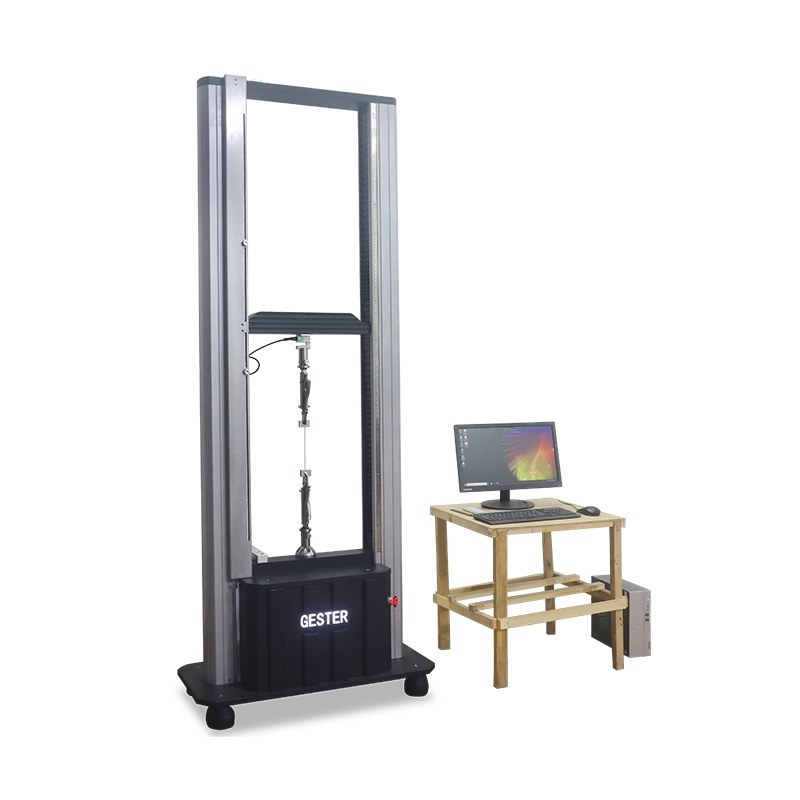
A universal testing machine can support more than tensile testing. The GESTER GT-K01 is described as a dual-column universal testing machine for footwear and material applications. Its stated uses include tensile, compression, bending, shearing, bonding-strength, peeling, and tearing tests across materials such as rubber, plastic, leather, metal, fabric, paper, and packaging materials.
For tensile work, machine configuration should match the specimen and test objective. This includes selecting appropriate fixtures, establishing the required travel and speed settings, and confirming that the test space accommodates the setup. The source lists a standard test width of 400 mm and plate travel space of 1200 mm, excluding fixtures. It also lists a speed-control range of 0.001–500 mm/min, with 0.001–1000 mm/min presented as an option.
Controls and data handling
The GT-K01 source description includes a servo motor and servo driver system, ball screw, pulse-command control, and RS232 data transmission. It also describes constant-speed, positioning, constant-power, constant-stroke, and multi-level control modes. Such functions can help operators configure a test method around the required movement and control conditions.
The equipment description also notes automatic return and data saving after testing, along with overload emergency stop, upper and lower stroke limits, automatic power cutoff for leakage, and automatic breakpoint stopping. Before beginning routine work, operators should verify the machine condition, fixture security, safety functions, and the test method settings required for the material being evaluated.
Interpreting results for quality decisions
ASTM D412 tensile strength testing provides data that can be compared across material batches, product-development samples, or defined internal requirements. Meaningful comparisons depend on keeping specimen preparation, test conditions, calculations, and reporting conventions consistent. A change in tensile strength, elongation, or tensile set may signal a difference worth investigating, but the result should be interpreted within the established material specification and test plan.
By pairing a documented method with a suitable universal testing machine, laboratories can organize tensile evaluation around repeatable measurements and clear reporting. This creates a practical basis for assessing rubber and thermoplastic elastomer behavior under tensile strain.