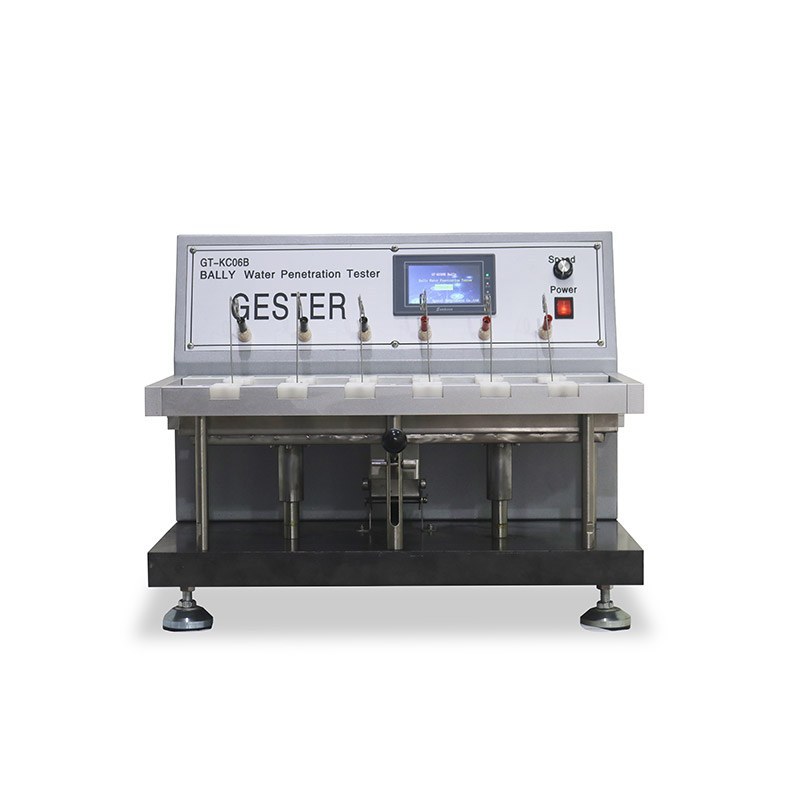
The BALLY Water Penetration Tester GT-KC06 is used to evaluate how flexible footwear upper materials resist water penetration while being repeatedly flexed. This type of assessment is relevant to leather, synthetic leather, cloth, and similar sheet materials used in shoe uppers. Rather than examining a material only in a static condition, the test combines water exposure with repeated movement.
For quality-control teams, the test can help compare materials, review the effect of waterproof processing, and identify specimens that leak during a defined flexing sequence. Results should be considered alongside the material specification and the laboratory’s established test procedure.
What the BALLY Water Penetration Tester GT-KC06 evaluates
Water resistance and breathability are important considerations when assessing leather and other upper materials. The BALLY method focuses on water penetration during flexing. A rectangular specimen is shaped around two cylindrical clamps, creating a trough-like form. The specimen is immersed in water while the clamps oscillate at a constant speed, repeatedly flexing the material.
During the test, the laboratory can record the time required for water to penetrate the specimen. The method may also be used to measure water absorbed by and transmitted through the test material. These observations provide a practical indication of how the material performs under combined flexing and wet exposure.
Test specimen and movement preparation
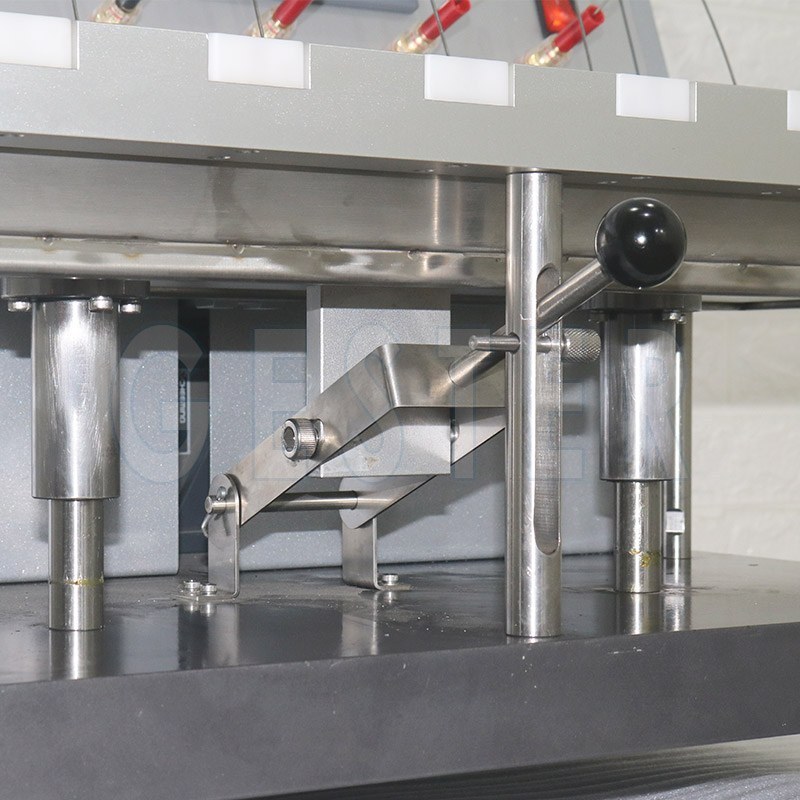
Careful setup is essential because the specimen position, movement stroke, and water level affect the consistency of the test. The source procedure describes movement-stroke settings of 15%, 10%, 7.5%, or 5%. The eccentric setting should correspond to the selected percentage of the available holes.
The stated specimen size is 75 x 60 mm. The 60 mm side is positioned in the 15% compression direction, while the 75 mm side is the clamping direction for the U-shaped fixture. Before installing the specimen, the distance between the two fixtures is moved to its maximum stated position of 40 mm and aligned with the red reference line.
Water bath and detection setup
After the sample is secured, insert the electrode and add the conductive copper spring specified in the procedure as 17 g. Raise the sink containing water and use the pin to fix its position. The water should reach the water-level mark on the fixture. Maintaining this reference level helps keep the wetting condition consistent from one sample to another.
Before beginning a new run, clear the displayed values with the controls labeled [Zero Ch] and [Zero Total]. Select the stations to be used: a station set to [ON] is available for operation, while a station set to [OFF] does not run. The procedure refers to four station displays during operation.
Running the BALLY water penetration test
Set the intended stop condition in the [Stop Mode] interface, then press Start to begin the test. During operation, [SPD] displays speed. The controls also distinguish between [PV], the set number of flexing cycles, and [CV], the actual cycle count.
The equipment stops when the selected number of cycles has been reached. It can also stop if a specimen leaks before reaching that number. In the example described by the source, a channel such as [CH.4] stopping its count indicates that the corresponding specimen has leaked. Operators should document the applicable channel, cycle status, and observed penetration result according to their laboratory records.
Interpreting results for material comparison
A longer time or higher cycle count before penetration may indicate better resistance under the particular test conditions used. However, comparisons are most meaningful when specimens have the same preparation, orientation, stroke setting, water level, and stop criteria. Differences in leather structure, coating, seams, thickness, or finishing can influence the outcome.
The BALLY Water Penetration Tester GT-KC06 is therefore useful as part of a controlled material-evaluation workflow. It supports repeatable observation of leakage during flexing, but it does not replace a broader assessment of the finished footwear design or every condition the product may encounter in use.
Related water penetration test approaches
Other methods may be selected depending on the product being assessed. A Maeser Water Penetration Tester is described for determining resistance to water penetration during flexing in leather, artificial leather, fabric, and other flexible sheet materials. It is mainly applicable to footwear upper outer materials, while also being suitable for other flexible sheets.
For finished footwear, the Footwear Water Penetration & Flexing Tester GT-KA02 is identified as an option for testing the dynamic waterproof performance of different types of finished shoes. Selecting between material-level and finished-shoe testing should follow the item being evaluated and the objective of the quality inspection.