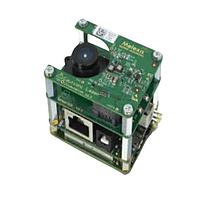
Open Frame Distance Sensor Modules
When a design needs reliable distance measurement without adding a fully enclosed sensing package, Open Frame Distance Sensor Modules offer a practical path for prototyping, embedded development, and system integration. These modules are often chosen in robotics, smart devices, industrial sensing, and lab projects where developers want direct access to the sensing hardware, flexible mounting, and straightforward electrical integration.
Compared with sealed assemblies, open-frame formats are especially useful when space, cost, or customization matters. They can support proof-of-concept builds, compact electronics, and application-specific housings while still giving engineers a ready-to-use sensing platform.

Where open-frame distance modules fit in embedded sensing
In many embedded systems, distance measurement is not a standalone function. It may support obstacle detection, presence sensing, level monitoring, positioning, or user interaction. An open-frame module makes it easier to integrate this capability into a custom product, especially when the mechanical enclosure is still being developed or when the sensor must be aligned to a specific optical or acoustic path.
This category is relevant for engineers looking for modules that bridge the gap between raw sensing components and finished industrial sensor heads. If your project needs a more chip-level approach for deeper integration, it may also be worth exploring distance sensor ICs and embedded modules as part of the overall design path.
Why choose an open-frame format
The main advantage of an open-frame design is integration flexibility. Developers can place the module into a custom mechanical assembly, tune the surrounding structure to the application, and evaluate sensor behavior before committing to a final housing. This is particularly helpful in early-stage product development, academic research, and low-volume specialized equipment.
Open-frame modules can also simplify testing and diagnostics. Because the sensing elements and interface are more accessible, teams can validate alignment, wiring, and signal behavior more easily during development. In some projects, this saves time when compared with reverse-engineering behavior from a sealed sensor body.
Common sensing approaches in this category
Distance sensing can be implemented with different physical principles, and the right choice depends on target material, range, ambient conditions, and required response time. In this category, you may encounter modules intended for ultrasonic or optical measurement workflows, each with its own strengths in embedded applications.
For example, the SparkFun SEN-17777 Qwiic Ultrasonic Distance Sensor - HC-SR04 illustrates a compact module approach for general distance measurement tasks. Ultrasonic sensing is often considered for straightforward object detection and short- to mid-range measurement where simple integration is important. By contrast, evaluation-oriented platforms such as the Melexis EVK75026-110-940-2 are more aligned with developers assessing sensing technology and field-of-view behavior in a controlled design process.
Representative products and development use cases
Some products in this category are aimed at rapid prototyping, while others are better suited to engineering evaluation. The SparkFun SEN-17777 module, for instance, is useful when teams need a compact board-level sensor with accessible integration into low-voltage embedded environments. Its stated sensing range and 3.3 V operation make it relevant for many microcontroller-based builds and educational or experimental platforms.
The Melexis EVK75026-110-940-2, on the other hand, is positioned as an evaluation kit. That makes it more suitable for engineers who need to assess sensor behavior, optical characteristics, or application feasibility before selecting a final architecture. These two examples show how the category can support both fast implementation and deeper technology validation.
How to select the right module
Selection usually starts with the measurement scenario. Consider the required sensing distance, the size and surface properties of the target, available supply voltage, and the mechanical constraints of the end product. Open-frame modules can be attractive for custom assemblies, but they also require careful thinking about mounting stability, exposure to dust or impact, and the final enclosure design.
It is also important to review how the module will connect to the rest of the system. Board form factor, interface convenience, development ecosystem, and evaluation workflow all matter. If your project involves multiple sensing functions, it can be useful to compare related module families such as temperature sensor modules or acceleration sensor modules to build a more complete embedded sensing architecture.
Mechanical and environmental considerations
Because these are open-frame devices, mechanical integration has a direct effect on performance and reliability. The sensor should be mounted in a way that preserves alignment and avoids unwanted obstruction, vibration, or reflections. For optical designs, housing geometry and window materials can influence measurement quality. For ultrasonic designs, the surrounding structure can affect acoustic behavior.
Environmental exposure should also be considered early. If the final application involves moisture, dust, frequent handling, or demanding industrial conditions, an open-frame board may be best suited for development or for installation inside a protective assembly. In those cases, users comparing packaging strategies may also want to review enclosed distance sensor modules for applications that benefit from more integrated protection.
Typical applications across industries
Open-frame distance modules are used in a wide variety of embedded and OEM contexts. Typical examples include object detection in compact machines, proximity-based user interaction, robotic navigation experiments, bin or level sensing, and custom electronic products that need distance awareness without a large sensor housing.
They are also useful in engineering labs and pilot projects where teams want to test placement, field-of-view, and response characteristics before moving to production hardware. In that sense, this category supports both practical deployment and early-stage system learning.
Choosing with long-term integration in mind
A good module choice is not only about range or interface; it is also about how smoothly the sensor will transition from evaluation to product integration. Teams should think about power requirements, mechanical fit, software compatibility, and whether the module is intended primarily for prototyping or for incorporation into a more mature design.
Open-frame distance sensor modules are especially valuable when you need visibility into the sensing hardware and room to adapt the mechanics around it. By comparing development-oriented options from suppliers such as SparkFun and Melexis, engineers can narrow the field based on real integration priorities rather than on specifications alone.
For buyers and developers working on embedded sensing projects, this category is a useful starting point for evaluating board-level distance measurement solutions. The best choice will depend on your target environment, integration constraints, and whether the priority is fast prototyping, technology evaluation, or preparing for a custom end-product design.
Get exclusive volume discounts, bulk pricing updates, and new product alerts delivered directly to your inbox.
By subscribing, you agree to our Terms of Service and Privacy Policy.
Direct access to our certified experts