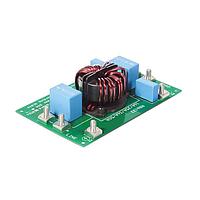
Active Filter Development Tools
When you need to validate cutoff behavior, noise performance, or signal conditioning before committing a design to production, having the right development platform can save significant time. Active Filter Development Tools help engineers evaluate analog filter topologies, programmable filter ICs, and related signal-path building blocks under realistic conditions, from low-frequency conditioning circuits to RF and microwave filtering applications.
On this page, you can explore evaluation boards, kits, and demonstration platforms used to test filter response, compare implementation approaches, and shorten prototyping cycles. These tools are especially useful in lab environments where designers need to verify bandwidth, insertion behavior, power requirements, and integration with the rest of the analog front end.
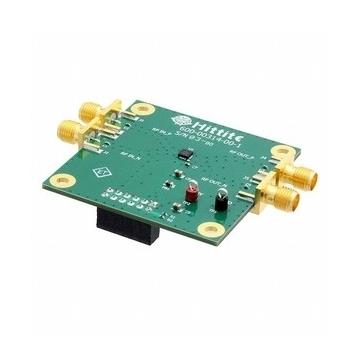
Where active filter development tools fit in the design process
In practical product development, filter circuits are rarely isolated. They are part of a broader signal chain that may include amplification, data acquisition, RF stages, clocking, or audio processing. Development tools in this category provide a controlled way to evaluate how a filter behaves before it is embedded into a more complex board or subsystem.
For engineering teams working across multiple analog functions, it can also be useful to review related platforms such as amplifier IC development tools when filter stages must interact closely with gain blocks or operational amplifiers. This broader view often helps when optimizing stability, noise, and overall signal integrity.
Typical use cases for filter evaluation boards and kits
These tools are commonly used during proof-of-concept testing, performance characterization, and circuit tuning. In lower-frequency applications, engineers may evaluate active filter stages for conditioning sensor outputs, anti-aliasing, or shaping analog signals before conversion. In higher-frequency designs, programmable and tunable filters can help verify channel selection, harmonic suppression, or band-limiting behavior in communication and instrumentation systems.
Some platforms in this category address high-pass, low-pass, or diplexer-related evaluation, while others support digitally tunable architectures. That makes the category relevant to a wide range of projects, from precision analog interfaces to RF front-end development.
Examples of development tools available in this category
Analog Devices is strongly represented in this category with evaluation hardware covering several filter approaches. For example, the ADMV8818-EVALZ board supports evaluation of a digitally tunable high-pass and low-pass filter across a wide GHz-range, making it suitable for engineers working on frequency-agile RF signal chains. The EVAL01-HMC1044LP3E board is another example for programmable harmonic low-pass filter evaluation in the 1 GHz to 3 GHz range.
For lower-frequency analog design, the MAX274EVKIT-DIP+ provides a way to evaluate a continuous-time active filter implementation, while the DC104B-D demonstration board is aimed at testing a low-power 8th-order filter device. Designers exploring modular filter stages may also find daughter boards such as EVAL-FW-HPSK2 and EVAL-FW-HPMFB2 useful when comparing circuit techniques for high-pass filter development.
Beyond Analog Devices, the category also includes application-specific options such as the Texas Instruments TPSF12C1EVM-FILTER for active EMI filter evaluation and the Schurter 3-109-440 board for assessing compensated high-current choke related behavior in filtering contexts. These examples show that the category is not limited to one frequency band or one design style.
How to choose the right active filter development tool
The most important starting point is the intended frequency range. A board designed for kHz-level continuous-time filtering serves a very different purpose from a tunable RF filter evaluation kit operating in the multi-GHz domain. Before choosing a platform, define whether your task involves signal conditioning, anti-aliasing, EMI mitigation, or RF channel filtering.
It is also helpful to check the target device, supply voltage, and the style of evaluation the board supports. Some kits are built to demonstrate a specific IC, while others are better suited for topology exploration or modular experimentation. If your design depends on digital control, frequency agility, or rapid lab retuning, a programmable or tunable evaluation board may be the better fit than a fixed analog stage.
Another factor is how the filter will interact with the rest of the system. If the project eventually feeds an ADC, reviewing data conversion IC development tools alongside filter evaluation hardware can help align front-end bandwidth and sampling requirements more effectively.
Comparing active, programmable, and modular filter approaches
Not every development board in this category supports the same design goal. Traditional active filter kits are often used to study transfer functions, filter order, and analog implementation details in op-amp-based circuits. These are valuable when the design requires predictable analog behavior and direct control over topology choices.
Programmable and digitally tunable boards are better aligned with systems that need adjustable passbands or reconfigurable signal paths. Devices such as ADMV8818-EVALZ or EKIT01-HMC1023LP5 illustrate how engineers can assess filter performance over changing frequency requirements without redesigning the entire circuit. That flexibility is especially useful in advanced communications, test equipment, and adaptive platforms.
Modular daughter boards, on the other hand, support bench-level experimentation with particular stages or filter methods. They can be a practical option for engineering teams that want to compare implementation techniques before moving into a custom board layout.
Working within a broader analog and mixed-signal ecosystem
Filter development rarely happens in isolation. In many lab workflows, the same team may also evaluate amplifiers, converters, timing devices, and audio-related signal paths. If your application includes waveform shaping or analog front-end verification, related categories such as audio IC development tools may also provide useful context for system-level testing.
This is one reason category-level browsing matters in B2B engineering procurement. Instead of selecting a board based only on a part number, engineers can compare platforms by application intent, target function, and integration path. That approach generally leads to faster shortlist building and fewer mismatches during prototyping.
What engineers usually look for before ordering
For most buyers, the key questions are straightforward: what device the board is designed to evaluate, what operating range it supports, and whether it matches the intended lab setup. Frequency coverage, supply conditions, and evaluation purpose are often more relevant than a long feature list, especially when the goal is to validate a concept quickly.
It is also worth considering whether the board is intended as a full evaluation kit, a demonstration board, or an add-on daughter board. Those formats support different workflows. A complete kit may be better for fast standalone testing, while daughter boards can be more suitable when working within an established platform or reusable motherboard environment.
For teams building a broader bench around timing-sensitive analog circuits, a quick comparison with clock and timer development tools can also help when synchronization and signal conditioning must be validated together.
Final considerations
Choosing from the available active filter development platforms becomes much easier once the application, frequency range, and evaluation method are clearly defined. Whether you are testing a continuous-time active filter, a GHz-range programmable solution, a high-pass daughter board, or an EMI-focused evaluation module, the right tool can make early-stage verification more efficient and more reliable.
This category brings together practical options for engineers who need to characterize filtering behavior before committing to final hardware. By focusing on the target device, signal path requirements, and system context, you can narrow the selection to development tools that support faster prototyping and better-informed design decisions.
Get exclusive volume discounts, bulk pricing updates, and new product alerts delivered directly to your inbox.
By subscribing, you agree to our Terms of Service and Privacy Policy.
Direct access to our certified experts