Cellular Development Tools
Bringing a cellular design from concept to field test usually takes more than a modem alone. Engineers often need a practical way to evaluate network connectivity, verify interfaces, test firmware behavior, and understand how a radio platform fits into the rest of an embedded system. That is where Cellular Development Tools become especially useful for prototyping, validation, and early-stage design work.
Within this category, you will find evaluation kits, breakout boards, demo boards, and expansion boards that support a range of cellular and wireless development tasks. These tools help shorten setup time when working with LTE, 4G, GSM, or LTE Cat-M1 platforms, while also making it easier to assess UART, USB, I2C, or board-level integration before moving to production hardware.
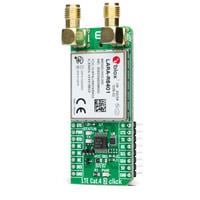
Designed for embedded connectivity evaluation
Development tools in this category are intended to help engineers explore how a cellular module, RF front end, or evaluation platform behaves in real use. In practice, that can include checking network registration, measuring communication stability, validating host interfaces, or confirming that a device can support the intended deployment environment.
Depending on the project, the right platform may be a compact breakout board for fast bench testing or a more complete evaluation kit for broader system validation. If your design also involves other wireless standards, it can be helpful to compare options alongside multiprotocol development tools when planning a mixed-connectivity architecture.
Common formats in this category
Not every project requires the same kind of hardware. Evaluation kits are often chosen when developers need a fuller environment for testing module behavior, interface access, and software bring-up. Expansion boards and adapter boards are more suitable when a base processor or host platform is already defined and the goal is to add cellular capability quickly.
Breakout boards are especially useful for early proof-of-concept work because they expose essential connections in a compact format. Demo boards, on the other hand, can be a practical starting point for focused RF or transmitter evaluation where the design task is narrower and speed matters more than system completeness.
Examples of development platforms available
Several products in this category illustrate the range of use cases. For LTE-based embedded development, the Sony Spresense CXD5602PWBLM1NA LTE board provides an expansion option for Spresense-based designs, while the Renesas Electronics RYZ014A-NA-EVK supports evaluation of a Cat-M1 module using UART and USB connectivity. These kinds of tools are often selected for low-power IoT and connected edge applications where module-level testing is a key early step.
For broader 4G module evaluation, Sierra Wireless platforms such as the 6001173 kit for EM series devices and the 6000648 kit for MC series modules give developers a way to assess module integration and data interface behavior. In more application-oriented deployments, the Advantech WSKIT4BLTE-VZ kit is relevant for LTE-focused development where system-level wireless connectivity is part of a larger industrial or remote monitoring concept.
Sub-GHz and adjacent wireless evaluation use cases
Although this category centers on cellular development, some listed tools also support related wireless evaluation workflows that matter during product development. For example, Microchip Technology boards such as the ATAB5750-8, ATAB5750-9, and ATAB8401 are useful for reviewing Sub-GHz or RF transmitter behavior in development environments where short-range wireless and cellular may coexist in the same solution.
The Analog Devices MAX7036EVKIT-315+ is another example of a radio evaluation platform that can support ASK receiver assessment in relevant RF design work. Where antenna matching, range, or RF path performance is part of the design effort, it is often worth reviewing available antenna development tools at the same time rather than evaluating the radio section in isolation.
How to choose the right cellular development tool
A good starting point is the target cellular protocol. Some projects are centered on LTE or 4G data connectivity, while others are focused on LTE Cat-M1 for lower power IoT deployments or GSM-based communication for legacy or region-specific requirements. Matching the development board to the intended network technology helps avoid unnecessary redesign later in the project.
Next, look at the host-side interface and mechanical integration path. UART is common for embedded controller integration, USB is useful for rapid PC-based testing, and expansion or PMOD-style adapter boards can simplify evaluation when a processor platform already exists. Power requirements, board size, and the level of software support you need should also be considered before selecting a kit.
Brand preference may also matter if your team already works within a known ecosystem. Platforms from Microchip Technology, Renesas Electronics, Sierra Wireless, Sony Spresense, and Advantech each fit different evaluation styles, from module validation to more complete application-level prototyping.
Typical application areas
These tools are commonly used in connected sensors, industrial gateways, telematics, asset monitoring, remote data logging, and proof-of-concept IoT systems. In those environments, developers need to confirm both communication performance and practical integration details such as command handling, power behavior, and peripheral compatibility.
They can also support migration planning when a design must move from a lab setup to a deployable embedded product. If location awareness is also part of the system, browsing GNSS/GPS development tools may help complete the evaluation stack for tracking, fleet, or mobile asset applications.
What matters during evaluation
When comparing options, it is useful to focus on the practical questions your team needs to answer. Can the platform expose the interfaces required by your host processor? Does it support the network technology and regional approach your application expects? Is it intended for quick module assessment, or for deeper firmware and hardware development?
Development efficiency often depends on choosing a board that matches the stage of the project. A simple breakout may be ideal for a fast proof of concept, while a richer kit is more appropriate when validating end-to-end communication, firmware workflows, and integration constraints. Selecting the right tool early can reduce rework and make later design decisions more straightforward.
Supporting a smoother path to deployment
This category brings together hardware that helps engineers evaluate cellular connectivity in a more structured and practical way. From compact breakout boards to module-specific evaluation kits and expansion hardware, these tools support the transition from idea to testable embedded design with less friction.
If you are narrowing down options, start with the network type, required interfaces, and the role the board will play in your workflow. That approach makes it easier to identify a development platform that fits your project scope today while still supporting the next step toward a production-ready wireless design.
Get exclusive volume discounts, bulk pricing updates, and new product alerts delivered directly to your inbox.
By subscribing, you agree to our Terms of Service and Privacy Policy.
Direct access to our certified experts