Touch Sensor Development Tools
When teams move from a touch interface concept to a working prototype, the quality of the development platform matters almost as much as the sensor itself. Evaluation kits and development boards help engineers validate sensitivity, user interaction, interface compatibility, and controller behavior before committing to a final hardware design. That makes Touch Sensor Development Tools especially useful in HMI projects, consumer electronics, appliances, industrial panels, and embedded control systems.
This category brings together platforms designed to evaluate capacitive, touchscreen, and related touch-sensing solutions. Instead of relying on datasheets alone, developers can use these tools to test response, communication methods, and integration workflows in a more practical way. For design teams comparing sensing approaches across a wider platform, related options such as magnetic sensor development tools may also be relevant in broader interface and detection systems.
Where touch sensor development tools fit in the design process
Touch development hardware is typically used early in product development to reduce uncertainty around sensing performance and controller selection. Engineers can check how a device behaves with different panel structures, firmware settings, noise conditions, and host interfaces before building a custom PCB. This shortens iteration time and helps identify practical limits in a real operating environment.
These tools are also valuable during proof-of-concept work, especially when the project needs fast validation of gestures, button replacement, or touchscreen behavior. In many cases, the development kit becomes the reference point for firmware bring-up, signal tuning, and host communication tests using interfaces such as I2C, SPI, or USB.
Typical tool types in this category
Not every project needs the same type of evaluation platform. Some kits are built around touchscreen controllers intended for larger touch surfaces and richer user interaction, while others focus on simpler capacitive touch buttons or proximity-style sensing. There are also boards intended mainly for controller evaluation, where the goal is to study device behavior and integration requirements rather than to serve as a finished interface module.
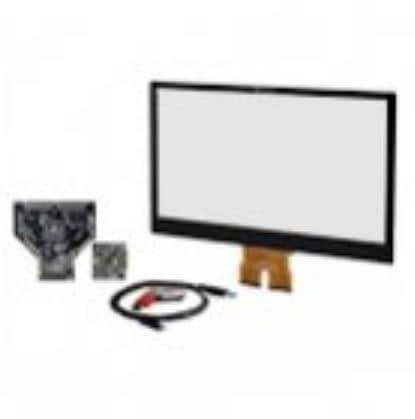
Within this category, that distinction is visible in products such as the Microchip Technology ATEVK-MXT1067TDAT-C Evaluation Kit, the EV49N79A development board for ATMXT1066TD, and the AC160219 kit for AT42QT1010. These examples illustrate different levels of complexity, from single-touch or simpler sensing evaluation up to more advanced touchscreen controller development and tuning.
Representative platforms from leading manufacturers
A significant share of the featured products here come from Microchip Technology, reflecting the breadth of its touch and maXTouch evaluation ecosystem. Kits such as ATEVK-MXT2912TDAT-B, ATEVK-MXT2113TDAT-A, ATEVK-MXT1665TDAT-A, and ATEVK-MXT799TAT-A give developers a practical path to assess controller families aimed at different touch implementations. Boards like ATMXT1067TDAT-SPI-PCB and ATMXT1665TAT-I2C-PCB are also useful when the design task centers on communication, firmware access, and platform-level validation.
This category also includes a different sensing approach through the Texas Instruments LDC2114EVM, an evaluation module for inductive touch sensing. For projects where capacitive sensing is not the only option under consideration, this provides a useful contrast in how interface hardware can be assessed under real design constraints. If your work spans multiple sensing methods, you may also want to review distance sensor development tools for non-contact detection scenarios.
How to choose the right evaluation kit
The first step is to match the tool to the target controller or sensing IC that your design team plans to evaluate. In this category, many products are clearly linked to a specific device, such as MTCH2120, ATMXT1066TD, ATMXT2912TD, or LDC2114. If the development objective is highly device-specific, a dedicated evaluation kit is usually the safest choice because it aligns more closely with the intended firmware flow and electrical behavior.
Next, consider the required communication interface and development workflow. Some boards support SPI, while others are built around I2C or USB-based connectivity. Interface selection affects how quickly the platform can be connected to a host MCU, test PC, or embedded application. This is particularly important when the goal is not only to evaluate sensing quality but also to confirm software integration and system architecture.
Finally, think about the intended user interface. A project involving a touchscreen panel, gesture input, or multi-point interaction may require a different class of board than a simple button replacement design. For more general embedded sensing comparisons, teams sometimes evaluate neighboring categories such as multiple function sensor development tools to understand whether a combined sensing platform could simplify the system.
Common application areas
Touch evaluation platforms are used across a broad range of industries. In industrial equipment, they support the development of operator panels, sealed input surfaces, and modern replacements for mechanical buttons. In appliances and consumer products, they help teams fine-tune responsiveness, improve industrial design flexibility, and reduce moving parts in the user interface.
They are also relevant in medical devices, access control products, retail terminals, and smart building systems where reliable input detection is important. Depending on the project, touch sensing may be used alone or alongside other sensing modalities. In embedded prototyping environments, developers often compare touch with alternatives from suppliers such as Texas Instruments when assessing broader signal-processing and interface options.
What engineers typically evaluate on these boards
Using a development tool is not only about confirming that a sensor responds to touch. Engineering teams often evaluate baseline stability, immunity to electrical noise, tuning flexibility, latency, and host-side communication. For touchscreen-related solutions, they may also examine controller behavior across different panel conditions, overlay materials, and mechanical layouts.
Products in this category support that kind of hands-on validation. For example, the EV64Z42A evaluation kit provides a path to assess MTCH2120 with I2C and USB Type-C connectivity, while kits built around ATMXT families help explore controller-specific implementation paths. This practical evaluation phase is often where teams decide whether a selected controller can move forward into a custom board design.
Supporting faster prototyping and better design decisions
One of the main advantages of using purpose-built touch development hardware is faster learning with lower risk. Instead of creating a custom test platform from scratch, engineers can begin with a known reference design and focus on the variables that matter most to the final product. That may include interface architecture, touch behavior, environmental robustness, or software integration effort.
For procurement teams, these tools also make the early design stage easier to support because they provide a more structured path from evaluation to component selection. Whether the requirement is a simple capacitive input experiment or a more advanced touchscreen controller assessment, this category helps narrow the gap between concept testing and production-oriented engineering.
Choosing the right platform depends on the sensing method, target controller, interface requirements, and the level of interaction your application needs. By comparing the available touch evaluation kits and development boards in context, design teams can move forward with clearer technical direction and a more confident prototype plan.
Get exclusive volume discounts, bulk pricing updates, and new product alerts delivered directly to your inbox.
By subscribing, you agree to our Terms of Service and Privacy Policy.
Direct access to our certified experts