Coin Cell Battery Holders
Reliable backup power often depends on a small mechanical component that is easy to overlook. In embedded electronics, metering devices, medical instruments, security products, and portable controls, the quality of the battery connection can directly affect service life, vibration resistance, and ease of assembly. That is why selecting the right Coin Cell Battery Holders matters just as much as choosing the battery itself.
This category brings together board-mount and panel-oriented holder options for common coin cell formats used in compact electronic designs. Whether the priority is low-profile SMT assembly, through-hole retention, support for different cell diameters, or a secure fit for replaceable batteries, the right holder helps simplify integration while maintaining dependable electrical contact over time.
Where coin cell battery holders are used
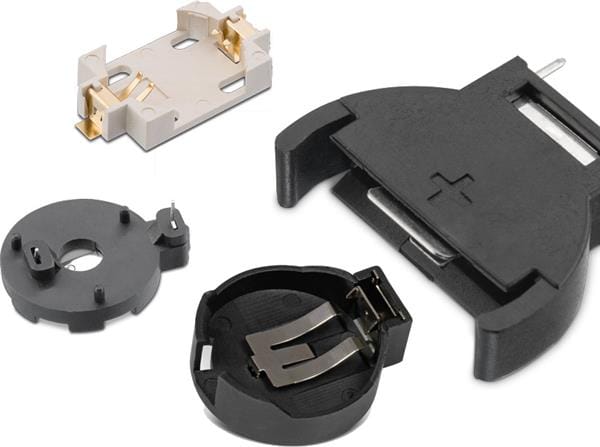
Coin cell holders are commonly designed into products that need compact, low-current power sources for memory retention, real-time clocks, backup circuits, wireless sensors, handheld interfaces, and small control boards. In these applications, the holder needs to do more than just keep the battery in place. It also has to support stable contact pressure, practical battery replacement, and compatibility with the intended assembly process.
Compared with fixed battery tabs or improvised retention methods, a dedicated holder provides a more serviceable and repeatable solution. For engineers and buyers comparing related options, it can also be useful to review battery contacts when a design requires a more customized mechanical arrangement.
Key holder styles in this category
This category covers several common formats, with through-hole and SMD/SMT versions being the most typical. Through-hole holders are often selected when stronger board retention is needed or when the end product may be exposed to handling stress, shock, or frequent battery replacement. SMT holders are preferred in automated assembly lines where low profile and high-volume PCB processing are priorities.
There are also differences in battery capacity and layout. Some holders are built for a single coin cell, while others are designed for dual-cell arrangements. A product such as Keystone Electronics 1092, intended for two CR2032 coin cells, suits designs that need a higher combined voltage from a compact footprint. By contrast, retainers and compact single-cell holders are more suitable for standard memory backup or standby functions.
What to consider when choosing a holder
The first selection factor is battery size compatibility. Coin cells vary by diameter and thickness, so the holder must match the intended battery family. Within this category, examples include holders for CR2450 cells, compact 12 mm cells, and multi-fit options that accommodate several closely related sizes such as 2016, 2020, 2025, and 2032 formats.
Mounting style is the next practical decision. For example, Wurth Elektronik 79523211 is a through-hole option intended for multiple battery types in the 20 mm family, which can help simplify sourcing when a design may use more than one compatible cell thickness. Keystone Electronics 3000TR, on the other hand, represents an SMT approach for smaller coin cell applications where automated placement is important. Material choice, plating, and termination style also play a role in contact reliability, corrosion resistance, and assembly consistency.
Examples from leading manufacturers
Several well-known suppliers are represented in this category, including Keystone Electronics, Wurth Elektronik, Harwin, and Linx Technologies - TE Connectivity. Each brand is commonly associated with battery interconnect components used in PCB-based electronic products, giving buyers a range of options for both prototyping and production sourcing.
Examples in the assortment show the breadth of available configurations. Wurth Elektronik 79578211 is intended for CR2450-type applications, while Harwin S8401-46 addresses a vertical board-mount need for CR2032-related use. Linx Technologies - TE Connectivity BAT-HLD-013-SMT-TR illustrates a surface-mount holder format, and Keystone Electronics 3001 or 3088/3088TR-style retainers support compact coin cell integration where board space and retention method must be balanced carefully.
Mechanical and assembly considerations
In practice, holder selection is often driven by assembly and service requirements rather than battery size alone. If the device will be assembled on a reflow line, SMT packaging and coplanarity become important. If the battery may be replaced in the field, access, insertion direction, and contact durability should be reviewed at the design stage.
Mechanical stability is especially important in portable or vibration-prone equipment. A through-hole holder may provide stronger anchoring, while a low-profile SMT retainer may be better suited to slim products with controlled operating conditions. In some projects, designers may also need complementary parts such as battery enclosures or additional accessories for broader power management and protection.
Beyond coin cells: understanding the wider holder ecosystem
Although this page focuses on coin cell solutions, the broader battery holder landscape includes cylindrical cell holders and other battery-related hardware. For example, Keystone Electronics 1131 is a tray-style holder for 18650 cells, which highlights how retention, contact geometry, and mounting choices vary significantly depending on battery chemistry and product architecture.
This wider perspective can be useful for OEM sourcing teams that manage multiple product families at once. If your application extends beyond coin cells, you may also want to explore other battery accessories for supporting components that complete the power interconnect system.
How to narrow down the right option
A practical way to filter this category is to begin with the required cell type, then move to mounting style, then evaluate holder geometry against the PCB layout and enclosure clearance. After that, review contact material, plating, and whether the design needs one battery or multiple batteries in series. This approach usually reduces selection risk faster than comparing parts by price or footprint alone.
For procurement teams, it also helps to align selection with the intended manufacturing process and service model. A holder that works well in engineering samples may not always be the best fit for automated production, and a compact retainer may not be ideal if end users must replace batteries without tools. Looking at representative parts from Keystone Electronics, Wurth Elektronik, Harwin, and Linx Technologies - TE Connectivity can make those tradeoffs clearer.
Choosing with application fit in mind
The best coin cell holder is usually the one that fits the battery, the board, and the maintenance requirements at the same time. A secure electrical connection, sensible mounting method, and service-friendly mechanical design all contribute to long-term product reliability. That is why this category is most useful when viewed not just as a list of parts, but as a set of design options for compact power retention.
If you are comparing holders for new product development or replacement sourcing, use this category to evaluate fit by battery format, mounting approach, and intended operating environment. With the right selection criteria, coin cell battery holders can support cleaner assembly, easier maintenance, and more dependable low-power performance across many electronic applications.
Get exclusive volume discounts, bulk pricing updates, and new product alerts delivered directly to your inbox.
By subscribing, you agree to our Terms of Service and Privacy Policy.
Direct access to our certified experts