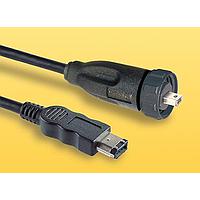
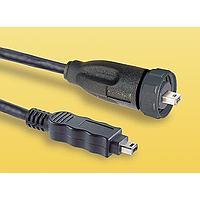
IEEE 1394 Cables
Reliable high-speed device communication often depends on something as simple as choosing the right cable type, connector format, and environmental protection level. For systems that still use FireWire interfaces in industrial equipment, imaging, legacy computing, and specialized instrumentation, IEEE 1394 Cables remain an important part of maintaining stable data transfer and clean system integration.
This category brings together cable assemblies designed for IEEE 1394 and IEEE 1394b connections, with options suited to standard indoor use as well as more demanding industrial environments. Whether you need a straightforward 6-pin to 6-pin cable for equipment interconnects or a sealed version for harsher conditions, selecting the right assembly helps reduce compatibility issues and unnecessary downtime.
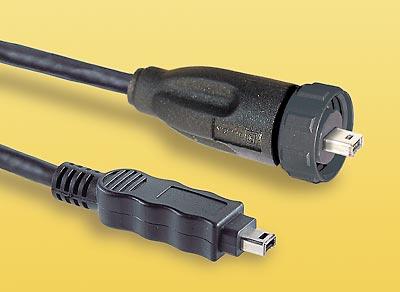
Where IEEE 1394 cables are still used
Although newer interfaces are common in many applications, IEEE 1394 continues to appear in equipment where a proven communication standard must be maintained. This can include machine vision components, industrial PCs, legacy peripherals, data acquisition setups, and specialized control or media systems that were originally designed around FireWire connectivity.
In these cases, cable selection is not only about plugging one device into another. Buyers often need to match connector pin count, supported data format, cable length, and installation environment. That is especially important when replacing an existing assembly in a production line or service environment where interface changes are not practical.
Common connector formats in this category
One of the main differences between products in this range is the connector style at each end. Standard IEEE 1394 cables may use 4-pin or 6-pin formats, while IEEE 1394b versions commonly use 9-pin connectors. Mixed-end assemblies are also available when devices on each side use different interface formats.
For example, the Tripp Lite F005-006 and Tripp Lite F005-015 are typical 6-pin to 6-pin options for standard FireWire connections. Where newer 1394b interfaces are involved, products such as the Tripp Lite F015-010 provide a 9-pin to 9-pin configuration, while the Tripp Lite F019-006 supports a 9-pin to 4-pin connection for mixed-device compatibility.
If you are reviewing alternatives for adjacent data cabling needs, it may also be helpful to compare this range with broader computer cable options or application-specific networking cable assemblies where the communication standard differs.
Standard vs. sealed industrial cable assemblies
Not every IEEE 1394 cable is intended for the same operating environment. In office, lab, or panel-based installations, a standard cable may be sufficient. In industrial settings, however, cables may be exposed to moisture, dust, vibration, washdown procedures, or repeated mechanical handling, making environmental sealing a more important requirement.
This is where manufacturers such as PHOENIX CONTACT and Bulgin are particularly relevant. Models such as PHOENIX CONTACT 1654028, 1655849, 1654167, and 1656712 include IP67-rated construction for more demanding environments. Bulgin PX0417/4M00 and PX0418/4M00 also stand out where sealed connector performance is needed, with the PX0417/4M00 offering IP68 protection and the PX0418/4M00 supporting a 4-pin to 6-pin arrangement.
What to consider when choosing an IEEE 1394 cable
The first step is confirming the exact interface on both devices. A 4-pin, 6-pin, or 9-pin mismatch can prevent connection altogether, so connector identification should be checked before ordering. In retrofit or maintenance work, it is also worth verifying whether the application uses IEEE 1394 or IEEE 1394b, since the physical interface and data handling may differ.
The next factor is cable length. Shorter assemblies may be preferable where signal integrity and compact routing matter, while longer lengths can simplify installation across machine frames or equipment racks. This category includes examples ranging from 2 m sealed industrial cables to 15 ft standard assemblies, giving buyers flexibility based on panel layout and equipment spacing.
Finally, consider the installation environment and cable construction. PVC jackets are common for general-purpose use, while PUR jackets are often selected where better resistance to abrasion or industrial handling is needed. If the cable will be routed in exposed or wet areas, an IP-rated assembly may be the safer choice.
Examples of product types available
This category includes a practical mix of cable assemblies rather than a single fixed format. Standard indoor options from Tripp Lite include 6-pin to 6-pin and 9-pin to 9-pin variants for everyday FireWire and FireWire 800 connections. These are suitable when the main priority is interface compatibility and dependable point-to-point connection between devices.
For more specialized installations, Bulgin and PHOENIX CONTACT provide assemblies with enhanced sealing features. That makes them relevant for equipment builders and maintenance teams working in production areas, mobile systems, or installations where connectors may be exposed to contaminants. The result is a category that supports both legacy device connectivity and tougher industrial deployment requirements.
How this category fits into broader system cabling
IEEE 1394 cables are often only one part of a larger interconnect strategy. A machine or workstation may also require video, network, serial, or peripheral cabling depending on the equipment architecture. Keeping these cable types organized by interface standard makes replacement and specification work more efficient, especially for procurement teams handling mixed technical inventories.
Where equipment uses other connector families for data and control, related categories such as D-Sub cable assemblies can also be relevant. This helps buyers compare interconnect options by application rather than treating every cable as interchangeable.
Why careful selection matters
A cable assembly may seem like a small component, but in practice it affects uptime, fit, and long-term reliability. Choosing the wrong pin configuration can stop installation immediately, while overlooking ingress protection or jacket material can shorten service life in industrial conditions. For that reason, it is worth evaluating not only connector type but also the physical demands of the operating environment.
Within this category, buyers can find both standard and more ruggedized IEEE 1394 solutions from recognized manufacturers, including PHOENIX CONTACT, Tripp Lite, and Bulgin. That makes it easier to source a cable matched to the actual interface, length, and protection level required by the application.
Final thoughts
When maintaining or expanding equipment that still relies on FireWire communication, the right IEEE 1394 cable helps preserve compatibility without unnecessary redesign. By focusing on connector format, cable length, jacket material, and environmental rating, you can narrow the selection to assemblies that fit both the device interface and the installation conditions.
If you are specifying replacements or building out a legacy-compatible system, this category provides a focused range of IEEE 1394 cable assemblies for both standard and industrial use cases.
Get exclusive volume discounts, bulk pricing updates, and new product alerts delivered directly to your inbox.
By subscribing, you agree to our Terms of Service and Privacy Policy.
Direct access to our certified experts