Temperature Meters & Indicators
Clear temperature visibility is essential in production areas, warehouses, clean rooms, laboratories, HVAC monitoring points, and utility systems. When operators need to read values quickly from a distance or connect temperature display to a control loop, the right combination of sensor input, display format, and installation method makes a real difference. This page brings together Temperature Meters & Indicators used for local monitoring, environmental display, and process observation in industrial and technical environments.
Where temperature meters and indicators are typically used
In many facilities, temperature data needs to be visible without opening software dashboards or control cabinets. Large LED indicators and wall-mounted displays are commonly installed where operators, technicians, or visitors must confirm ambient or process conditions at a glance. Typical use cases include manufacturing lines, storage rooms, calibration areas, environmental monitoring points, and building services.
Some applications focus on a single temperature value, while others combine temperature with humidity or even indoor air quality parameters such as CO2. For projects that need broader display and monitoring options, it can also be useful to review related process indicator solutions for more general signal display requirements.
Main product types in this category
This category includes several practical device formats. A common group is the large digital temperature indicator, designed for long-distance readability in workshops, machine rooms, or public-facing monitoring areas. Models such as the skSATO SK-M350-T and SK-M460-T illustrate this approach, using prominent LED digits and Pt100 input for local temperature display.
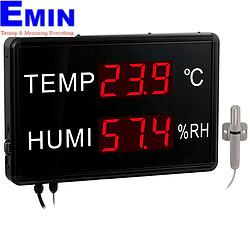
Another important group combines environmental parameters on one screen. Examples include the skSATO SK-M350-TRH, skSATO SK-M460-TRH, and PCE G 2, which display both temperature and humidity for room monitoring. For installations that require a larger feature set, some units also integrate sensor modules, multiple sensor support, or optional alarm behavior.
There are also display-and-control combinations rather than display-only devices. The Emko ECO PID.4.5.2R.S.485 is a good example of a unit that pairs visible temperature indication with controller functionality, making it relevant where the displayed value is part of an active process control setup rather than passive observation alone.
Key selection criteria before buying
The first point to check is measurement task. Some devices are intended for ambient room temperature, while others are built around process sensor inputs such as Pt100. If the application involves ovens, tanks, ducts, chambers, or machinery, verify that the display accepts the appropriate input type and covers the required measuring range.
The second point is viewing distance. Large-character displays are often selected because readings must remain legible across production floors, corridors, or warehouses. Character height, enclosure style, and mounting method all affect usability in real environments, especially where lighting conditions or operator position vary throughout the day.
It is also worth checking whether you need temperature only, or temperature plus humidity, and whether outputs or communication are necessary. In some projects, a simple local readout is enough. In others, analog output, alarm signaling, or integration with wider process metering systems is more suitable.
Examples of devices for different monitoring needs
For straightforward process temperature display, the skSATO SK-M350-T and SK-M460-T are representative options, especially where a visible LED readout and Pt100-based measurement are preferred. Their format is well aligned with local indication tasks in production support areas, technical rooms, and equipment zones.
Where both ambient temperature and relative humidity need to be shown together, the PCE G 2 and PCE G1A provide a more environmental-monitoring-oriented approach. The PCE EMD 5 and PCE EMD 10 series also fit this use case, with large displays and support for temperature and humidity presentation, including versions supplied with an ISO calibration certificate for users who require documented measurement confidence.
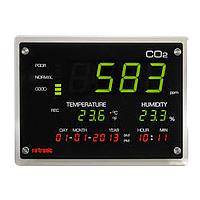
For combined monitoring beyond temperature and humidity, the PCE AC 2000 adds CO2 alongside temperature and humidity on a single display. This makes it relevant for indoor environmental awareness in occupied spaces, meeting rooms, training areas, or controlled workplaces where air condition status needs to be immediately visible.
Manufacturers commonly associated with this category
This category includes products from established names such as Emko, PCE, and skSATO. Each serves slightly different needs within the broader temperature display landscape. Emko is often associated with controller-oriented solutions, while PCE and skSATO are well represented in large-format indication and environmental display applications.
Other manufacturers listed for this category, including OMEGA, Rotronic, Triplett, Comet, ATPRO, EMIN, and Sansel, help define the broader ecosystem around measurement and display solutions. The most suitable brand still depends less on name alone and more on the practical match between sensor input, installation style, readability, and required functions.
How these devices fit into a wider monitoring setup
Temperature indicators are often part of a larger measurement chain rather than stand-alone products. A sensor captures the value, the display makes it visible, and other components may handle alarms, recording, or control logic. In that sense, a local indicator can serve as the operator-facing layer of a broader instrumentation system.
For panel-based installations, users may also compare models in the wider panel meter range when compact integration into cabinets or machine interfaces is more important than wall-mounted long-distance visibility. The best choice depends on whether the priority is remote readability, operator confirmation, environmental monitoring, or process integration.
Practical points to compare on product pages
Before selecting a unit, review the sensor type, measurement range, display size, power supply, and mounting arrangement. These details affect not only performance but also installation time and long-term usability. A technically suitable display that is difficult to mount or hard to read in the actual space may still be the wrong choice.
It is also helpful to confirm whether the device is intended for indoor ambient monitoring or closer-to-process use, and whether calibration documentation is required. Some buyers prioritize a simple visible display, while others need a unit that supports alarms, communication, or multi-parameter indication. Looking at the intended environment first usually narrows the shortlist quickly.
Choosing the right temperature display with confidence
A good temperature indicator should do more than show numbers. It should match the sensor, suit the installation environment, provide readable information at the required distance, and support the way your team actually works. Whether the need is a basic temperature readout, a temperature and humidity display, or a display linked with control functions, this category covers several practical options for industrial and facility monitoring.
Use the available product data to compare input type, visibility, environmental parameters, and installation method. That approach makes it easier to select a device that fits both the technical requirement and the day-to-day reality of your application.
Get exclusive volume discounts, bulk pricing updates, and new product alerts delivered directly to your inbox.
By subscribing, you agree to our Terms of Service and Privacy Policy.
Direct access to our certified experts