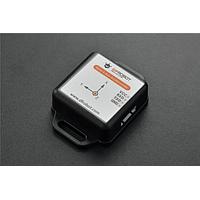
Inertial Measurement Units
Accurate motion data is essential in systems that need to detect orientation, vibration, angular rate, or linear acceleration in real time. In industrial automation, robotics, navigation, stabilization, and embedded control, Inertial Measurement Units help transform physical movement into usable digital signals for monitoring and control.
This category brings together IMU devices for engineers and technical buyers looking for compact motion sensing solutions with integrated accelerometer and gyroscope functions. Depending on the application, selection may focus on sensing range, output interface, resolution, environmental robustness, or the level of onboard processing available in the device.
Where IMUs fit in motion sensing systems
An IMU typically combines multiple sensing elements in one package to measure angular velocity and linear acceleration across several axes. This makes it useful in equipment that must track movement, detect tilt changes, compensate for vibration, or support sensor fusion in dynamic environments.
Compared with using separate sensors, an IMU can simplify board design and reduce integration effort. For applications that only need part of this functionality, related sensor families such as gyroscopes or industrial accelerometers may also be relevant depending on the required measurement approach.
Typical applications for inertial measurement units
IMUs are widely used in industrial and embedded systems where direct position feedback is not always available or where motion must be interpreted at high speed. Common use cases include platform stabilization, machine condition tracking, robotics, mobile equipment, asset motion monitoring, handheld devices, and smart edge products.
They are also valuable in systems that combine motion data with additional sensors for orientation estimation or event detection. In broader sensing architectures, IMUs can complement inclinometers for tilt-focused measurement or work alongside distance sensors where motion and position need to be interpreted together.
Key selection factors when choosing an IMU
The right device depends heavily on operating conditions and data requirements. Important considerations include the number of sensing axes, acceleration range, angular rate range, digital interface, power supply limits, mounting style, and operating temperature. In practical terms, engineers often begin by matching the sensor’s dynamic range to the expected motion profile so that fast movement can be captured without sacrificing too much sensitivity.
Another important factor is system architecture. Some designs need a straightforward digital output over SPI or I2C for host-side processing, while others benefit from integrated sensor fusion or hub functionality that can reduce MCU workload. Environmental stability, current consumption, and packaging constraints also matter, especially in compact or thermally demanding designs.
Examples of devices in this category
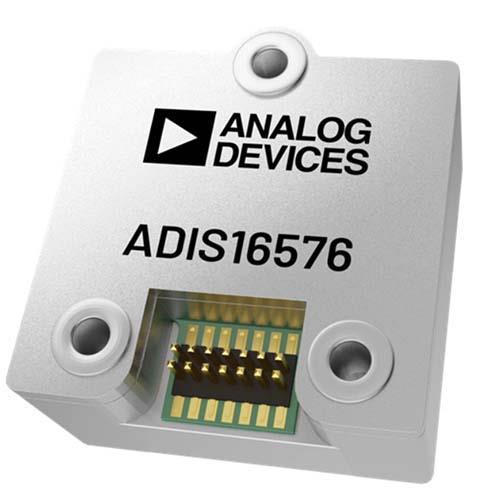
Several products in this range illustrate how IMUs can be optimized for different priorities. The Analog Devices ADIS16576-2BMLZ and ADIS16507-1BMLZ are examples of 6-DOF precision IMUs aimed at applications where stable, high-quality inertial data is important. Other Analog Devices options in this category, including ADIS16467 and ADIS16465 variants, show how different acceleration and angular rate ranges can support different motion environments.
For industrial motion tracking, the TDK InvenSense IIM-20670 offers a 6-axis approach suited to embedded sensing tasks, while the ICM-30670 adds an integrated sensor hub concept that can be attractive in more feature-rich designs. Bosch Sensortec BHI360 and STMicroelectronics LSM6DSO16ISTR represent another direction, combining motion sensing with smarter onboard processing features that can help in compact embedded platforms.
At the ecosystem level, products such as the Adafruit 4503 board can be useful for evaluation, prototyping, or rapid integration workflows, while Murata Electronics SCC2130-D08-6 highlights how some devices in the broader IMU landscape may be chosen for more specialized sensing behavior.
Industrial-grade vs embedded and development-oriented options
Not every IMU is selected for the same reason. Some are intended for precision inertial measurement in demanding industrial environments, where stability, repeatability, and higher operating temperature limits are significant. Others are better aligned with compact electronics, wearable devices, portable equipment, or prototyping, where board space, power consumption, and software integration may take priority.
This is why comparing only one parameter rarely leads to the best choice. A high-range device may suit aggressive motion and vibration, while a lower-power smart sensor may be more practical for battery-powered embedded systems. The intended algorithm, update rate, and installation environment should all be considered together.
Working with major IMU manufacturers
Supplier preference can also shape the selection process, especially in B2B purchasing where lifecycle, documentation quality, and platform familiarity matter. This category includes recognized manufacturers such as TDK InvenSense, Bosch Sensortec, STMicroelectronics, Murata Electronics, and Adafruit, alongside established precision sensing solutions from Analog Devices.
For buyers standardizing around a known vendor ecosystem, brand pages can help narrow compatible options more quickly. For example, teams already working with motion and embedded analog components may want to review the wider TDK InvenSense range or compare alternative sensor portfolios available from other manufacturers listed in this category.
How to narrow down the right category results
A practical way to filter IMUs is to start with the motion profile of the target system. Ask whether the application involves slow tilt changes, constant vibration, sudden shocks, fast rotational motion, or a combination of these. Then check interface compatibility, required supply voltage, package constraints, and whether the host controller will perform the signal processing directly.
If the project calls for broader motion sensing beyond an IMU alone, it may also be worth reviewing board mount motion and position sensors to compare adjacent technologies. That comparison can be especially useful when deciding between full inertial sensing and a more specialized sensor type.
Choosing with application context in mind
IMUs are rarely selected in isolation; they are chosen as part of a complete sensing and control strategy. The best fit depends on how the device will be mounted, how data will be fused or filtered, and how much motion detail the system truly needs to capture. Looking beyond headline specifications often leads to a more reliable design decision.
Whether you are sourcing a compact 6-axis device for embedded electronics or a high-performance IMU for industrial motion tracking, this category provides a focused starting point for comparing available options by interface, sensing capability, and integration style.
Get exclusive volume discounts, bulk pricing updates, and new product alerts delivered directly to your inbox.
By subscribing, you agree to our Terms of Service and Privacy Policy.
Direct access to our certified experts