PID Controllers
Stable temperature and process performance often depends on how quickly a controller can respond to changing conditions without creating overshoot, drift, or unnecessary cycling. In industrial heating, process equipment, panels, and machine automation, that is where PID Controllers remain a practical and widely used control solution.
On this page, you can explore PID control devices used for regulating temperature and similar process variables with better precision than simple on/off switching alone. The category includes compact panel-style controllers, PLC expansion modules, and more application-specific options for environments that need relay, SSR, analog output, or communication capability.
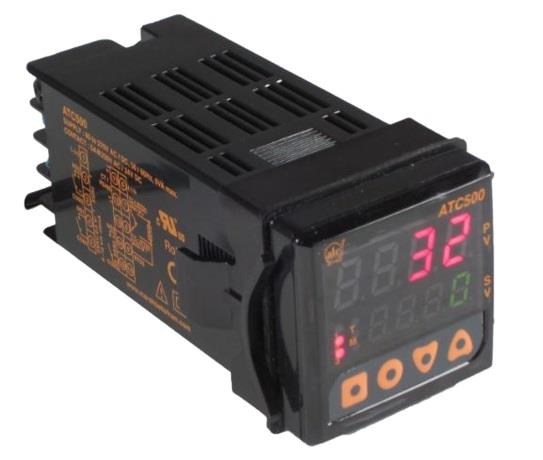
Where PID controllers fit in process control
A PID controller continuously compares a measured value with a desired setpoint and adjusts the output to reduce error over time. The three control actions—proportional, integral, and derivative—help balance response speed, steady-state accuracy, and system stability, making this approach suitable for many thermal and process applications.
Compared with basic switching control, PID regulation is typically chosen when tighter process stability matters. This can be important in ovens, heaters, packaging equipment, laboratory systems, production machines, and panel-based control assemblies where repeatable temperature control supports product quality and equipment safety.
Product types available in this category
This category covers more than one implementation style. Many users look for classic chassis-mount or panel-mount temperature controllers with front displays for local setup and monitoring, while others need a PID function built into a control architecture through PLC modules.
Examples in this range include ATC Automatic Timing & Controls models such as the ATC500-0004-00, ATC500-2004-00, and ATC550-S00000, which illustrate common panel control formats with dual LED display layouts and multiple output options. For control systems that are more modular, IDEC FC6A-F2M1, FC6A-F2M4, and FC6A-F2MR4 show how PID functionality can also be added as a module rather than as a standalone front-panel instrument.
For more specialized temperature work, the OMEGA CYC325 represents a benchtop approach designed for demanding measurement and control scenarios. If your application requires coordinating several loops together, it may also be worth reviewing multi-loop controller options alongside single-loop PID devices.
Common output and interface choices
One of the most important selection points is the output type. Depending on the process and the final control element, buyers may need relay outputs, SSR drive, analog signals such as 4-20 mA, or voltage-based outputs like 0-10 V. The right output helps the controller integrate correctly with heaters, contactors, solid-state relays, valves, or downstream control hardware.
Several products shown in this category reflect those differences. ATC500 variants include configurations with relay outputs, analog output options, and versions with RS485 communication, while ATC550 models provide more economical control options in relay or SSR-oriented formats. This makes the category useful for both straightforward thermal control tasks and applications that need communication back to a supervisory system.
How to choose the right PID controller
The best fit usually depends on the control architecture, not just the controller itself. Start with the process variable, sensor type, and required control accuracy, then check how the output must be delivered to the load. Input compatibility, mounting format, operating environment, display needs, and communication requirements all affect the final choice.
For panel installations, display readability and front protection can be important, especially in machine environments where the operator needs quick visibility of setpoint and process value. Some models in this category feature dual 7-segment displays and chassis mounting, while selected versions also indicate IP65 suitability for the front-facing use case.
If the system already uses a PLC platform, a PID module may simplify wiring and keep the control strategy inside the automation system. For standalone temperature safety or shutdown logic, users may also pair control hardware with limit controllers where an independent protective layer is needed.
Representative brands in this category
OMEGA, IDEC, and ATC Automatic Timing & Controls are among the featured manufacturers represented here. Each supports a different buying pattern, from benchtop or application-specific temperature control to modular PLC expansion and compact industrial panel devices.
ATC Automatic Timing & Controls is especially visible in this category through ATC500 and ATC550 series examples, which are relevant for users comparing economical on/off or PID-capable temperature control formats. IDEC products are useful when PID control needs to be implemented as part of a broader PLC-based solution, while OMEGA is often considered for more specialized temperature measurement and control environments.
Typical applications and integration considerations
PID controllers are commonly used wherever heat input or process response needs to be adjusted smoothly instead of switching fully on and off at wide intervals. Typical use cases include heaters, tanks, thermal tooling, small process skids, test setups, and machine panels where process stability can influence throughput, consistency, or component life.
Integration planning should also consider panel space, wiring method, communication access, and enclosure conditions. In some installations, the controller is mounted with related components inside a control enclosure to protect electronics and simplify maintenance access. In others, a front-mounted controller provides direct operator interaction while the rest of the system remains inside the cabinet.
Single-loop control, modular control, and specialized temperature systems
Not every application needs the same PID format. A single-loop panel controller is often sufficient for one heater zone or one controlled process variable. A modular PID unit is often more suitable when control functions need to be managed from a PLC, especially in OEM equipment or compact automation systems.
Specialized systems, such as dual-channel benchtop temperature control, can be relevant in laboratory or advanced thermal applications where measurement method, sensor support, and tuning behavior matter more than simple panel replacement. Understanding that difference helps narrow the category quickly and avoids selecting hardware that does not match the control environment.
Finding a controller that matches your process
Choosing from a PID controller category is easier when the decision is based on application logic: what you need to measure, how the control output must behave, and how the device will fit into the surrounding system. Whether you are replacing a panel temperature controller, adding a PID module to an automation platform, or evaluating a more specialized temperature control instrument, the right product is the one that aligns with your process, wiring, and operating requirements.
Use the products in this category as a practical starting point for comparing display style, output method, communication capability, and control format. A well-matched controller can improve process consistency, reduce manual adjustment, and support more reliable operation across everyday industrial temperature control tasks.
Get exclusive volume discounts, bulk pricing updates, and new product alerts delivered directly to your inbox.
By subscribing, you agree to our Terms of Service and Privacy Policy.
Direct access to our certified experts