Reed Relays
When signal integrity, compact switching, and reliable isolation matter, engineers often turn to reed relays for precision control tasks. These components are widely used in measurement systems, automated test equipment, instrumentation, medical electronics, and other circuits where low-level signal handling is just as important as repeatable switching performance.
On this page, you can explore reed relay options suited to PCB-based designs and specialized control applications. The category includes compact parts from established relay manufacturers, with examples from Coto Technology, Renesas Electronics, and Celduc Relais, making it easier to compare solutions for signal routing, isolation, and compact relay integration.
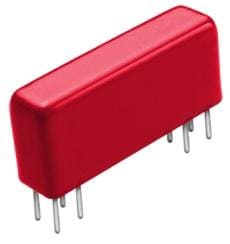
Where reed relays fit in electronic and industrial systems
A reed relay combines a magnetically actuated reed switch with a coil, creating a compact electromechanical device that can switch circuits with good isolation between control and load sides. In practice, this makes reed relays a strong fit for test and measurement paths, data acquisition equipment, telecom interfaces, and precision switching boards where contact stability and low leakage are important considerations.
Compared with broader industrial relays and accessories, reed relays are typically selected for smaller signals, denser PCB layouts, and applications that benefit from fast, consistent switching. They are also often evaluated alongside low signal PCB relays when designers need a balance between signal sensitivity, package size, and electrical isolation.
Typical applications for reed relay selection
Many buyers arrive at this category with a clear functional need rather than a fixed part number. Common use cases include switching analog signals in test fixtures, routing measurement channels in instrumentation, controlling small loads on PCB assemblies, and isolating sensitive circuits from the drive side. Reed relays are especially relevant when the switching path must remain clean and predictable across repeated operations.
They are also found in automated production equipment, laboratory systems, communication modules, and control boards that require dependable signal path management in a compact footprint. For applications involving very different operating environments or load types, it may also be useful to compare neighboring categories such as high frequency / RF relays, which are designed for another class of switching requirement.
What to consider when choosing a reed relay
The right selection usually starts with the electrical and mechanical demands of the circuit. Buyers typically review coil voltage, contact arrangement, mounting style, current handling, package dimensions, and whether the relay is intended for low-level signal switching or a more specialized load profile. In PCB design, available board space and terminal format can strongly influence the shortlist.
It is also important to think about switching architecture at system level. A simple SPST or SPDT relay may be enough for straightforward control, while multi-pole configurations can support denser signal routing in test and switching matrices. If the project involves precision measurement or sensitive interfaces, engineers often pay close attention to contact configuration, isolation behavior, and long-term consistency over repeated switching cycles.
Examples from this category
This category includes several representative reed relay options that illustrate the range available. From Coto Technology, models such as the HGRM57212T00, HGRM55211Q00, HGRM51111J02, and HGRM52112Q01 show the breadth of compact reed relay choices used in signal switching and PCB integration. These references are useful for buyers comparing package style, circuit type, and general application fit within the same product family.
Other examples include the Renesas Electronics PU1A-05D and the Celduc Relais R1329L00, which broaden the available selection across manufacturers. For projects requiring specific coil voltages or mounting preferences, parts like the Coto Technology 9007-24-00 or 7204-05-1100 can help clarify what type of relay package may suit the design. Rather than choosing by brand alone, it is usually more effective to match the relay to the required switching characteristics and board-level constraints.
Manufacturer coverage and sourcing context
Reed relay sourcing often depends on both technical fit and availability across approved brands. This category highlights products from manufacturers already well recognized in relay and switching applications, including Coto Technology, Renesas Electronics, and Celduc Relais. Depending on the project, buyers may also review broader relay portfolios from brands such as OMRON, PANASONIC, TE Connectivity, Littelfuse, and Schneider Electric Relays when standardization across multiple relay types is part of the procurement strategy.
For OEM, maintenance, and integration teams, having access to a focused category page helps reduce search time and keeps comparison work aligned with actual application needs. Instead of scanning unrelated relay formats, engineers can concentrate on parts intended for compact signal switching, precision routing, and specialized PCB-based relay functions.
How reed relays compare with other relay categories
Not every relay is designed for the same job. Reed relays are commonly selected for controlled switching of smaller signals, compact assemblies, and applications where clean isolation and repeatable operation are more important than handling large industrial loads. This makes them distinct from many power-oriented or panel-oriented relay families used in machine control and heavy switching circuits.
They may also overlap with low signal and RF relay selections depending on the frequency range, signal type, and required switching behavior. In practical sourcing, the best category is usually the one that matches the signal environment first, then the electrical ratings and mounting requirements. That approach helps avoid over-specifying the device while still maintaining system reliability.
Finding the right part for your application
If you are selecting for a new design, start with the circuit role the relay needs to perform: signal path routing, isolated control, compact PCB switching, or multi-channel measurement support. Then narrow the shortlist using coil voltage, pole configuration, load profile, and package style. Reviewing a few representative products in this category can quickly show whether a compact through-hole relay, a specialized multi-contact option, or another reed relay format is more appropriate.
For replacement sourcing or approved-vendor purchasing, matching the original part number remains the safest route whenever possible. If you are still evaluating alternatives, the products listed in this category provide a practical starting point for comparing manufacturer families and identifying a reed relay that fits the electrical design, installation method, and switching purpose of your system.
Reed relays remain a practical choice for engineers who need precise, compact, and application-focused switching solutions. By comparing relay configuration, signal requirements, and manufacturer family within this category, buyers can make a more informed selection for instrumentation, automation, and PCB-based control designs.
Get exclusive volume discounts, bulk pricing updates, and new product alerts delivered directly to your inbox.
By subscribing, you agree to our Terms of Service and Privacy Policy.
Direct access to our certified experts