Foot Switches
Hands-free machine control is often essential where an operator needs both hands available for positioning parts, handling tools, or maintaining a stable workflow. In these environments, Foot Switches provide a practical control interface for starting, stopping, or triggering equipment without reaching for a panel-mounted actuator. They are commonly used across industrial machinery, workstations, testing setups, and operator-controlled production processes where quick actuation and repeatable input matter.
Compared with many hand-operated controls, a foot-operated switch can improve ergonomics and help simplify operator interaction with equipment. The category includes compact and heavy-duty options, with differences in pedal count, enclosure style, contact arrangement, and environmental protection depending on the application.
Where foot switches are typically used
A foot switch is most useful when the operator must keep both hands free while still sending a deliberate control signal. Typical use cases include machine actuation, fixture control, test benches, operator stations, packaging systems, and assembly environments. In some setups, the foot pedal is used for a simple momentary command, while in others it becomes part of a broader control and interlock scheme.
In industrial settings, selection usually depends on duty level and surrounding conditions. Metal housings, cable connection styles, and higher ingress protection ratings are often preferred where dust, splashing liquids, or mechanical wear are concerns. For applications that involve protective logic or guarded operation, users may also compare these products with safety switch solutions to understand where standard actuation ends and safety-related switching begins.
Common product formats in this category
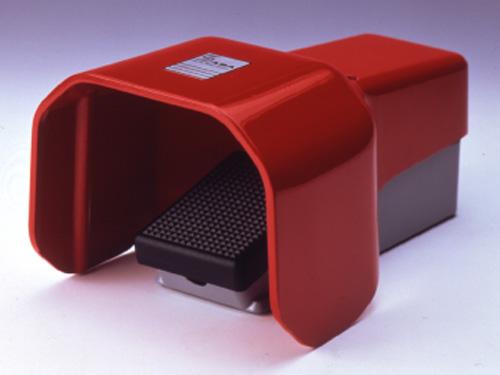
This category includes both single-pedal and two-pedal designs. A single-pedal version is often chosen for straightforward on/off or trigger-style operation, while two-pedal designs can support more complex machine functions, staged control, or separate commands within the same workstation. Hooded constructions may also be preferred where users want additional protection against accidental activation.
Contact configuration is another key distinction. Depending on the control circuit, buyers may need SPDT, DPDT, or multiple NO/NC combinations to match the intended wiring logic. Environmental resistance also matters: several featured industrial models are built with IP65-rated metal housings for demanding operating conditions, while lighter-duty options can fit simpler control tasks.
Examples from leading manufacturers
For rugged industrial use, SIEMENS is strongly represented in this category with a wide range of pedal-operated devices. Examples include the 3SE29122AB20 single pedal switch for momentary operation, the 3SE29320AB20 two pedal switch, and the 3SE29321AA20 hooded two-pedal model for applications that benefit from extra physical protection around the actuator. These examples illustrate how pedal count, hood style, and contact arrangement can change according to machine requirements.
Users looking at established control brands can also consider SCHNEIDER, including the XPEM111 foot switch, as well as models from Square D and TE Connectivity such as the 679502-1 footswitch assembly. For lighter or project-oriented needs, Adafruit 423 shows that not every foot switch in the category is aimed at the same operating environment. The practical takeaway is that this category serves both industrial control panels and more specialized device-level control tasks.
How to choose the right foot switch
The first step is to define the control action clearly. Consider whether the application needs momentary actuation, one or two pedals, a hooded actuator, or a specific contact form such as 1NO+1NC or 2NO+2NC. This affects not only how the operator uses the pedal but also how the switch integrates into the control circuit.
Next, review the electrical rating and installation method. Current and voltage capability should match the control load or interface design, especially in industrial AC or DC systems. Cable termination style, housing material, and mounting approach should fit the installation environment and maintenance expectations.
Finally, account for mechanical and environmental demands. If the switch will be used in an exposed production area, a robust enclosure and suitable IP rating can help support long service life. In nearby control architectures, some buyers also evaluate related categories such as disconnect switches when building a broader machine isolation and operator control setup.
Standard foot switches vs. safety-oriented designs
Not every pedal-operated device serves the same purpose. A standard foot switch is generally selected for operator input and routine control, while a safety foot switch is used where the application requires a more specific protective function within the machine design. That distinction matters because control convenience and functional safety are not interchangeable requirements.
An example in this category is the SIEMENS 3SE29243AA20 safety foot switch, which shows that some pedal devices are intended for more safety-focused applications. Buyers should define the required function early in the selection process, especially if the device is part of a machine control system with protective logic, emergency behavior, or guarded operating conditions.
Material, protection, and durability considerations
For many industrial users, enclosure construction has a direct impact on reliability. Metal-bodied foot switches are commonly preferred where there is frequent actuation, possible impact, or exposure to harsher shop-floor conditions. Models with IP65 protection can be especially relevant in environments where dust and splashing are part of normal operation.
Plastic-housed versions may still be appropriate in cleaner or less demanding areas, particularly when lower weight or different form factors are desirable. The intended duty cycle, surrounding contamination, and operator footwear can all influence which build style is most suitable over time. If a project also requires peripheral parts for installation or maintenance, browsing switch accessories may be helpful.
Integration in industrial control systems
Foot switches are rarely selected in isolation. They are usually one part of a wider control chain that may include relays, contactors, interlocks, sensors, and operator interface components. Because of that, the best choice is not simply the pedal with the highest rating, but the one that fits the control logic, operator workflow, and environmental conditions of the actual machine.
When comparing options, it is useful to think in terms of operator intent, electrical compatibility, enclosure durability, and the level of protection expected in the application. A simple single-pedal unit may be sufficient for a workstation trigger, while a hooded multi-contact version can be more appropriate for industrial equipment where deliberate actuation and tougher construction are priorities.
Final considerations
The right foot switch helps create a cleaner and more efficient operator interface, especially in applications where hands-free actuation supports productivity and control. Whether you are comparing compact options, heavy-duty industrial pedals, or safety-oriented designs, the most effective selection starts with the real operating task, the required contact logic, and the physical environment.
By reviewing pedal configuration, enclosure style, electrical characteristics, and integration needs, buyers can narrow the category quickly and focus on the models that truly fit their machine or workstation. That approach leads to a more reliable choice than selecting on form factor alone.
Get exclusive volume discounts, bulk pricing updates, and new product alerts delivered directly to your inbox.
By subscribing, you agree to our Terms of Service and Privacy Policy.
Direct access to our certified experts