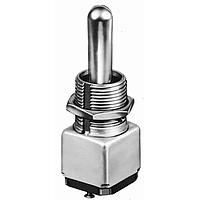
Toggle Switches
Reliable manual switching is still essential in control panels, operator interfaces, test equipment, vehicles, and compact electronic assemblies. When a design requires a clear mechanical action, repeatable contact changeover, and straightforward installation, toggle switches remain a practical choice across many industrial and electronic applications.
This category brings together toggle-style switching components for different mounting methods, circuit configurations, and operating behaviors. From compact low-current signal switching to panel-mounted devices for general equipment control, the range supports engineers, maintenance teams, and OEM buyers looking for dependable manual switching hardware.
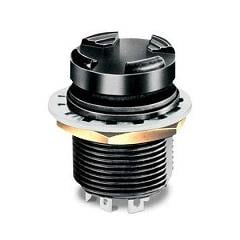
Where toggle switches fit in real-world equipment
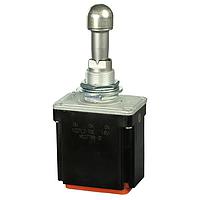
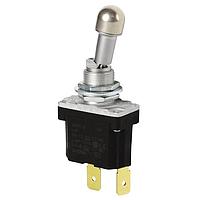
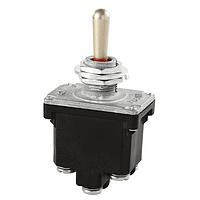
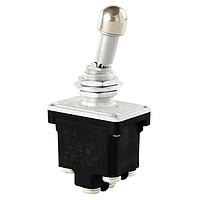
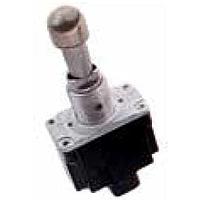
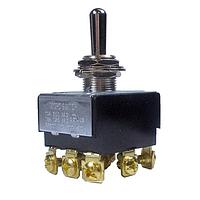
A toggle switch is commonly selected when operators need a simple lever-based interface with a clear physical position. In practice, these components are used to start or stop functions, select between operating states, switch signal paths, or provide momentary action in machinery, instruments, and embedded systems.
Compared with touch interfaces or non-contact switching, a mechanical toggle can be easier to service and easier to recognize at a glance. For applications that require a different protection or shutdown approach, it may also be useful to review related options such as safety switches or disconnect switches, depending on the function of the system.
Key configurations found in this category
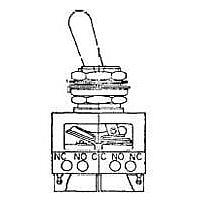
One of the main selection points is the circuit arrangement. Within this category, examples include SPST, SPDT, and SP3T designs. These options affect whether the switch simply opens and closes one circuit, changes over between two paths, or provides multi-position selection for more flexible control logic.
Operating behavior also matters. Some models are maintained types such as ON-ON or ON-ON-ON, while others include center-off or momentary positions like (ON)-OFF-(ON) and ON-OFF-(ON). Choosing the correct action helps prevent user error and aligns the switch with the intended machine or device behavior.
Mounting style and integration considerations
Mounting type has a direct impact on assembly, servicing, and panel design. Panel-mount toggle switches are widely used where the lever must be accessible to an operator, while through-hole versions can suit PCB-based equipment that still needs a mechanical actuator. Some products in this range also support right-angle or vertical orientations, which can simplify enclosure layout and board positioning.
In more compact electronics, low-current switch elements may be surface mounted rather than panel mounted. The OMRON D2LS-21 and OMRON D2LS-11 illustrate this smaller-form-factor approach, using snap-action switching in applications where board space, actuation force, and signal-level performance are important. If your design also needs complementary parts around the switching interface, browsing other switch accessories can help during system planning.
Representative products in the range
Several products in this category show how broad the selection can be. For example, the Littelfuse 7101SD9V4BE is a through-hole SPDT toggle switch with ON-ON operation, suitable for basic changeover tasks in PCB-based assemblies. The Littelfuse 7107P3YAQE and Littelfuse 7107P3HAV2QE2 provide panel-mount options with ON-OFF-(ON) functionality, which can be useful when a maintained state and a temporary command are both required.
Where a multi-position selector is needed, the Littelfuse 7211P3YW4QE offers an SP3T ON-ON-ON configuration. For lower-power signal applications, the Littelfuse 7105K12V3BE and 7105K12CWZ3BE3 represent lighter-duty panel-mount options. This category also includes products such as the Honeywell 2NT11A, giving buyers access to established industrial switch families from recognized manufacturers.
Leading manufacturers and product ecosystem
This range is supported by well-known switch manufacturers including Littelfuse, OMRON, and Honeywell, along with other major names in electromechanical connectivity and control. Each brand typically brings a slightly different focus, whether that is compact board-level switching, rugged panel components, or long-established industrial control hardware.
For many B2B buyers, manufacturer preference is tied to qualification history, mechanical compatibility, or maintenance standardization across installed equipment. That is why brand continuity can be as important as electrical ratings, especially when replacing an existing switch in field equipment or keeping spare parts aligned with current assemblies.
How to choose the right toggle switch
The most effective starting point is the actual switching task. Define the number of positions needed, whether the action should be maintained or momentary, and whether the switch controls a power circuit or only a low-level signal. Then confirm the required current and voltage range, contact arrangement, and mounting style so the chosen part fits both the electrical design and the mechanical envelope.
It is also worth checking actuator feel, orientation, and service conditions. A compact SMT device such as the OMRON D2LS series may suit miniature assemblies, while a panel-mounted Littelfuse toggle can be more appropriate for equipment front panels or operator-accessible control points. In systems moving toward electronic switching rather than mechanical actuation, some designers may also compare alternatives such as solid state switch solutions for specific use cases.
Common application scenarios
Toggle switches are used in a wide variety of environments, including laboratory instruments, industrial control boxes, communication devices, transportation equipment, and service panels. Their appeal often comes from fast manual operation and easy visual indication of position, especially where users need direct local control without navigating a software interface.
In maintenance and retrofit work, they are equally useful because replacement can often be planned around familiar pole configurations and mounting formats. Whether the goal is selecting modes, isolating a control signal, issuing a momentary command, or switching between outputs, this category covers practical options for both new designs and replacement sourcing.
Choosing with confidence
A well-matched toggle switch should fit the circuit logic, mounting approach, and operator interaction of the equipment it serves. Paying attention to electrical rating, functional operation, and installation method will usually narrow the selection quickly and reduce integration issues later in the project.
For buyers comparing multiple switch formats, this category provides a focused starting point for manual lever-operated switching across industrial and electronic applications. Reviewing representative models from brands such as Littelfuse, OMRON, and Honeywell can help you identify the right balance of size, switching behavior, and mounting style for your design or replacement requirement.
Get exclusive volume discounts, bulk pricing updates, and new product alerts delivered directly to your inbox.
By subscribing, you agree to our Terms of Service and Privacy Policy.
Direct access to our certified experts