What is the Mohs scale?
The Mohs scale, introduced by mineralogist Friedrich Mohs in 1812, ranks the hardness of minerals based on a material's ability to scratch another. The scale ranges from 1 (softest, such as talc) to 10 (hardest, diamond).
The core principle is that a harder material will scratch a softer one, but not vice versa. This serves as the basis for jewelers and buyers to use the Mohs scale as a quick, on-the-spot test.
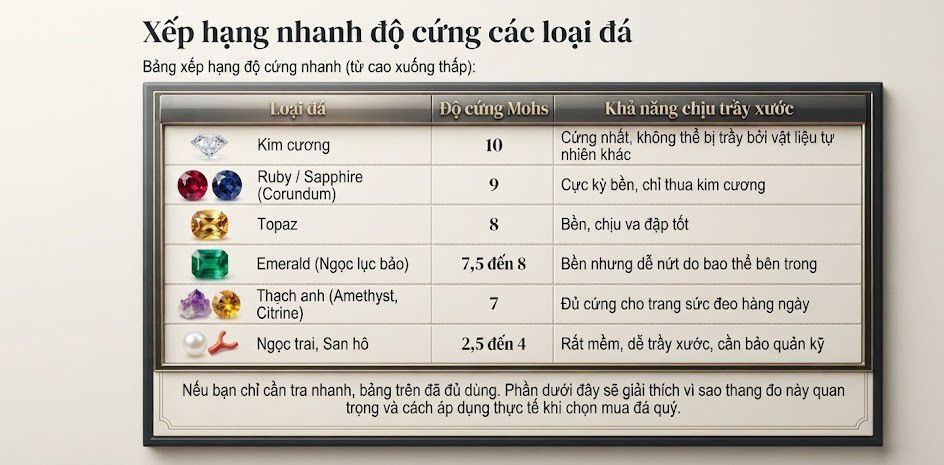
Quick ranking of stone hardness
Quick hardness ranking (from highest to lowest):
Why hardness determines the utility value of gemstones
Hardness does not determine a gemstone's beauty or aesthetic appeal, but it does dictate its durability over time. No matter how beautiful a gemstone is, if it has low hardness, it is prone to scratching and becoming dull with frequent wear particularly in high-contact jewelry like rings and bracelets.
This is why diamonds, rubies, and sapphires (with a hardness of 9 or higher) are typically chosen for wedding rings or everyday wear, whereas pearls and opals are generally recommended for earrings and necklaces pieces that are less exposed to impact.
Using hardness for a preliminary assessment of whether a gemstone is real or fake
This is the most sought-after practical tip when looking up the Mohs scale. Here are some quick testing methods that do not require specialized equipment:
Fingernail test: A human fingernail has a hardness of approximately 2.5. If a material is scratched by a fingernail, its hardness is below 2.5, meaning it is certainly not a genuine gemstone (with the exception of pearls and coral, which are naturally soft).
Coin test: Metal coins typically have a hardness of around 3.5. If the stone is scratched by a coin, its hardness is below 3.5.
Steel knife or window glass test: Steel and glass usually have a hardness of about 5.5. This is a crucial threshold because most common gemstones (quartz, topaz, ruby, sapphire, diamond) are harder than this and will not be scratched by light contact.
Please note that these tests are merely preliminary and cannot replace a certification from a reputable laboratory, as synthetic or artificially treated stones can possess the same hardness as natural ones. The Mohs scale helps quickly rule out obvious fakes (for example, glass imitating ruby is usually softer and scratches more easily than real ruby), but it cannot distinguish between natural stones and synthetic stones of the same mineral type.
Related article:
How Do the HRC, HRB, and HRA Hardness Scales Differ?
Common misconceptions about the Mohs scale
Misconception 1: Harder stones are more expensive. False. Hardness is not directly proportional to value. Diamonds are expensive due to their rarity, clarity, and cut not merely because of their hardness rating of 10. Conversely, opals have a hardness of only 5.5 to 6.5, yet certain varieties command high prices thanks to their unique optical effects (such as fire opal).
Misconception 2: Hard stones never break. False. Hardness measures resistance to scratching, whereas toughness refers to resistance against fracturing or shattering upon impact. Although diamonds are the hardest material, they are relatively brittle along their cleavage planes and can shatter if struck hard at the right angle.
Misconception 3: The Mohs scale is linear. False. The intervals between the levels are not uniform. In physical reality, the hardness of a diamond (10) is many times greater than that of corundum such as ruby or sapphire (9) rather than just one step higher as the numerical values might suggest.
Comprehensive hardness reference chart for common gemstones
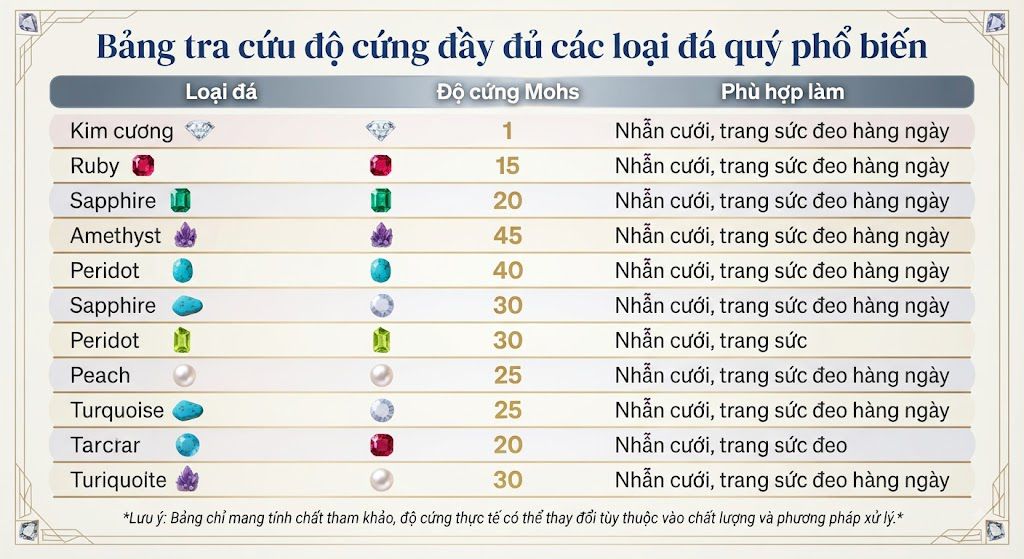
Which gemstones to choose based on hardness
If you are looking for everyday jewelry—such as wedding bands or office-appropriate rings—prioritize gemstones with a hardness of 8 or higher (e.g., diamond, ruby, sapphire, topaz) to minimize scratching over time.
If you are seeking fashion-forward jewelry that changes with the seasons and isn't worn constantly, stones with a hardness of 6 to 7.5 (e.g., quartz, peridot, aquamarine) are perfectly suitable and come at a more accessible price point.
For feng shui stones like pearls, turquoise, and coral, low hardness is not a drawback, provided you know how to care for them properly: avoid contact with perfumes, cosmetics, and sweat, and store them separately to prevent abrasion against other jewelry.
Can the Mohs scale be used for metals and industrial materials?
This is a crucial distinction to make. The Mohs scale is a qualitative scale based on scratch testing; it is suitable for minerals and gemstones because these materials possess relatively stable hardness characteristics and do not require absolute precision.
However, the Mohs scale is rarely used for quality control in mechanical engineering, metallurgy, or industrial manufacturing for two main reasons:
The Mohs scale does not yield precise quantitative valuesoffering only a relative ranking of materials whereas industry requires specific data for comparison, quality record-keeping, and verification against technical standards.
Metals undergo continuous changes in hardness during heat treatment and machining, requiring repeated measurements on the same component a process for which manual scratch testing is inadequate in terms of speed and repeatability.
Consequently, the metal industry employs quantitative measurement methods such as Rockwell, Brinell, Vickers, or Leeb. These methods provide specific numerical values (e.g., HRC 55, HB 200, HV 300) rather than the relative rankings found on the Mohs scale.
Accurately measure metal hardness with EMIN hardness testers
If you work in mechanical manufacturing, post-heat-treatment quality control, or incoming material inspection, EMIN offers a range of specialized metal hardness testers, including:
Rockwell hardness testers: Widely used for testing steel after heat treatment.
Brinell hardness testers: Suitable for materials with heterogeneous structures, such as cast iron and cast alloys.
Vickers hardness testers: Offer high precision; suitable for small components or thin coatings.
Portable Leeb hardness testers: Convenient for on-site testing, eliminating the need to transport parts to a laboratory.
Read more about hardness testing methods: