
Harmonic/Flicker
Power quality issues rarely appear as a single obvious fault. In many labs, production lines, and product compliance workflows, engineers need to understand whether unstable behavior is caused by harmonics, short-term voltage fluctuation, or visible light flicker effects on the mains supply. That is where Harmonic/Flicker analyzers become especially useful, helping teams move from symptom checking to structured measurement.
Within this category, you will find instruments designed for electrical measurement tasks such as harmonic current and voltage analysis, frequency and phase observation, power evaluation, and flicker assessment. These tools are relevant for product development, pre-compliance testing, troubleshooting of AC-powered equipment, and routine monitoring of power quality behavior under real operating conditions.
Why harmonic and flicker analysis matters
Modern electronic loads often draw non-linear current, which can distort the mains waveform and generate harmonic components. In practical terms, this can affect efficiency, thermal loading, power factor, and the ability of equipment to meet internal quality targets or external test requirements. A dedicated analyzer helps engineers see more than simple RMS values by revealing how the waveform behaves across harmonic orders and over time.
Flicker measurement adds another layer of insight. Voltage fluctuation can translate into visible lighting disturbance or unstable power conditions, which is particularly important when evaluating equipment connected to public or sensitive AC networks. Compared with general waveform viewing on a digital oscilloscope, a harmonic and flicker analyzer is built to quantify these effects in a way that supports repeatable analysis and reporting.
Typical measurement capabilities in this category
The products listed in this category are intended for more than one basic electrical reading. Depending on the model, users can work with parameters such as power, frequency, phase, harmonic current, harmonic voltage, and flicker or voltage fluctuation analysis. This makes the category relevant for engineers who need a single instrument for both waveform-related power checks and structured power quality evaluation.
Some systems are optimized for single-phase measurement, while others support wider wiring configurations including three-phase environments. This distinction is important in test planning because the correct analyzer depends on the type of load, the installation topology, and whether the goal is benchtop product evaluation or broader mains behavior assessment.
Single-phase and three-phase options
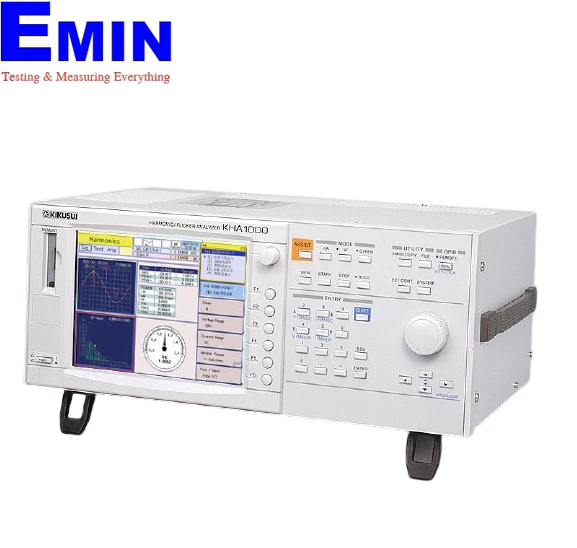
For single-phase applications, instruments such as the KIKUSUI KHA1000 Harmonic/Flicker Analyzer and the KHA1000 WITH ETHERNET focus on one-channel voltage and current input for single-phase 2-wire measurement. They are suitable when the test object is a single-phase device or when the engineer needs a straightforward setup for harmonic and flicker checks without the complexity of multi-line analysis.
Where larger systems or industrial loads are involved, the KIKUSUI KHA3000 extends coverage to three-phase / single-phase measurement and supports multiple common wiring methods. That broader input structure is useful for evaluating equipment with higher current demand, distributed loading, or more complex power arrangements. In workflows where report handling or network-based integration matters, users may also consider products from KIKUSUI as part of a wider electrical test setup.
Examples of instruments available
The category includes dedicated analyzers from KIKUSUI and TTI, each suited to slightly different use cases. The KIKUSUI KHA series is oriented toward harmonic and flicker analysis with support for power, phase, and frequency functions. The KHA1000 WITH ETHERNET adds Ethernet connectivity, which can be helpful in environments where results need to be shared with networked peripherals or incorporated into a connected lab workflow.
For AC line-focused analysis, the TTI HA1600A series is represented in regional variants such as UK, USA, and Schuko versions. These models combine mains analysis, harmonics analysis, and voltage fluctuation or flicker measurement in one platform, making them practical for routine bench testing of AC-powered products. If your work also involves broader bench diagnostics, related tools such as a PC oscilloscope can complement these analyzers for waveform capture and software-based troubleshooting.
How to choose the right harmonic/flicker analyzer
A good starting point is the power system type. If the DUT operates on a standard single-phase supply, a single-phase analyzer is often the most efficient choice. If the application involves three-phase power, mixed wiring schemes, or higher current conditions, a model built for those input arrangements will be more appropriate.
Next, consider the measurement scope. Some buyers primarily need harmonics and pass/fail style assessment, while others also need detailed observation of power, phase, frequency, and voltage fluctuation behavior. Interface requirements can also matter: USB, RS-232, printer support, or Ethernet may affect how easily the instrument fits into your existing reporting or archiving process.
Finally, think about the surrounding test environment. If your team is diagnosing transient symptoms as well as harmonic behavior, a dedicated analyzer may be paired with a handheld oscilloscope or benchtop scope for field or lab waveform checks. The analyzer provides structured compliance-oriented data, while the oscilloscope helps visualize fast events and signal anomalies.
Where these instruments are commonly used
Harmonic and flicker analyzers are widely used in electronics development, appliance testing, power electronics evaluation, and incoming or outgoing quality verification. They are also relevant when engineers need to investigate unstable mains interaction, verify the behavior of a product under load, or document electrical performance over a controlled test period.
In industrial and B2B settings, these instruments support communication between design teams, quality engineers, service departments, and compliance-related functions. Rather than relying on indirect indicators, users can review measured harmonic content, observe voltage fluctuation trends, and compare performance under different operating conditions with a more consistent technical basis.
Understanding the role of harmonic/flicker analyzers in a test bench
These instruments are most effective when viewed as part of a broader measurement ecosystem. An analyzer in this category is intended to quantify power quality behavior, not simply display a waveform. That distinction matters because harmonic order analysis, flicker evaluation, and repeatable mains-related measurements often require calculation methods and reporting logic beyond the scope of a general-purpose oscilloscope.
For that reason, many engineering teams use harmonic/flicker analyzers alongside other instruments rather than in isolation. The analyzer addresses power quality assessment, while oscilloscopes and related tools handle signal debugging, event capture, or board-level verification. Choosing the right combination depends on whether your priority is compliance preparation, design validation, failure analysis, or routine production support.
Final considerations
Choosing from this Harmonic/Flicker category starts with a clear view of your electrical environment: single-phase or three-phase, routine bench analysis or broader power quality investigation, and standalone operation or connected reporting workflow. Models such as the KIKUSUI KHA1000, KHA1000 WITH ETHERNET, KHA3000, and TTI HA1600A variants provide useful options for teams that need structured measurement of harmonics and flicker behavior.
If your application involves AC-powered equipment, mains disturbance analysis, or pre-compliance style evaluation, this category offers instruments that can help turn complex electrical behavior into measurable, comparable data. A well-matched analyzer improves not only test accuracy, but also decision-making across development, validation, and technical support.
Get exclusive volume discounts, bulk pricing updates, and new product alerts delivered directly to your inbox.
By subscribing, you agree to our Terms of Service and Privacy Policy.
Direct access to our certified experts

