
Manganese meter
When manganese needs to be monitored in water, the right instrument depends on both the expected concentration range and the way testing will be carried out. In routine water analysis, manganese measurement is commonly used for process control, compliance checks, troubleshooting discoloration issues, and verifying treatment performance. This category brings together Manganese meter options for portable testing, reagent-based photometric analysis, and online monitoring in water applications.
For many users, the key challenge is not simply finding a meter, but choosing a practical solution that fits the sample type, detection range, maintenance expectations, and workflow. Some applications require low-range measurement in the µg/L level, while others need high-range analysis in ppm or mg/L. There are also cases where continuous monitoring is more suitable than manual spot testing.
Where manganese meters are used
Manganese testing is relevant across raw water intake, drinking water treatment, industrial water systems, wastewater control, and laboratory verification. Depending on the process, manganese may be checked at low concentration to confirm treated water quality, or at higher concentration during source water screening and treatment optimization.
Portable photometers are often selected for field and plant use because they offer a balance between sensitivity, portability, and repeatability. In contrast, online analyzers are more appropriate when manganese needs to be tracked continuously with signal output to a control system. Supporting consumables such as reagents and calibration sets are also important because they directly affect day-to-day usability.
Common instrument types in this category
This category mainly includes portable photometers, compact checker-style devices, online automatic monitors, and related consumables. Portable instruments are typically used for grab-sample testing with cuvettes and dedicated reagents. They are suitable for operators who need clear digital readings and a repeatable method in the field or lab.
For lower concentration measurement, products such as the HANNA HI97748 and HI97748C focus on manganese low range analysis up to 300 µg/L. For broader utility, the HANNA HI97742 and HI97742C combine iron and manganese testing in one handheld platform, which can be useful when both parameters are relevant in the same water treatment workflow.
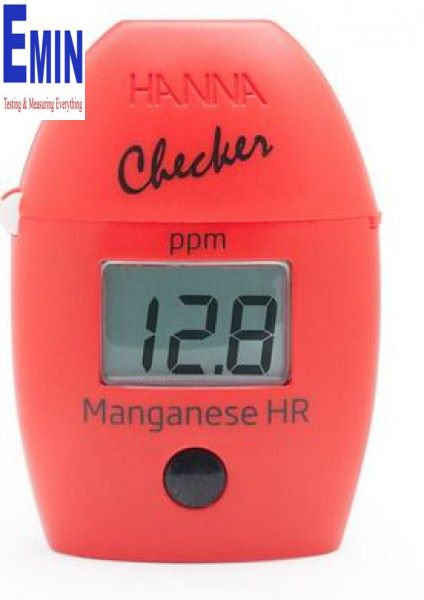
When the expected concentration is higher, high-range models like the HANNA HI97709 or the compact HI709 Checker can be a better fit. For fixed installation, the Probest PCM200-TMn represents a different approach, offering continuous total manganese monitoring with communication and output functions for integration into plant operations.
How to choose the right manganese meter
The first selection point is measurement range. If manganese levels are expected at trace or low levels, a low-range photometer is usually the better choice. If concentrations are higher, a high-range device helps avoid repeated dilution steps and may provide a more practical workflow for routine plant testing.
The second factor is how the instrument will be used. A portable unit is appropriate for mobile testing, operator rounds, and occasional verification. An online analyzer is better for continuous trend monitoring, alarm strategies, and automated reporting. Buyers should also consider whether the method requires regular reagent replenishment, cuvette cleaning, and periodic calibration checks.
Another practical factor is the test ecosystem. Some users prefer a complete kit with carrying case and CAL Check support, while others only need the base instrument and separate consumables. If your purchasing workflow also includes replenishment items, it can be helpful to review available water testing reagents alongside the meter itself.
Representative products and application fit
Several products in this category illustrate different use cases. The HANNA HI97748 and HI97748C are designed for low-range manganese measurement, making them relevant when fine control is needed in treated water or polished water analysis. The kit version adds accessories and calibration support for users who want a more complete field package.
The HANNA HI97742 and HI97742C add iron measurement to the same platform. This can simplify procurement and daily testing where iron and manganese are often evaluated together. In treatment systems where both metals affect water appearance or downstream performance, a dual-parameter photometer may be more efficient than maintaining separate devices.
For higher range testing, the HANNA HI97709 and HI709 support manganese analysis in a range better suited to stronger samples or process checks. Where continuous measurement is required instead of manual testing, the Probest PCM200-TMn provides an online monitoring option with signal output and communication capability for plant-level integration.
Reagents, calibration, and accessories matter
In practical operation, a manganese meter is only part of the testing system. Reagents, calibration standards, cuvettes, and cleaning accessories influence measurement consistency and maintenance effort. Examples in this category include HANNA HI93709-01 high-range reagents, HI709-25 reagents for the Checker platform, and HI709-11 calibration support.
Palintest PM174 Manganese HR Tablets show another consumable format for photometric workflows. Choosing the correct reagent format should match the instrument and method in use rather than relying only on the manganese range. If your site already uses multiple colorimetric tests, it may also be useful to compare supplementary formats such as test paper products for quick screening tasks, while keeping photometers for quantitative measurement.
Users looking for brand-specific instrument families can also explore the broader HANNA product range, especially where portable photometers, calibration tools, and consumables need to be sourced within one ecosystem.
Portable testing versus online monitoring
Portable manganese meters are generally preferred when testing points change frequently, when operators need to verify samples on demand, or when budgets favor manual analysis over fixed automation. They are also easier to deploy across multiple sites or for maintenance troubleshooting. Features such as backlit displays, onboard logging, and battery-powered operation support this use case well.
Online manganese monitors are more suitable when the process requires trend visibility over time, reduced manual sampling, or integration with SCADA and control systems. In these cases, the instrument becomes part of the broader plant monitoring architecture rather than just a handheld testing tool. The trade-off is that online systems typically require more planning around installation, calibration, and maintenance intervals.
Points to review before purchasing
Before selecting a meter, confirm the manganese form being monitored, the expected concentration range, sample conditions, and whether testing is intermittent or continuous. It is also worth checking what is included with the instrument and what must be ordered separately, especially for reagents, calibration kits, replacement cuvettes, and maintenance items.
- Choose low-range or high-range measurement based on actual process concentration.
- Decide between handheld testing and online monitoring based on workflow.
- Review reagent availability and calibration support.
- Consider whether combined iron and manganese testing would simplify routine analysis.
- Check communication or analog output needs for installed monitoring systems.
A well-matched manganese meter helps reduce retesting, supports more consistent water quality assessment, and makes daily operation more efficient. Whether the requirement is a portable photometer, a compact checker, an online analyzer, or the supporting reagents around them, this category is structured to help buyers compare suitable solutions for water environment testing with clearer technical context.
Get exclusive volume discounts, bulk pricing updates, and new product alerts delivered directly to your inbox.
By subscribing, you agree to our Terms of Service and Privacy Policy.
Direct access to our certified experts