Ozone reagent, Ozone meter
When ozone is used for water treatment, sanitation, or process control, measurement is what turns it from a useful oxidant into a manageable parameter. Reliable testing helps operators confirm dosing, check residual concentration, and maintain consistent water quality without relying on guesswork. That is why ozone reagent, ozone meter products are commonly selected for routine monitoring in laboratories, facilities, and field applications where dissolved ozone or ambient ozone needs to be verified.
This category brings together practical tools for different testing approaches, from simple reagent-based kits to portable digital instruments. Depending on the application, users may need a fast spot check, a higher-resolution dissolved ozone reading, or a handheld device for checking ozone concentration in air around treatment equipment.
Understanding the role of ozone measurement
Ozone is widely used because of its strong oxidation capability, but it is also a parameter that must be monitored carefully. In water-related processes, too little ozone may reduce disinfection efficiency, while too much residual ozone can affect downstream quality control, process stability, or compliance targets. A suitable ozone meter or test kit helps users evaluate actual concentration instead of estimating it from generator settings alone.
Measurement needs can vary significantly by site. Some users check dissolved ozone in tap water, rinse water, or treatment loops, while others need to verify ozone in surrounding air for safety and environmental control. This is why the category includes both chemical test methods and instrument-based solutions, each suited to different workflows.
Main product types in this category
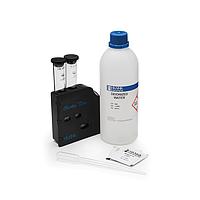
One practical option is a reagent-based test kit for quick manual analysis. The Hanna HI38054 Ozone Test Kit is an example of this approach, using a DPD method and visual comparison format for routine checks. This type of solution is useful where simplicity, portability, and low-volume periodic testing are more important than continuous digital readout.
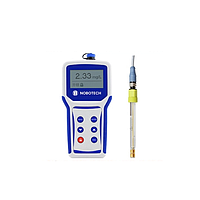
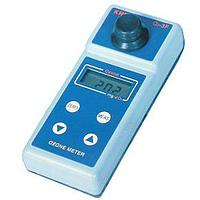
For users who need direct numerical measurement of dissolved ozone, portable analyzers and handheld meters are often a better fit. The NOBOTECH CLN-170 Dissolved Ozone Analyzer and the KASAHARA O3-3F Dissolved Ozone Meter illustrate this type of selection, offering instrument-based reading for water samples. In applications where airborne ozone is the focus, a device such as the Trotec OZ-ONE Ozone Meter is more relevant because it is designed around ambient ozone detection rather than dissolved ozone in liquid.
How to choose between reagent kits and digital meters
The first decision is usually the measurement target: dissolved ozone in water or ozone in air. Water treatment users should start by defining sample type, expected concentration range, and how often measurements are required. If testing is occasional and the workflow allows manual preparation, a chemical test kit may be sufficient. If readings are taken regularly or need better repeatability and easier documentation, a digital instrument is often more practical.
Another key factor is the expected measuring range and resolution. Lower-range applications may require finer resolution for process adjustment, while broader ranges can be useful when ozone concentration changes significantly across operating conditions. It is also worth considering portability, power supply, environmental protection, and whether the meter will be used mainly in a lab, on a production floor, or in field inspection work.
Typical application scenarios
In water environment testing, ozone measurement is commonly associated with treated water verification, sanitation process checks, and validation of oxidation stages. Portable dissolved ozone instruments can support operators who need a quick reading near the sampling point, while reagent kits are often preferred for basic field checks or routine maintenance tasks. Where multiple water quality parameters are monitored together, users may also compare ozone testing methods with related tools such as other reagent-based testing products.
Air monitoring has a different purpose. In spaces where ozone is generated intentionally, a handheld ambient meter helps confirm whether ozone is present in the surrounding environment and whether operational exposure control needs to be reviewed. For this reason, selecting the right instrument is not only about concentration range, but also about whether the sensor principle and form factor match the actual monitoring task.
Examples from leading manufacturers
Several established brands appear in this category, each representing a slightly different use case. HANNA is well known for practical water analysis tools, and its HI38054 kit is suitable for users who prefer a compact manual testing format. KASAHARA and NOBOTECH are relevant choices when the application calls for dedicated dissolved ozone measurement with digital indication for water samples.
Trotec is a useful reference point when the requirement extends beyond liquid testing into ambient ozone detection. Looking at manufacturers this way can help narrow the selection: not by brand name alone, but by the type of measurement problem each product is intended to solve. That approach usually leads to a better fit than comparing devices only by appearance or price range.
Practical selection points for B2B buyers
For procurement teams, maintenance staff, and technical users, the most effective way to compare products is to start with operating conditions. Consider whether the device will be used indoors or in the field, how many tests are performed in a day or week, and whether consumables such as reagents need to be stocked alongside the instrument. In many organizations, ease of training and repeatable handling are just as important as measurement capability.
It is also useful to think about the broader testing workflow. If your site already uses simple strip or paper-based checks for some parameters, categories like test paper may complement routine screening, while ozone-specific instruments remain the preferred option for quantitative verification. Matching the tool to the decision you need to make from the result is often the clearest way to avoid overbuying or under-specifying.
Finding the right ozone testing solution
This category is designed for users who need a practical way to monitor ozone in water or air with methods that fit real operating conditions. Some applications benefit from the simplicity of a reagent kit, while others require the convenience and clarity of a digital handheld meter. The best choice depends on sample type, expected range, testing frequency, and how the result will be used in process control or quality checking.
By comparing product type, measurement principle, and application fit, buyers can narrow the options more efficiently and select a solution that supports consistent testing over time. If your workflow includes broader liquid analysis tasks, ozone measurement can also be considered as one part of a more complete water testing setup rather than an isolated purchase.
Get exclusive volume discounts, bulk pricing updates, and new product alerts delivered directly to your inbox.
By subscribing, you agree to our Terms of Service and Privacy Policy.
Direct access to our certified experts
![Trotec OZ-ONE Ozone Meter (0- 1 ppm [O3])](/s-cdn/1e/1e92633a31787e548fc97947683484b6d1b3ae82.jpg)