When to Measure Voltage and Resistance with the Fluke 175?
In many situations, the Fluke 175 multimeter is an emergency rescue measurement tool. First, measure voltage when the battery is weak or a circuit is not working. For example, your motorcycle won't start? Connecting the Fluke 175 to the battery, you see the voltage is only 11.5V instead of the standard 12.6V - a sign that it needs immediate charging.
Furthermore, in industrial environments, the Fluke 175 is ideal for testing inverters. Is the AC voltage fluctuating due to harmonics? Fluke's True RMS feature helps provide accurate readings, avoiding costly mistakes. Finally, according to research from IEEE, periodic testing helps reduce electrical incidents by 30% in many cases.
Step-by-Step Guide to Measuring Voltage and Resistance with the Fluke 175 Multimeter
Measuring DC voltage with the Fluke 175
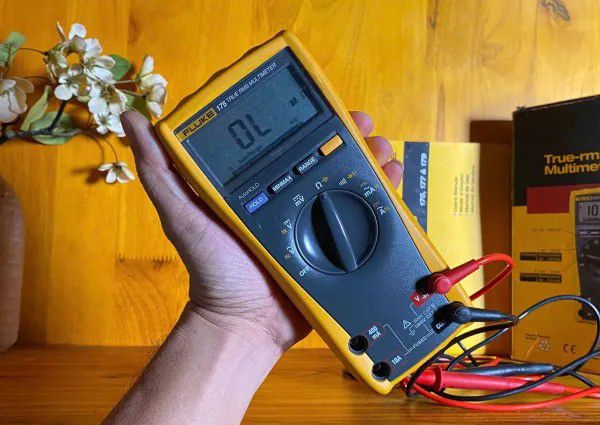
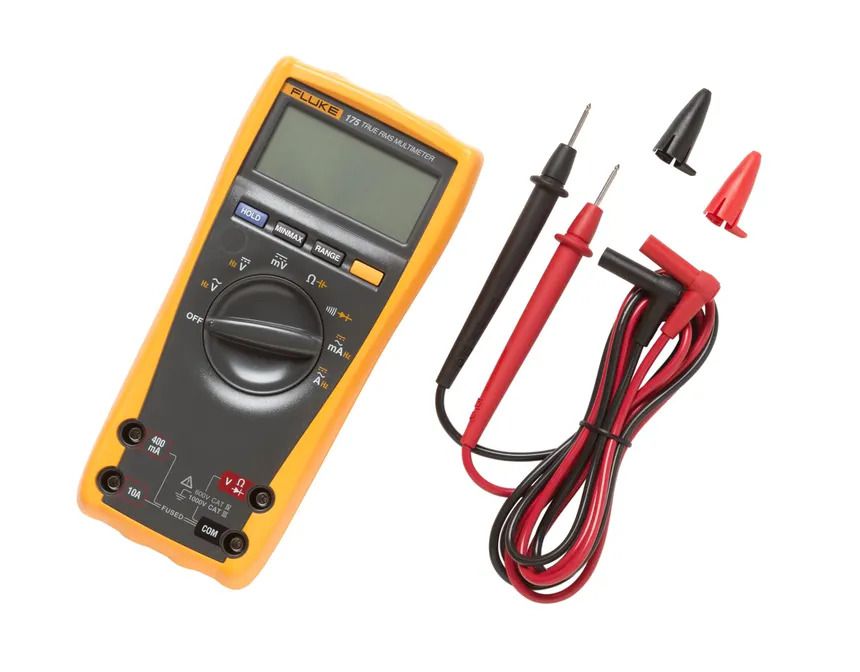
First, turn the rotary switch to the V-DC mode (straight line symbol). Plug the red test lead into the VΩ jack, and the black lead into the COM jack. Next, touch the probes to the two points to be measured. For a car battery, the screen will instantly display 12.4V.
Measuring AC voltage with the Fluke 175
Switch the dial to V-AC (wave symbol ~). The Fluke 175 True RMS reads accurately even with distorted waves from motors. When measuring a household outlet, the standard is 220V. If it fluctuates between 210-230V, you should call an electrician to check the power grid. The bar graph on the Fluke 175 updates quickly, helping you monitor changes immediately.
Measuring resistance with the Fluke 175
Turn off the circuit's power, then turn the dial to Ω, plug the probes in just like when measuring DC. Touch the probes to the component; a 1kΩ resistance will appear correctly on the screen, with an error margin of only 0.9%. When modifying an amplifier, a speaker will typically show an 8Ω resistance. If it reads infinity (OL), the reason is usually a broken wire. A beep sound will notify you of an open circuit that needs immediate repair. For safe use, you should use the TL75 test leads included with the Fluke 175, which have a load capacity of up to 1000V.
Read more:
Top Mini Multimeters of 2026: Extremely Convenient, Great Value for Money - What You Need to Know
Testing the heating resistance with a multimeter is easy to understand.
Tips for measuring 220V current with a multimeter that not everyone knows
What are some alternatives alongside the Fluke 175?
If you want to look deeper, you can refer to the Fluke 177 and Fluke 179 multimeters. First, the Fluke 177 and 179 add a backlight and Min/Max/Avg features. The Fluke 175, Fluke 177, and Fluke 179 are all CAT III 1000V rated, but the Fluke 179 is better suited for harsh environments. If your budget is tight, you can start with the Fluke 175 and gradually upgrade to higher versions. Research from NIST emphasizes that features like True RMS on the Fluke 175 help provide measurements that are over 20% more accurate compared to others in the same price range.