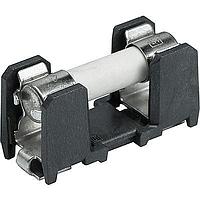
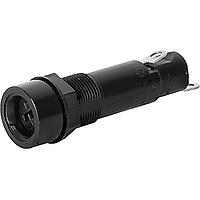
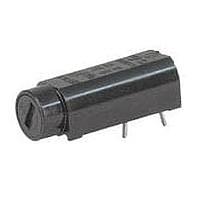
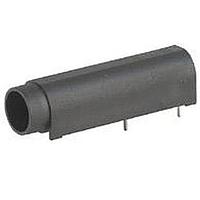
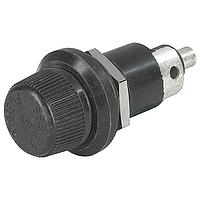
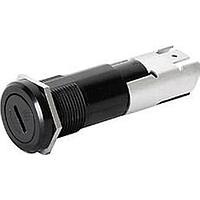
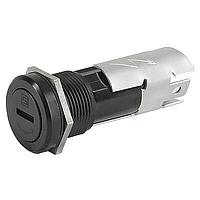
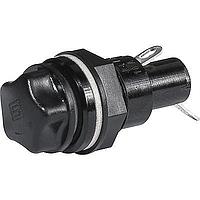
Fuse Holder
Protecting a circuit is not only about selecting the right fuse element. In many panels, machines, and power distribution assemblies, the holder plays an equally important role by ensuring safe installation, reliable electrical contact, and practical maintenance access. A well-matched fuse holder helps technicians replace fuses quickly while supporting the current, voltage, and mounting requirements of the application.
This category brings together fuse holder solutions used across industrial automation, control cabinets, OEM equipment, and electrical distribution systems. Whether the need is a compact DIN rail option for modular panels or a higher-current block for more demanding duty, the right holder improves serviceability and helps keep protection schemes organized.
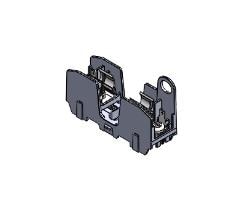
Where fuse holders fit in a protection system
A fuse holder provides the mechanical and electrical interface between the fuse and the circuit. In practice, it must hold the fuse securely, maintain dependable contact under load, and suit the installation method used in the equipment. This is why mounting style, terminal type, fuse format, and number of poles all matter during selection.
In industrial environments, fuse holders are often chosen alongside related parts such as fuse holder accessories for covers, mounting parts, or replacement components. For some designs, engineers may also compare them with fuse clips when a simpler mounting arrangement is acceptable.
Common fuse holder formats in this category
The range includes holders and blocks for cartridge fuse applications in several common physical sizes. DIN rail versions are often preferred in control panels because they support clean layout, easier wiring, and faster replacement during maintenance. Chassis-mount and screw-mount styles are also relevant where panel architecture or legacy equipment requires a fixed mechanical arrangement.
Single-pole and multi-pole configurations are both important depending on the circuit design. A one-circuit holder may be suitable for branch protection or individual loads, while multi-circuit formats can simplify three-phase or grouped installations. The category also includes supporting items such as covers and accessories that help complete a safe and serviceable fuse assembly.
Examples from Eaton and Eaton Bussmann
Eaton is strongly represented in this category with options that cover compact control-panel use through to heavier-duty power protection. For example, the Eaton CHM1D Fuse Holder 32A 690VAC Screw DIN Rail Box suits applications where DIN rail mounting and enclosed form factors are important, while the Eaton CH141DU Fuse holder supports cartridge fuse installation in a vertical DIN rail arrangement.
For higher-current or more robust fuse applications, products such as the Eaton SB2 Fuse Holder 400A 690VAC Screw Mount illustrate the type of holder used in more demanding installations. Chassis and block formats are also present, including the Eaton J60030-3C Fuse Block 30A 600V Solder Lug Chassis Mount and the Eaton 2601 Fuse Block 30A 250V Screw Screw Mount, which show how terminal style and mounting method can vary by project requirement.
How to choose the right fuse holder
The first point is fuse compatibility. The holder must match the fuse form factor and class used in the design, whether that means a 10x38 mm cartridge style, a 14x51 mm format, a 22x58 mm version, or another specified size. Mismatch at this stage can prevent proper fit or compromise service safety.
The second point is the electrical rating. Current and voltage values should align with the circuit design and the selected fuse. A compact holder like the Eaton CHM1D may be appropriate in lower-current panel circuits, while larger units such as the Eaton CH223DNMSU-F Fuse holder or Eaton SB2 Fuse Holder are intended for applications where higher current capacity or multi-pole arrangements are needed.
The third point is installation practicality. Engineers should consider whether the design calls for DIN rail mounting, chassis mounting, or screw mounting, as well as whether screw terminals, quick-connect options, or lug-style terminations are more suitable for the wiring method used in the cabinet or machine.
Why mounting style and service access matter
In many industrial control cabinets, the difference between a good layout and a difficult one comes down to accessibility. A DIN rail fuse holder can make replacement faster and reduce wiring disruption during service. Vertical and horizontal orientation can also affect spacing, cable routing, and how easily maintenance staff can inspect the device.
Serviceability becomes even more important when holders are paired with protective covers or related hardware. Items such as the Eaton SAMI-1N Fuse Cover 60A 600V and Eaton PFS3333 Fuse Accessories show that a complete solution may involve more than the holder body itself. In applications where environmental exposure or accidental contact is a concern, these supporting components can be part of a better-organized protection assembly.
Typical application areas
Fuse holders are used across a wide range of equipment where replaceable overcurrent protection is required. Common examples include motor control panels, OEM machinery, HVAC equipment, power supplies, distribution assemblies, and industrial automation cabinets. In these settings, the holder supports not only protection performance but also practical maintenance workflow.
They are also relevant in designs that need scalable protection architecture. A compact single-circuit holder may suit localized branch circuits, while multi-pole holders can support grouped loads or three-phase circuits. Where broader selection is needed across the protection chain, some buyers also review circuit protection kits to evaluate complementary components for system-level design.
Choosing between holders, blocks, and accessories
Although these products are closely related, they do not always serve the same purpose. A fuse block is often selected where a more fixed or grouped installation is required, especially in chassis-mounted or multi-circuit arrangements. A fuse holder may be preferred for modular, service-friendly panel layouts, particularly on DIN rail.
Accessories should not be treated as secondary details. Covers, mounting parts, and related support items can improve user safety, organization, and replacement convenience. Products such as Eaton BMM603-1SQ Fuse Accessories and other holder accessories are typically chosen to complete the assembly rather than act as stand-alone protection devices.
Finding a practical fit for your application
The best choice depends on balancing fuse size, electrical rating, installation method, and maintenance needs. In some projects, a straightforward DIN rail holder is enough. In others, a larger block, a multi-pole arrangement, or a cover-equipped assembly will be the more suitable option for safe and orderly panel construction.
This Fuse Holder category is designed for buyers who need dependable options for industrial and electrical protection layouts. By comparing holder format, circuit count, mounting style, and accessory requirements, it becomes easier to narrow down a solution that fits both the protection design and the realities of installation and service.
Get exclusive volume discounts, bulk pricing updates, and new product alerts delivered directly to your inbox.
By subscribing, you agree to our Terms of Service and Privacy Policy.
Direct access to our certified experts