Programmable Controllers
In modern automation, reliable machine control depends on hardware that can handle logic, signals, operator interaction, and repeatable execution without unnecessary complexity. That is why Programmable Controllers remain a core choice for panel builders, OEMs, and industrial maintenance teams working on machines, process skids, and production equipment.
Within this category, buyers typically look for a practical balance of I/O handling, communication capability, mounting format, and compatibility with the rest of the control architecture. Whether the goal is a compact machine panel or a broader automation upgrade, programmable control platforms help turn sensors, switches, and commands into consistent operating sequences.
Where programmable controllers fit in industrial automation
A programmable controller is used to execute predefined logic in response to real-world inputs and operating conditions. In practice, it sits at the center of many systems that need dependable control of motors, actuators, alarms, timing routines, interlocks, and operator commands.
Compared with more application-specific devices, this type of controller is often chosen when the machine or process requires flexible logic and easier future changes. For applications focused more narrowly on loop stability or environmental regulation, engineers may also compare them with PID controllers or a dedicated level controller, depending on the control task.
Typical applications and control scenarios
Programmable controllers are widely used in packaging equipment, conveyor systems, small assembly stations, utility panels, and standalone industrial machines. They are also suitable in systems where multiple digital and analog conditions must be processed in a predictable sequence, especially when operators need local visibility of alarms, status, or setpoints.
These devices are particularly useful when control logic may evolve over time. A machine builder might begin with basic sequencing and later add communication, safety interlocking strategy, or operator interface functions. This scalability makes programmable control platforms attractive for projects where future adaptation matters as much as present-day function.
Key selection factors before you buy
Choosing the right controller starts with the application rather than the model name. Important considerations include the number and type of signals, expected communication requirements, available panel space, power supply constraints, and the level of operator interaction needed on the machine.
It is also worth checking how the controller will integrate with adjacent devices such as drives, sensors, relays, and HMIs. In some control cabinets, a general programmable platform may be paired with more specialized equipment such as a power controller for heater loads or a humidity controller for environmental regulation.
- I/O requirements: digital and analog inputs or outputs needed now and in the near future
- Communication interface: compatibility with the plant or machine network
- Mounting and footprint: suitability for panel layout and service access
- Operator interface needs: local display, status feedback, and simple command entry
- Power requirements: fit with the available control voltage in the cabinet
Example from the category: compact HMI-based control
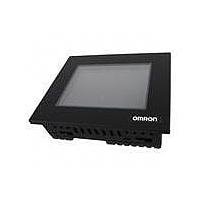
One representative product in this range is the Omron Automation and Safety NV3Q-MR21, a panel-mount unit that combines operator interface functionality with programmable control features in a compact format. Its 3.6-inch LED display and 24 VDC supply arrangement make it relevant for control panels where space efficiency and local visibility are important.
Devices in this type of format can be a practical choice for small machines and independent stations that benefit from a more integrated control layout. Instead of treating the control logic and operator access as completely separate layers, users can simplify cabinet design while keeping routine interaction close to the machine.
Why Omron is often considered for this category
Omron Automation and Safety is a familiar name in industrial control environments, particularly where users value established automation ecosystems and panel-level integration. For buyers evaluating programmable controllers, the brand is often considered alongside the wider context of machine control, operator interface, and industrial reliability.
When selecting within an established manufacturer ecosystem, practical benefits often include more predictable compatibility with related automation components and a clearer path for maintenance teams already working with that platform. That does not remove the need for application review, but it can make specification and lifecycle planning more straightforward.
How programmable controllers support system design
From an engineering perspective, programmable controllers help standardize control behavior across repeated machines and installations. They allow logic updates without redesigning hardwired relay schemes, which can reduce revision effort when process sequences, timing, or interlocks need to change.
This category also matters from a maintenance standpoint. A well-selected controller can make troubleshooting easier by centralizing machine logic, status signals, and operator messages. In facilities where uptime matters, that visibility can support faster diagnosis and more consistent service procedures.
What to compare when browsing this category
As you review available options, focus on the relationship between hardware format and the control objective. A compact unit may be ideal for a localized machine function, while a broader programmable platform may be better suited for systems with expanding I/O, more communication points, or more complex sequencing requirements.
It is also helpful to compare this category with other control approaches only after defining the job to be done. Some applications are primarily about sequence logic, while others are centered on temperature, pressure, level, or power regulation. Matching the control philosophy to the application usually leads to a better result than selecting by specification alone.
Final considerations for sourcing
For B2B buyers, the right programmable controller is usually the one that fits the control strategy, panel constraints, and service expectations of the project. Looking beyond headline features to integration, maintainability, and operator usability will often produce a more dependable long-term choice.
This category is a good starting point for teams building or upgrading industrial control panels, especially where flexible logic, panel integration, and practical machine operation are priorities. If you are comparing options, begin with the application requirements, then narrow the shortlist by interface, footprint, supply voltage, and the level of control functionality your system actually needs.
Get exclusive volume discounts, bulk pricing updates, and new product alerts delivered directly to your inbox.
By subscribing, you agree to our Terms of Service and Privacy Policy.
Direct access to our certified experts