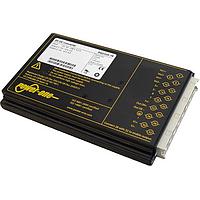
Rack Mount Isolated DC/DC Converters
Stable DC power distribution is a core requirement in control cabinets, telecom systems, transportation platforms, and other high-reliability equipment. When the application also needs galvanic separation between input and output, Rack Mount Isolated DC/DC Converters become a practical choice for protecting sensitive loads, managing different voltage domains, and simplifying power architecture in modular systems.
This category focuses on rack-mount converter solutions designed for integration into industrial and embedded power environments. These products are especially relevant when engineers need compact installation, isolated outputs, and predictable performance across a wide input range.
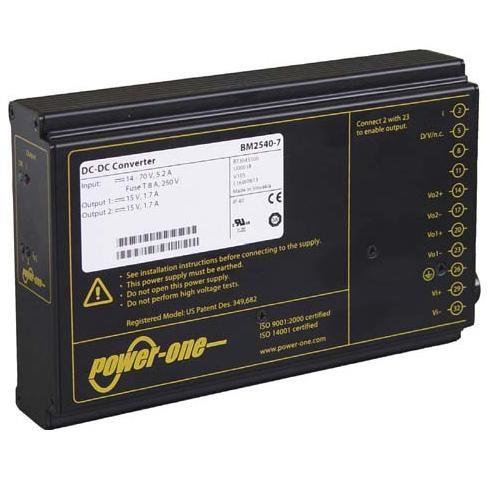
Where rack-mount isolated converters fit in industrial power systems
In many industrial and electronic systems, the incoming DC bus does not match the voltage required by downstream equipment. A rack-mount isolated converter bridges that gap by converting one DC level to another while maintaining electrical isolation between source and load. This helps reduce noise transfer, supports safer system segmentation, and can improve compatibility between subsystems.
Rack-mount formats are often selected where organized installation, serviceability, and power density matter. Compared with other mounting approaches, they are well suited to shelves, subracks, and equipment frames used in telecommunications, process control, transportation electronics, and similar applications. If your project requires panel-friendly alternatives, it may also be useful to compare with DIN rail mount isolated DC/DC converters for cabinet-based layouts.
Why isolation matters in DC/DC conversion
The main role of an isolated converter is not only voltage conversion but also separation of input and output grounds. That separation can be important in systems with mixed power domains, long cable runs, sensitive electronics, or a need to limit the propagation of disturbances. In practice, isolation helps support cleaner power delivery and more controlled integration of multiple subsystems.
For buyers and design engineers, this means the selection process should go beyond output voltage alone. Input range, number of outputs, power level, thermal operating window, and physical format all influence whether a converter will fit the intended system. In broader cabinet power design, isolated converters may be used alongside DIN rail power supplies or upstream backup equipment such as UPS systems depending on the application.
Typical configurations available in this category
The products shown in this category cover a wide range of power and voltage combinations. Some models are designed for lower-power conversion with dual outputs, while others support higher output levels for more demanding loads. This makes the category relevant for both distributed subassemblies and larger rack-based power systems.
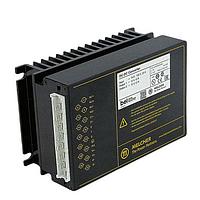
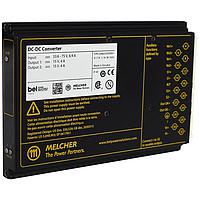
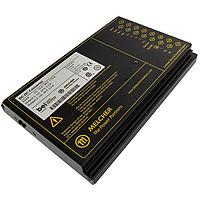
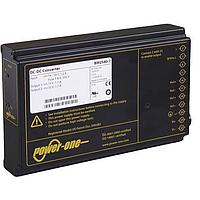
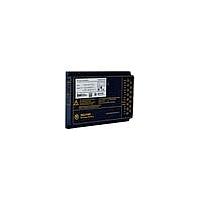
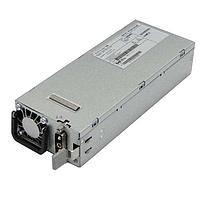
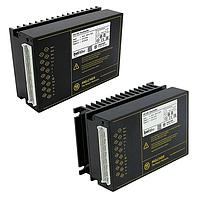
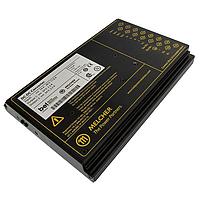
Examples from Bel Power Solutions illustrate that range clearly. The DM2540-7 provides 50 W with dual 15 V outputs, while the EK1601-9ERT moves into a 150 W single-output format with 24 V output. For applications needing higher output power, the ER2880-9RG is listed at 192 W with a 48 V output configuration, and the HR2320-9RG reaches 240 W in a euro-cassette style package.
Examples of product types and application fit
Lower- to mid-power units are often used to supply control logic, communication modules, interface boards, or auxiliary loads inside larger equipment. Models such as the Bel Power Solutions DP2020-9RG and DP3040-9RG show how multi-output designs can support mixed-voltage requirements within one converter footprint, which can be useful when legacy and modern circuits coexist in the same rack.
For higher-power conversion in industrial environments, the TDK-Lambda EZA2500-32048FC stands out as an example of a much larger rack-mount isolated DC/DC solution, delivering power in the kilowatt class. At the compact end of the category, the CUI Inc PDQE20-Q24-S15-U represents a lower-power isolated option that may be more suitable where space and load demand are modest. These examples show that this category is not limited to one system size or one power architecture.
How to choose the right rack-mount isolated DC/DC converter
A good starting point is the input voltage range. Industrial DC sources can vary significantly depending on the system, so the converter must tolerate both nominal conditions and expected fluctuations. The listed products span wide input windows, from lower-voltage ranges up to high-voltage DC inputs, which is important in telecom, transportation, and specialized industrial power systems.
Next, look at output requirements in practical terms: single or multiple outputs, required current per channel, and whether the load needs 5 V, 12 V, 15 V, 24 V, or 48 V rails. Thermal conditions also matter. Some models in this category are specified for operation from -40 C up to elevated ambient temperatures, which can be relevant for installations exposed to harsh or variable environments.
Mechanical integration should not be overlooked. Rack mounting, cassette-style construction, and overall dimensions influence airflow, service access, and system density. If the upstream source is derived from AC conversion or transformer-based distribution, related products such as industrial control transformers may also be part of the wider design path.
Manufacturer options in this category
This category includes products from recognized power conversion suppliers such as TDK-Lambda, Bel Power Solutions, and CUI Inc. Each brand is associated with different form factors and power ranges, giving buyers more flexibility when matching converter architecture to installation constraints and electrical requirements.
Bel Power Solutions is especially prominent in the currently listed examples, with multiple rack and cassette-style isolated DC/DC products covering dual-output and single-output needs. TDK-Lambda adds a strong option for higher-power industrial conversion, while CUI Inc contributes a compact isolated design for lighter-duty use cases. Other featured manufacturers in the wider brand ecosystem include Artesyn and OmniOn Power (Formerly ABB Power Conversion), which may be relevant when comparing sourcing preferences or standardization needs across projects.
Common use cases for rack-mount isolated conversion
These converters are typically chosen where equipment must operate from an available DC bus while supplying regulated and isolated power to downstream assemblies. Typical use cases include communications racks, distributed control systems, transportation electronics, medical-adjacent power assemblies shown by some product data, and industrial platforms where multiple voltage rails are required inside a structured enclosure.
They are also useful in retrofit and upgrade scenarios. Instead of redesigning the full power system, an isolated rack-mount converter can help adapt an existing DC infrastructure to new electronics with different voltage and grounding needs. This makes the category relevant not just for new machine design, but also for lifecycle extension and system modernization.
Find a converter that matches your power architecture
Choosing among rack-mount isolated DC/DC converters is usually a matter of balancing input range, output configuration, isolation needs, thermal conditions, and mounting constraints. A compact dual-output converter may be ideal for control electronics, while a higher-power unit is better suited to heavier industrial loads or centralized rack distribution.
By reviewing the available models in this category, buyers can narrow down options that align with real system requirements rather than relying on generic power ratings alone. If you are building or upgrading a structured industrial power system, this category provides a focused starting point for selecting isolated conversion hardware that fits both the electrical design and the installation format.
Get exclusive volume discounts, bulk pricing updates, and new product alerts delivered directly to your inbox.
By subscribing, you agree to our Terms of Service and Privacy Policy.
Direct access to our certified experts