This leads to eye strain, dry eyes, and a temporary decrease in accommodation after stopping observation.
The effects do not appear immediately but accumulate over time. The higher the frequency and the longer the duration of each viewing session, the more pronounced the discomfort.
What are the main reasons why using a microscope causes eye strain?
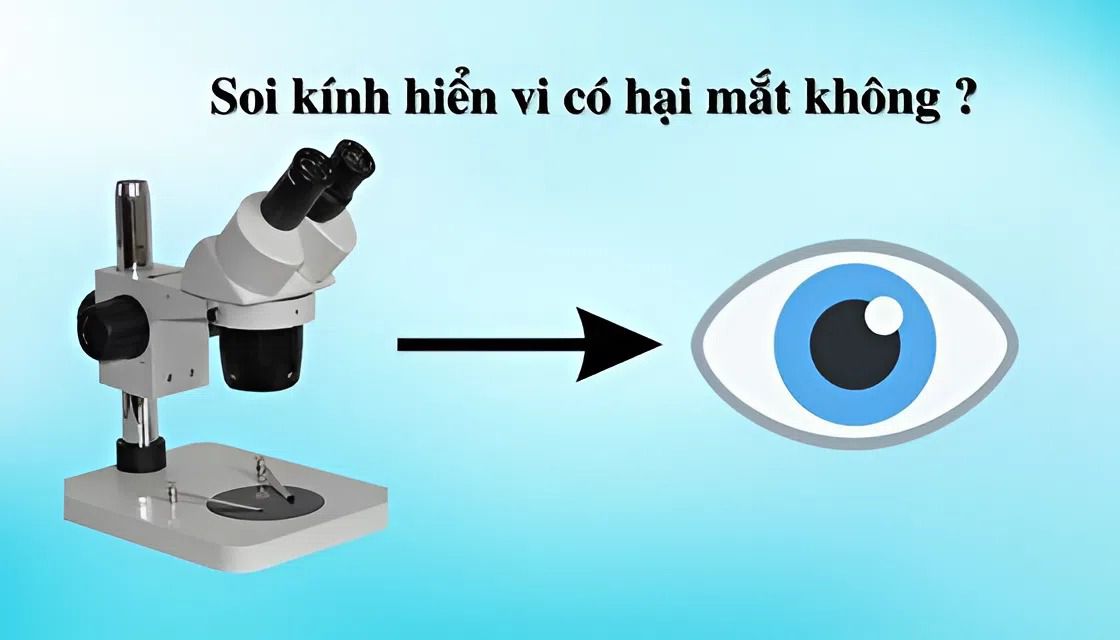
The eye muscles are responsible for adjusting focus to see clearly at different distances. When using a microscope, the eye is held at a fixed level of accommodation for an extended period. This reduces the eye's natural ability to relax its muscles.
Furthermore, observing fine details within a narrow field of view requires continuous, intense focus. When combined with inappropriate lighting or incorrect posture, the strain on the eyes increases significantly.
A magnification of 1200x is commonly used in basic biology studies and observation. However, this level isn't always necessary.
For many specimens, 400x to 600x is sufficient for identifying structures. Increasing to 1200x narrows the field of view, and image stability decreases if the optical system isn't robust enough. The eye has to work harder to maintain a clear image.
The principle for efficiency is to start at a low level, gradually increase it, and stop at a level that provides sufficient information. This reduces eye strain and maintains stability during observation.
Lighting and posture directly affect the eyes
Lighting is an often overlooked factor. Low intensity forces the eyes to strain to see clearly. Excessively high intensity causes glare and rapid fatigue. Stable, evenly distributed light allows the eyes to adapt better throughout the observation process.
Posture also has a significant impact. Bending the head too low or keeping the neck at a fixed angle for extended periods reduces blood flow and increases fatigue. When the eyes and body are not in a comfortable state, observational efficiency decreases.
Read more about Microscopes:
Adjusting the eyepiece on a microscope?
Evaluating fluorescence microscopes: Are they worth investing in?
ZEISS Microscopes - The pinnacle of optical technology
What is a reasonable observation period?
Continuous observation for 15 to 20 minutes is a common threshold before eye strain begins. After this time, it's advisable to stop, shift your gaze to a distant area, or close your eyes briefly to allow your eyes to recover.
In work environments requiring frequent observation, breaking down observation time into smaller intervals helps maintain more consistent efficiency compared to continuous observation over a long period.
When should you adjust your usage?
Some signs that indicate a change in microscope usage is needed:
- Rapid eye fatigue from the start
- Having to squint to maintain a clear image
- A persistent dry or gritty feeling after stopping use
These signs are often related to selecting the wrong magnification level, inappropriate lighting, or not adjusting the eyepiece properly.
Microscope use is not harmful to the eyes if used properly. The problem lies in the observation time, magnification level, and how the equipment is adjusted.
Maintaining proper observation habits, choosing the appropriate magnification level, and controlling usage time helps reduce eye strain and maintain stable work efficiency.