ISO 105-B02 light fastness testing helps laboratories and manufacturers evaluate how textile colours respond to exposure to artificial light that simulates natural daylight. Colour change caused by light exposure can affect the appearance, consistency, and perceived quality of fabrics, garments, and textile components. A controlled xenon arc test provides a repeatable way to assess this characteristic under defined exposure conditions.
The method is relevant to quality control and product development where a textile’s colour fastness to light needs to be considered before production or during material qualification. It may be applied to different textile types and forms, including bleached and fluorescent white textiles.
What ISO 105-B02 Covers
ISO 105-B02 concerns the assessment of textile colour fastness to artificial light. The test uses a xenon arc lamp apparatus to simulate daylight with a D65 light source characteristic. Rather than relying on uncontrolled outdoor exposure, the laboratory setup enables light exposure to be managed and monitored.
The purpose is to compare the visual colourfastness performance of textile specimens after exposure. This makes the method useful when evaluating dyed fabrics, printed textiles, and other materials for which appearance retention is important. The test conditions and assessment process should be selected and performed in accordance with the applicable standard requirements and the laboratory’s established procedure.
Why Xenon Arc Exposure Matters
Natural daylight contains a range of wavelengths and varies with location, weather, season, and time of day. A xenon arc system is used in this application because it can simulate the spectral distribution of daylight when paired with an appropriate filter system. This supports more consistent comparison between samples than relying solely on outdoor conditions.
Light exposure can involve ultraviolet, visible, and infrared energy. In a light fastness tester, filters are important for controlling the spectral output. The source information notes that filters attenuate ultraviolet radiation, while heat filters attenuate infrared radiation. For ISO 105-B02-related equipment considerations, filter transmittance is described as at least 90% from 380 nm to 750 nm and decreasing to 0% from 310 nm to 320 nm.
Key Equipment Considerations
Stable light source and filter system
A suitable xenon arc apparatus needs a stable light source and filtering arrangement capable of simulating daylight. Stable conditions help laboratories make meaningful comparisons across specimens and test runs. Lamp condition, filter condition, and operating controls should therefore be part of routine test management.
Temperature control
Black panel temperature is one factor that may vary with the selected test condition. The referenced information identifies a typical range of 50°C to 63°C, including temperate and American conditions. Laboratories should not treat this range as a substitute for a defined procedure; the chosen condition should match the applicable testing requirement.
Irradiance monitoring
Irradiance describes the radiation intensity received by the specimen. It is measured with a radiometer and should be monitored so exposure remains controlled. The source material cites a recommended value of 42 W/m² over 300 nm to 400 nm, equivalent to 1.1 W/m² at 420 nm for water-cooled xenon lamp equipment. The relevant wavelength band and control setting depend on the selected method and equipment configuration.
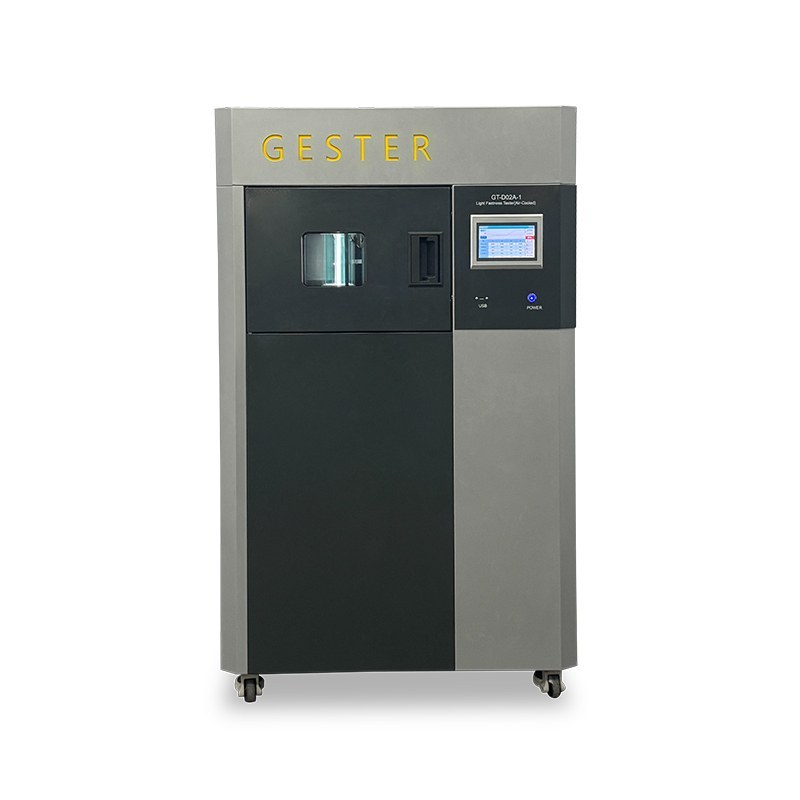
GESTER GT-D02A-1 Light Fastness Tester
The GESTER GT-D02A-1 is presented for light colour fastness, weather-related colour fastness, light and perspiration colour fastness, and light ageing tests. Its stated application scope also includes textiles, paint, dyes, coatings, rubber, plastics, wood flooring, paper, and other materials.
According to the available product information, GT-D02A-1 uses a 2500W long-arc xenon lamp to simulate the solar spectrum. It includes a 420 nm wavelength band as standard, digital irradiance setting, real-time monitoring, and closed-loop automatic regulation. Optional wavelength bands are listed as 340 nm, 420 nm, 300–400 nm, and 300–800 nm.
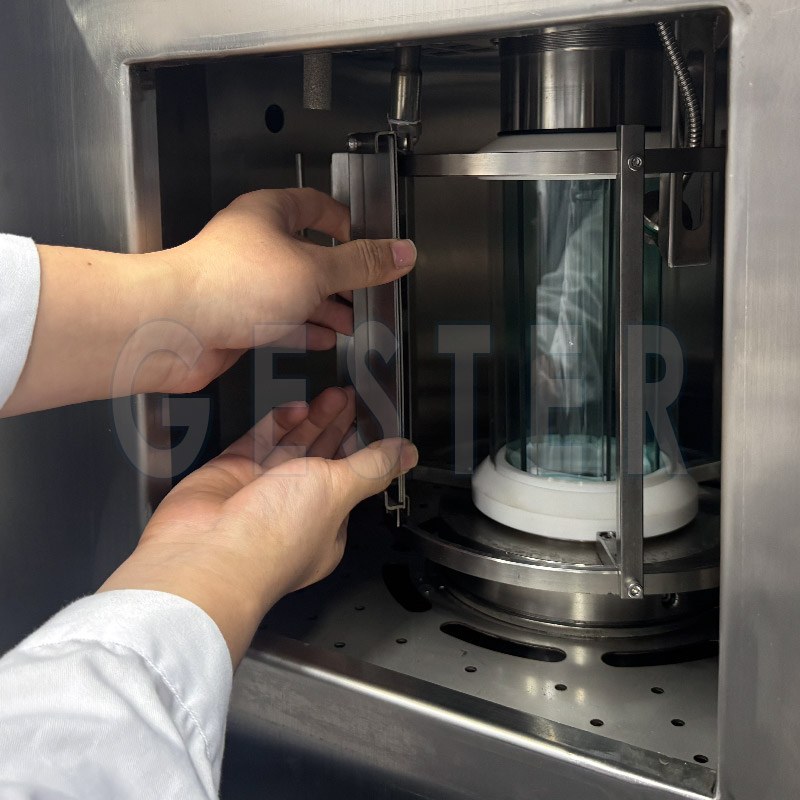
The tester is also described as offering spray, alternating light and dark, and revolution operating modes to simulate climate-related conditions. Individual timing for each sample clamp can support the testing of different samples in the same instrument while making test monitoring more convenient.
Building a Consistent Light Fastness Test Process
Reliable results depend on more than selecting a xenon arc tester. Laboratories should define specimen preparation, exposure conditions, irradiance monitoring, temperature control, test duration, and evaluation criteria before beginning the test. Consistent handling is especially important when comparing multiple fabric lots, colours, suppliers, or product versions.
It is also helpful to record the selected wavelength band, filter configuration, operating mode, and specimen timing for each run. These records support result review and make it easier to investigate differences between test batches. Where a requirement calls for a particular standard, the laboratory should confirm that the instrument configuration and procedure are appropriate for that requirement.
Standards Referenced for the Tester
The available information lists ISO 105-B02/B04, ISO 105-B10, ISO 12040, ISO 11341, GB/T 8427, GB/T 8430, GB/T 14576, GB/T 15102, GB/T 15104, ATCC TM 16, AATCC 169, ASTM D5010, ASTM D4303, JIS L0843, and M&S C09/C09A among the referenced standards. ISO 105-B10 is noted as requiring an irradiance meter for the 300–400 nm range. Users should verify the applicable edition, method, and equipment setup for their own testing work.