The ISO 12945-2 Martindale pilling test is used to assess a fabric’s tendency to develop surface pilling, fuzzing, or matting during rubbing. These visible changes can affect the appearance of a textile, although the acceptable level may vary with the garment type and intended end use.
The method described in ISO 12945-2:2020 uses the Modified Martindale approach. It subjects specimens to rubbing under controlled conditions and supports a visual comparison of the tested fabric surface. For textile manufacturers, quality-control laboratories, and researchers, the test provides a structured way to examine changes that may occur as a fabric is worn.

What the Modified Martindale Method Evaluates
Fabric surfaces can change when fibers migrate from the structure and become entangled through use. The Modified Martindale method focuses on three related surface conditions:
- Pilling: the formation of small fiber balls on the fabric surface.
- Fuzzing: the development of a fuzzy surface texture.
- Matting: the flattening or compaction of fibers, which can change texture and visual appearance.
Because these conditions are assessed on the surface, specimen condition, preparation, rubbing, and grading should be considered as parts of one consistent evaluation process. A clear agreement on specimen condition before the test is especially useful when results are being compared.
Key Conditions Before Testing
Testing is conducted under standard environmental conditions. The method is not applicable to fabrics thicker than 3 mm because the fabric gripper cannot adequately secure those specimens.
Specimens may be assessed before or after washing. Washing or dry-cleaning before testing is recommended in the source procedure, and both treatments may be used where necessary. However, the selected specimen condition should be agreed by the parties involved before testing begins. This helps ensure that the reported result is understood in the context of the fabric’s treatment state.
Specimen Preparation for ISO 12945-2
The specimen held in the fixture has a diameter of 140(0,+5) mm. Material placed on the pilling table may be circular with a diameter of 140(0,+5) mm or square with a side length of (150±2) mm.
Loose fibers or yarns around an edge can interfere with the friction area and cause wrinkling. Where needed, edges may be secured, for example by gluing or taping, to keep the test area in suitable condition.
A minimum of three specimen sets is required. Each set includes one specimen in the fixture and one specimen on the pilling table used as the abrasive. When a wool fabric abrasive is used on the pilling table, at least three specimens are tested. If more than three are used, the number selected should be odd. Additional specimens may also be prepared for comparative grading.
Role of a Martindale Abrasion and Pilling Tester
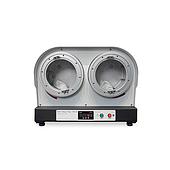
A Martindale abrasion and pilling tester is used with many textile structures to determine resistance to abrasion and pilling. During the evaluation, samples rub against a known abrading material at low pressure while the direction of movement changes continuously. The resulting surface condition is compared with the relevant grading references.
The source equipment description identifies a dual-servo-driven tester that produces a standard Lissajous motion trajectory. It also lists six selectable test modes: abrasion 60×60, pilling 24×24, 60-X, 60-Y, 24-X, and 24-Y. Selecting a mode can be done without hardware conversion according to the source information.
Visual Assessment and Pilling Grades
For grading, a 38 mm circular specimen is positioned squarely on double-sided adhesive tape in a rating box. Under suitable lighting, the front surface is compared with appropriate standard fabrics or photographs. The specimen is viewed from a 45° downward angle during assessment.
The reported grade describes the extent of surface abrasion and pilling observed:
| Grade | Surface condition |
|---|---|
| 5 | No change. |
| 4 | Slight surface abrasion and/or slight pilling. |
| 3 | Moderate surface abrasion and/or pilling, with fiber balls of different sizes and densities covering part of the surface. |
| 2 | Significant surface abrasion and/or pilling, with fiber balls of different sizes and densities covering most of the surface. |
| 1 | Severe surface abrasion and/or pilling, with fiber balls of different sizes and densities covering the entire surface. |
Using Results in Textile Quality Control
The ISO 12945-2 Martindale pilling test helps teams document how a fabric surface responds to rubbing and compare specimens evaluated under the same agreed conditions. It can support material evaluation during product development, incoming inspection, and quality-control activities.
A useful report should identify the specimen treatment condition, the number of specimens tested, the abrasive arrangement, and the visual grade assigned. Keeping these details together gives the grade its practical context and makes it easier to interpret differences between fabrics or production samples.