Sample Bags
Reliable sample handling starts long before analysis. In laboratories, food testing, environmental monitoring, and routine quality control, the right sample bags help protect specimen integrity during collection, temporary storage, transport, and basic preparation workflows.
This category brings together practical bag formats used for collecting and containing samples in controlled work environments. Depending on the task, users may need sterile wire-close bags for microbiological work, simple PP bags for general sample containment, or resealable PE options for repeated opening and closing during handling.
Where sample bags are typically used
Sample bags are commonly used when a specimen needs to be isolated from the surrounding environment and moved through a workflow with minimal disturbance. This can include incoming material inspection, production sampling, lab receiving, field collection, and short-term storage before testing.
In many facilities, the bag is not just a container but part of the overall sample management process. Size, closure style, and material type can influence ease of use, labeling practice, contamination control, and compatibility with the sample form, whether solid, powder, granule, or liquid in limited volume.
Choosing between sterile, zipper, and general-purpose bag formats
Different applications call for different bag constructions. Sterile sampling bags are often selected when microbiological integrity matters, while resealable zipper bags are convenient for repeated access during sorting, sub-sampling, or temporary segregation of materials.
For example, Simport sterile wire-close bags such as SP.EPR.4590 and SP.EPR.7012 are suited to workflows where controlled sample collection is important. In contrast, PE zipper options like SciLab SL.Bag3025, SL.Bag3026, SL.Bag3027, and SL.Bag3028 can be practical when users need fast opening and resealing during routine handling.
If your application specifically requires resealable formats, you can also review the dedicated zipper bag range for related options.
Material and size considerations
Bag selection often starts with the sample itself. Polypropylene and polyethylene are common choices in lab consumables because they are lightweight, easy to handle, and available in multiple sizes suited to different sample volumes. The right dimensions help reduce wasted space while still allowing convenient filling and closure.
Within this category, examples include PP sample bags such as SciLab SL.Bag3031, SL.Bag3032, SL.Bag3033, SL.Bag3034, and SL.Bag3035 in progressively larger sizes. This makes it easier to match the container to the amount of material being collected rather than relying on a one-size-fits-all approach.
When comparing options, users typically look at bag dimensions, material type, closure method, and film thickness. These factors affect handling feel, puncture resistance in routine use, and the practicality of storing or transporting the filled sample.
Supporting accessories for sealing and handling
In some workflows, the bag itself is only part of the solution. General sample bags may require a separate sealing method after filling, especially when using open bag styles for temporary containment or transport between stations.
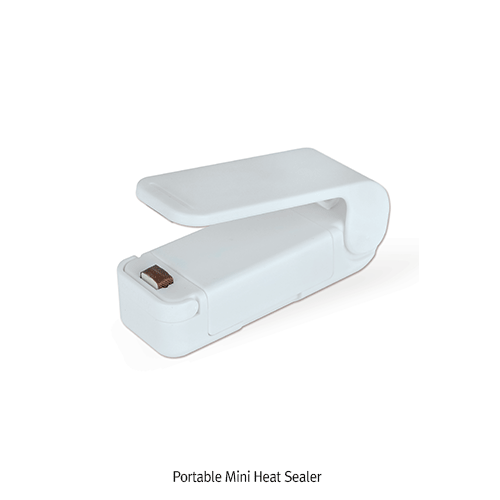
A compact accessory such as the DaiHan DH.Pac3001 MINI portable heat sealer can support manual sealing tasks where heat closure is preferred. This type of accessory is relevant when users need a straightforward way to close filled bags without moving to a larger sealing station.
For buyers building a complete consumables setup, it can be useful to evaluate bags together with sealing tools, labeling methods, and the expected handling route from collection point to analysis bench.
How to select sample bags for your workflow
A good starting point is to define the sample type and the handling conditions. Dry powders, granules, semi-solid materials, and liquid samples may each place different demands on bag size, closure security, and ease of transfer. If sterility is required, that should be treated as a primary filter rather than a secondary preference.
Next, consider how many times the bag will be opened. A wire-close bag may be appropriate for controlled one-step collection, while a zipper style may be more efficient for repeated access. For routine non-sterile containment, PP sample bags can offer a practical balance of simplicity and range.
It is also worth thinking about downstream handling. If samples are moved into disposal streams after testing, related waste bags may help complete the workflow and keep collection and disposal functions clearly separated.
Representative products in this category
This selection includes several commonly needed formats rather than a single uniform bag type. Sterile sampling options include Simport SP.EPR.4590 and SP.EPR.7012, both designed for sample collection with wire-close sealing. These are relevant where hygiene and controlled handling are priorities.
For general-purpose lab use, SciLab offers PP sample bags such as SL.Bag3031 through SL.Bag3035 in multiple sizes. Users looking for resealable handling convenience may prefer PE zipper models including SL.Bag3025, SL.Bag3026, SL.Bag3027, and SL.Bag3028. You can also explore more options from SciLab when comparing bag types across similar laboratory applications.
Practical buying considerations for B2B users
For laboratories, manufacturers, and industrial quality teams, purchasing sample bags is usually tied to consistency, not just unit availability. Standardizing bag format across teams can simplify SOPs, reduce handling errors, and make storage more predictable across receiving, testing, and archiving steps.
It is helpful to align bag choice with actual use frequency, sample volume range, and whether the operation prioritizes sterile collection, resealability, or simple disposable containment. That approach usually leads to a more efficient selection than focusing only on size or price point.
Find the right sample bag for controlled handling
The most suitable option depends on how your samples are collected, moved, and accessed through the workflow. Whether you need sterile wire-close bags, general PP formats, or resealable PE types, this category is structured to support clearer comparison based on practical laboratory use.
By matching material, size, and closure style to the real handling environment, buyers can improve day-to-day sample control and reduce unnecessary friction in routine lab operations.
Get exclusive volume discounts, bulk pricing updates, and new product alerts delivered directly to your inbox.
By subscribing, you agree to our Terms of Service and Privacy Policy.
Direct access to our certified experts