Cassettes
Accurate sample handling starts long before analysis or archiving. In pathology, histology, and general laboratory workflows, the right Cassettes help protect tissue specimens, support consistent processing, and make downstream embedding and identification more reliable.
This category brings together laboratory cassettes and related specimen-holding formats used to organize tissue and biopsy samples during preparation. Whether the application calls for standard tissue processing, smaller biopsy handling, or accessories that improve sample retention, selecting the right format can reduce handling errors and support a smoother lab routine.
Where laboratory cassettes fit in the workflow
Laboratory cassettes are commonly used to hold specimens securely through fixation, processing, embedding, and storage steps. Their role is practical but important: they keep samples contained, identifiable, and easier to manage across multiple stages of laboratory work.
In many settings, cassette selection depends on specimen size, fragility, and the way technicians prefer to load and close the holder. For routine tissue sections, a standard tissue cassette may be sufficient, while smaller or more delicate biopsy samples often benefit from designs intended to improve retention and handling stability.
Types of cassettes and related formats in this category
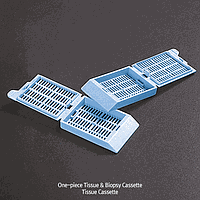
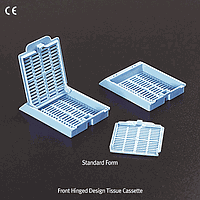
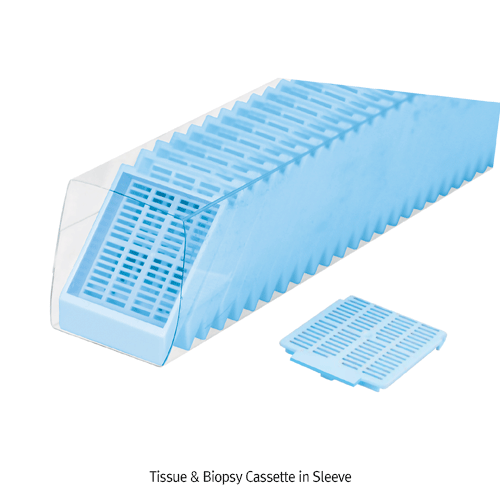
This category includes both tissue and biopsy-focused formats. Standard options such as the SciLab SL.Cas3004 Cassettes, Tissue, w/Front-hinged Lid, 1- Compartment and the SciLab SL.Cas3002 Cassettes, Tissue, w/One-piece Integral Lid, Blue illustrate common approaches for routine specimen organization.
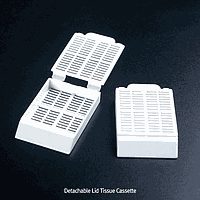
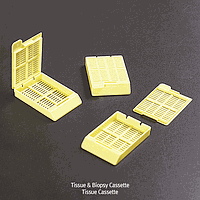
For smaller samples, biopsy-oriented designs such as the SciLab SL.Cas3007 Cassettes, Biopsy, w/One-piece Integral Lid, Blue, the SciLab SL.Cas3026 Cassettes, Biopsy, w/Special Hinge-Hold, Yellow, and the SciLab SL.Cas3034 Cassette in Sleeve, Biopsy, White highlight formats intended for more controlled handling. Combination styles are also represented by products such as the Simport SP.M492.2 Cassette tissue combi. white and Simport SP.M493.5 Cassette biopsy combi. yellow.
Some related items in this range support the broader embedding and processing workflow rather than serving as the primary cassette itself. Examples include tissue capsules like Simport SP.M470 Capsules tissue 28*h5mm and Simport SP.M471 Capsules tissue 38*h10mm, as well as support components such as the Simport SP.M476.3 Pad embedding sponge large, round-type.
How to choose the right cassette for your laboratory
A practical starting point is the sample type. Larger routine tissue pieces may work well with general tissue cassettes, while biopsy samples often require a design that offers better containment and handling control. Lid style also matters, since front-hinged, integral-lid, and special-hinge formats can affect how quickly users load specimens and how securely the cassette remains closed during processing.
Another key factor is compatibility with internal lab procedures. Color coding, compartment style, and accessory use can all support clearer sorting and easier identification, especially in higher-throughput environments. If your workflow includes embedding aids or small-sample retention accessories, related formats such as tissue capsules or embedding sponges may be worth considering alongside the cassette itself.
Manufacturer preference can also play a role when teams want consistency across consumables. This selection includes products from Simport and SciLab, both of which are commonly used in laboratory sample handling contexts.
Supporting tissue processing and embedding efficiency
Well-matched cassette systems can contribute to a more organized bench workflow. When samples are easier to load, close, identify, and transfer, the overall process becomes more repeatable and less dependent on workarounds.
This is especially relevant when dealing with mixed sample sizes or fragile biopsy material. Pairing the right cassette with accessories such as embedding sponges or tissue capsules can improve sample retention and help laboratories maintain cleaner, more controlled specimen preparation steps.
Related labware that may be useful in the same environment
Laboratories purchasing cassettes often review other consumables and general-purpose handling items at the same time. Depending on the workflow, related categories such as bags for lab use, laboratory bowls, or lab adhesives may also support preparation, storage, or routine bench organization.
These items serve different purposes, but they can be part of the same operational setup where sample handling, labeling, containment, and preparation all need to work together efficiently.
What to look for when comparing products
When reviewing available options, it helps to focus on a few practical points: intended specimen type, closure design, workflow compatibility, and whether supporting accessories are needed. A cassette that performs well in one lab may not be the most efficient choice in another if the specimen mix or processing routine is different.
It is also useful to compare whether the application is more aligned with routine tissue processing, biopsy-specific handling, or a combination format. Products such as the SciLab SL.Cas3021 Special Hinge Cassette, Blue or the Simport SP.M492.5 Cassette tissue combi. yellow show how different construction approaches may suit different operator preferences and laboratory methods.
Choosing with workflow consistency in mind
For many laboratories, the best choice is not simply a matter of selecting an individual item, but of building a consistent specimen handling approach. Standardizing cassette types where possible can simplify training, reduce variation between users, and make routine processing easier to manage across teams.
This category is designed to support that process with a focused range of tissue cassettes, biopsy cassettes, combination formats, and related accessories. By matching the product type to specimen characteristics and handling requirements, laboratories can build a more dependable and efficient sample preparation workflow.
If you are comparing options for routine tissue work, biopsy processing, or accessory-supported embedding steps, this selection provides a practical starting point for choosing cassettes that fit your laboratory’s daily procedures.
Get exclusive volume discounts, bulk pricing updates, and new product alerts delivered directly to your inbox.
By subscribing, you agree to our Terms of Service and Privacy Policy.
Direct access to our certified experts