Dissecting Tools
Precision work in biology labs, education, sample preparation, and routine bench procedures often depends on having the right hand tools close at hand. Dissecting Tools support controlled cutting, lifting, trimming, and specimen handling, helping users work more accurately while protecting both the sample and the operator. For laboratories that need dependable manual instruments, this category brings together practical options for dissection and related preparation tasks.
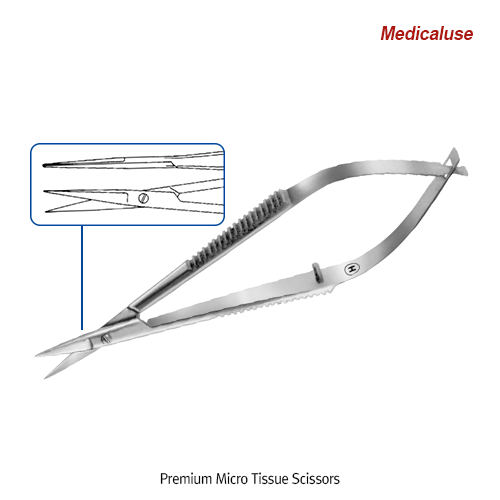
Tools designed for careful specimen handling
Dissection work is rarely about force alone. In many workflows, the priority is fine control, clean access to the specimen, and consistent handling across repeated tasks. That is why tool geometry, edge shape, prong style, and material all matter when selecting instruments for laboratory use.
This category includes instruments suited to different stages of manual specimen preparation, from cutting and trimming to retraction and positioning. Depending on the task, users may need compact scissors for delicate work, retractors to hold tissue aside, or boards and blades that support a more organized preparation area.
Typical product types found in this category
Several examples in this range illustrate how dissecting tools fit into a broader lab workflow. Micro scissors such as the Hammacher HA.HSB504.10 are intended for fine cutting where a short blade and straight form can improve visibility and control. For users comparing options from Hammacher, this kind of instrument is especially relevant in applications that require small, precise cuts rather than general-purpose cutting.
Hook retractors are another important group. Models such as DaiHan DM.Ret7005, DM.Ret7006, DM.Ret7007, DM.Ret7010, and DM.Ret7011 show how variations in prong count and tip style can affect handling. Sharp versus blunt ends, along with 2-prong, 3-prong, or 4-prong configurations, allow users to choose an instrument that better matches the delicacy of the material and the level of holding force required.
This category also includes preparation accessories and cutting components. Simport dissecting boards provide a defined working surface, while MUTO microtome blades and trimming knives support sectioning-related preparation steps. Although these items serve different functions, they contribute to the same objective: a cleaner, more controlled specimen workflow.
How to choose the right dissecting tools
A practical selection process usually starts with the specimen type and the level of manipulation required. For delicate structures, compact tools with refined cutting edges or controlled tip profiles are often preferred. For holding or exposing an area during manual work, a retractor may be more appropriate than repeated handling with force.
Material choice also matters. Many products listed here use stainless steel, a common choice for laboratory hand tools because it supports durability and routine cleaning. In parallel, disposable accessories such as PP dissecting boards can be useful where workflow separation, convenience, or reduced cleanup is important.
Users should also think about whether they need a tool for primary dissection, sample trimming, or supporting tasks around the bench. If a process involves preparation, transfer, storage, and cleanup, it may be helpful to review related lab consumables such as bags for sample handling or lab bowls for general bench organization.
Understanding key differences between common tools
Micro scissors are typically selected when the operator needs a controlled cutting action in a limited working area. A shorter cutting blade can help reduce overcutting and improve precision, especially in teaching labs or detail-oriented specimen work.
Hook retractors are used to pull back or separate material to improve access and visibility. The choice between blunt and sharp tips depends on the nature of the tissue or specimen and the handling method preferred by the user. A higher prong count may provide a different balance of grip and distribution than a simpler two-prong design.
Dissecting boards create a more stable workspace for manual procedures. They can help standardize setup, support cleaner handling, and simplify changeover between tasks. Microtome blades and trimming knives, while more specialized, are relevant where dissection is linked to sample shaping or preparation before further examination.
Representative brands and product examples
This category includes products from recognized laboratory suppliers such as DaiHan, MUTO, Simport, and Hammacher. Rather than covering every possible instrument type, the available examples give buyers a useful cross-section of tools for cutting, retracting, trimming, and setting up the specimen workspace.
Examples include the Simport SP.M630.2 and SP.M630.3 dissecting boards in different sizes, the MUTO DM.His7001 and DM.His7003 microtome blades for specific specimen preparation needs, and the MUTO DM.Tri7001 trimming knife in dispenser format. On the manual handling side, DaiHan hook retractors provide multiple prong and tip variants, helping laboratories choose based on technique, operator preference, and specimen sensitivity.
Where these tools fit in lab workflows
Dissecting tools are commonly used in educational laboratories, biological sample preparation, pathology-related bench work, and general research environments where specimens must be opened, exposed, trimmed, or positioned manually. Even when a workflow later moves to imaging, sectioning, containment, or storage, the initial manual handling step often sets the tone for overall sample quality.
Because of that, selection should focus not only on the individual tool but also on how it fits into the wider workstation. Labs building a more complete bench setup may also review supporting categories such as adhesives where fixation or labeling support is needed in adjacent processes.
Buying considerations for B2B and laboratory procurement
For institutional buyers, repeatability and task fit are usually more important than choosing the widest possible assortment. It is often more efficient to standardize around a small set of scissors, retractors, boards, and blades that align with the lab’s common procedures. This can simplify training, ordering, and replacement planning.
When comparing products, look closely at dimensions, blade or tip style, and whether an item is intended for delicate manipulation, routine bench work, or a more specific preparation step. A well-matched tool can improve workflow consistency without adding unnecessary complexity to the bench.
Find dissecting tools that match your lab process
The right selection depends on how your team handles specimens day to day. Whether the priority is precise cutting, controlled retraction, a disposable working surface, or specimen trimming before further analysis, this category brings together useful options for laboratory preparation work.
By choosing tools that match the material, handling method, and workflow stage, laboratories can create a safer and more consistent setup for manual specimen preparation. Explore the available range to identify dissecting tools that fit your application, operator preference, and purchasing requirements.
Get exclusive volume discounts, bulk pricing updates, and new product alerts delivered directly to your inbox.
By subscribing, you agree to our Terms of Service and Privacy Policy.
Direct access to our certified experts