Grease & Lubricants
Reliable operation in laboratory and technical workspaces often depends on small maintenance materials that are easy to overlook. From reducing friction on moving parts to protecting metal surfaces during storage or routine use, Grease & Lubricants help support equipment uptime, cleaner handling, and more stable day-to-day performance across a wide range of labware and support tools.
Within this category, buyers typically look for products that match a specific maintenance purpose rather than a generic “one-size-fits-all” solution. Some applications call for silicone fluids used where smooth motion, surface treatment, or compatibility with sensitive assemblies is important, while others focus on corrosion protection through rust inhibitor sprays for metal parts, instruments, and accessories exposed to humidity or intermittent use.
What this category is used for in laboratory and technical environments
Greases, silicone fluids, and protective lubricant products are commonly used as part of preventive maintenance. In practice, they can help reduce wear on contact surfaces, improve movement in mechanical assemblies, and create a protective layer that limits oxidation or moisture-related deterioration on exposed metal components.
In lab settings, these materials may be relevant not only for instruments themselves but also for supporting hardware, fixtures, closures, moving joints, and general-purpose workshop items used around the laboratory. For buyers managing mixed inventories, this category often sits alongside other practical consumables such as adhesives for lab and maintenance tasks, where assembly, sealing, and upkeep are closely related.
Silicone fluids and rust inhibitors serve different maintenance needs
Although they are grouped together, silicone-based lubricants and rust inhibitor sprays usually address different problems. Silicone fluid products are often selected where smooth spreading, lubrication, or surface conditioning is needed without using heavier grease types. They may also be preferred in applications where a clean, controlled fluid is more practical than a dense paste.
By contrast, rust inhibitor sprays are typically chosen to protect metal surfaces during operation, storage, or transport. They are especially useful where equipment, tools, or metal accessories may be exposed to moisture, ambient humidity, or periods of inactivity that increase the risk of corrosion. Understanding this distinction helps purchasing teams avoid overbuying products that do not match the actual maintenance task.
Representative products in this range
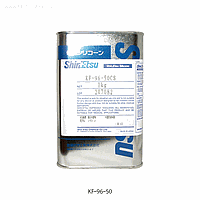
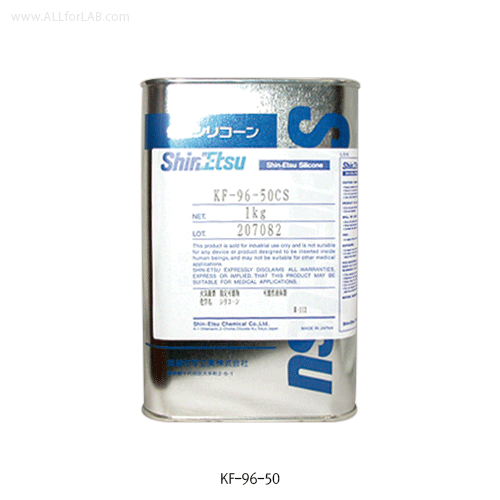
This category includes examples from ShinEtsu and DaiHan that reflect these two main use cases. On the silicone side, products such as ShinEtsu S8.KF96.100 Fluid silicon kf96-100 and ShinEtsu S8.KF54 Fluid silicon kf54 illustrate fluid lubricant options used where controlled application and material compatibility are important considerations.
It also includes related alternatives such as ShinEtsu DH3.Too6001 [대체:S8.KF96.100] Fluid silicon kf96-100 and ShinEtsu DH3.Too6002 [대체:S8.KF54] Fluid silicon kf54. For corrosion protection, examples from DaiHan include 0442-905 Rust Inhibitor Spray, 0468-629 Rust Inhibitor Spray, 0470-691 Rust Inhibitor Spray, and 0493-740 Rust Inhibitor Spray, offered in several pack sizes to support different usage volumes and maintenance routines.
How to choose the right product for your application
A practical first step is to define whether the main goal is lubrication, surface treatment, or corrosion prevention. If you are working with moving parts, seals, contact points, or assemblies that require a fluid medium, a silicone fluid may be more appropriate. If the priority is protecting metal parts during storage or reducing the risk of rust in humid environments, a rust inhibitor spray is generally the more relevant choice.
Packaging size is also an important purchasing factor. Smaller formats can make sense for infrequent maintenance, trial use, or controlled bench-side application, while larger spray volumes may be better suited to routine facility maintenance or multi-user environments. Buyers should also consider how the product will be applied, how often reapplication may be needed, and whether the item is intended for active equipment or standby inventory.
Why pack size and handling format matter
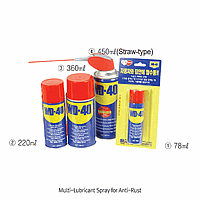
In B2B purchasing, pack size affects more than stock quantity. It can influence storage practices, ease of distribution to maintenance teams, and how consistently the product is applied. A 78 ml rust inhibitor spray may suit light-duty use or targeted treatment of smaller parts, while 220 ml, 360 ml, and 450 ml options can be more efficient for broader maintenance coverage.
The same principle applies when selecting fluid lubricants for regular use across multiple assets. Standardizing on a suitable product family can simplify procurement and reduce unnecessary variation. When these materials are handled together with containers or transfer tools, related labware such as bottle top solvent pumps may also be relevant in broader chemical handling workflows, depending on the surrounding process.
Brand-focused sourcing for consistent procurement
For many industrial and laboratory buyers, sourcing by manufacturer can help maintain consistency across maintenance procedures. DaiHan is represented here through multiple rust inhibitor spray formats, giving users a straightforward path when they need the same product type in different volumes. This can be useful for organizations balancing bench use, maintenance room stock, and site-wide replenishment.
ShinEtsu, meanwhile, appears in this category with silicone fluid products and substitute-listed variants that may help buyers align with existing internal references. Where procurement teams need to compare families of related materials, navigating by manufacturer can often reduce approval time and improve repeat ordering accuracy.
Common buying considerations for grease and lubricant categories
When selecting from a category like this, technical buyers usually review a few core points: the maintenance objective, the application method, the material surface involved, and the expected frequency of use. They may also consider whether the product is intended for laboratory instruments, general-purpose hardware, or mixed-use technical environments where one stock item needs to support several maintenance scenarios.
It is also useful to think about how these products fit into the wider lab support ecosystem. In some workflows, maintenance materials are purchased together with storage or handling accessories such as protective bags and packaging items for organizing parts, consumables, or preserved components between uses.
Supporting cleaner maintenance decisions
This category is best approached as a practical maintenance resource rather than simply a list of chemical products. Silicone fluids and rust inhibitor sprays each serve a different role, and choosing well usually comes down to understanding the equipment condition you want to maintain or the failure risk you want to reduce.
Whether you are standardizing routine upkeep for laboratory hardware or looking for a suitable product for occasional servicing, this selection offers a focused starting point. Reviewing the intended function, handling format, and preferred manufacturer can help narrow options quickly and lead to a more efficient purchase decision.
Get exclusive volume discounts, bulk pricing updates, and new product alerts delivered directly to your inbox.
By subscribing, you agree to our Terms of Service and Privacy Policy.
Direct access to our certified experts